Owls and Larks: Schedule Your Workday by Chronotype
Get the next article and product update in your inbox
Short product notes, fresh blog posts, and focus systems. No noisy sequence.

Larks are morning chronotypes. They fall asleep early, wake early without much help from an alarm, and do their sharpest thinking before lunch. Owls are evening chronotypes. Their sleep drifts late, alarms hurt, and their minds switch on in the afternoon and evening. Every result on page one gives you that much, and it’s accurate.
What it leaves out is the part that’s actually useful at work:
- It’s a dial, not two boxes. In the Munich Chronotype Questionnaire database, roughly 300,000 entries by 2017, chronotype varies continuously. “Lark” and “owl” are the two ends, and plenty of people sit between.
- You can measure yours in a week, without a personality quiz: it’s the midpoint of your sleep on days without an alarm.
- Being out of sync has a name and a number. Social jetlag is the gap between your mid-sleep on free days and on work days.
- It moves. Age shifts it, and light shifts it more. The researchers who built the questionnaire treat chronotype as closer to a state than a fixed trait.
- Scheduling around it is simple: hardest thinking in your peak, meetings in the window you share with everyone else, admin in your trough.
The rest of this piece works through those five points, plus the part nobody on page one covers: what to do when you’re an owl in a company that runs on lark time.
One note first. I plan workdays for a living. I’m not a sleep doctor, and this isn’t medical advice. If your sleep is genuinely broken — not just late — that’s a conversation for a clinician, not a calendar.
Owls and larks, defined properly
Chronotype is the timing of your internal day relative to the clock on the wall: when your body wants to sleep, wake and be alert. Larks run early, owls run late.
The Globalist’s short history of the subject, drawing on Elizabeth Kolbert’s reporting in The New Yorker, adds two details worth keeping. Chronotype changes with life stage: toddlers tend to be larks, teenagers tend to be owls. And the single consolidated block of night-time sleep most of us treat as natural is closely tied to factory and office schedules, not a timeless human default.
The standard workday wasn’t designed around anyone’s biology. It sits toward the lark end of the dial, while indoor life and artificial light, per the Munich research below, have pushed most people later.
Two things the labels hide:
- Owl doesn’t mean bad sleeper. An owl who sleeps from 1:30 to 9:30 is getting eight hours. The trouble starts when an alarm drags them up at 7.
- Owl/lark is about timing, not duration. Arianna Huffington’s Thrive Global piece makes duration its whole argument — “The real question is how much sleep you’re getting” — and cites the usual 7–9 hours. She’s right that duration comes first. Where I’d push back: timing decides whether those 7–9 hours are even possible on a workday.
What the science actually says (and what it doesn’t)
Most of the useful research here comes from one group: Till Roenneberg and colleagues in Munich, who developed the Munich Chronotype Questionnaire (MCTQ). Their 2019 paper in Biology, “Chronotype and Social Jetlag: A (Self-)Critical Review”, is unusually candid about its own limits, which is why it’s the one I lean on. What it establishes:
- The measure is mid-sleep on free days. The MCTQ doesn’t ask whether you feel like a morning person. It asks when you sleep on days you don’t have to be anywhere, and takes the midpoint (MSF). The authors describe the midpoint of sleep as one of the most accurate behavioural markers of circadian phase. A corrected version (MSFsc) adjusts for the sleep debt you repay on free days.
- It’s a continuum. The distribution is continuous; the colour bands people draw over it are arbitrary, as the authors themselves note. The authors add that modern life, with little daylight and a lot of artificial light in the evening, has widened the spread and delayed nearly everyone except the earliest larks.
- Age moves it. Chronotype gets progressively later from about age ten to the end of adolescence, around twenty, then gradually earlier for the rest of life.
- Light moves it more. Weak indoor lighting has widened the gap between early and late types, and rural populations are earlier than urban ones. With stronger light exposure, late types advanced their sleep timing by roughly two hours — and drifted back once the intervention stopped. Hence the review’s best line: “chronotype is as stable as its entraining environment.”
- The health associations are real; the causality isn’t settled. Late chronotypes and high social jetlag are associated with metabolic problems and obesity, depressive symptoms, worse academic performance, more smoking and less healthy diets. The authors say plainly that the mechanisms, and whether any of it is causal, aren’t clear. They suggest the conflict between body clock and social clock may be the problem, rather than lateness itself.
What the science doesn’t say: that owls are lazy, that larks are more successful, or that everyone has a precise “golden hour” a quiz can reveal. A 2025 paper in the Journal of Sleep Research, titled “Beyond larks and owls”, revisits the typology with a cluster-based approach instead of the two-box split.
Some popular explainers go further. One page ranking for this term states flatly that night owls are 10% more likely to die early. Treat numbers like that as a prompt to find the original paper, not a fact to plan around.
Find your chronotype from one ordinary week
You don’t need a quiz. You need seven days of honest sleep times, ideally including at least two free days with no alarm set. This is the MCTQ logic, done by hand:
- Log when you fell asleep and when you woke, every day. Roughly when you fell asleep, not when you got into bed.
- Mark each day as a work day or a free day. A free day is one where you woke without an alarm.
- Work out your mid-sleep on free days. Asleep at 1:00, awake at 9:00: mid-sleep is 5:00.
- Correct for catch-up sleep. If you sleep much longer on free days, part of that is debt repayment, and it pushes the midpoint late. My rough hand version (not the official MSFsc formula): subtract about half the extra. Nine hours on free days against seven on work days means taking roughly an hour off the free-day midpoint.
- Place yourself on the dial. I use three loose bands: corrected mid-sleep before about 3:00 is the lark end, about 3:00–4:30 is the broad middle, later than about 4:30 is the owl end. Those are my working bands, not cut-offs from the research, which treats chronotype as a continuum.
Then run a second instrument alongside it: an energy log. For the same week, rate your alertness from 1 to 5 at six fixed times — 9, 11, 13, 15, 17 and 19. Mid-sleep tells you where your clock sits. The energy log tells you where your peak and trough actually land on a workday, with your caffeine, commute and 10am standup already baked in.
When the two disagree, the energy log wins for scheduling, because it measures the day you actually have.
Social jetlag: the number that tells you what it costs
Roenneberg’s group defines social jetlag as the absolute difference between mid-sleep on free days and mid-sleep on work days: |MSF − MSW|.
A worked example. An owl sleeps 1:30–9:30 on weekends (mid-sleep 5:30) and 0:30–7:00 on work days (mid-sleep 3:45). Social jetlag: 1 hour 45 minutes. Every week, that person crosses almost two time zones on Friday night and flies back on Monday morning. Notice the other cost hiding in the example: eight hours of sleep on free days, six and a half on work days.
That number is more useful than your label. A mild lark with twenty minutes of social jetlag needs no changes; a moderate owl with two hours does. And it’s a figure you can take into a conversation about start times — the same logic as bringing countable workload numbers instead of feelings to your manager.
Map deep work, meetings and admin to your curve
Now the scheduling. Three kinds of work, three parts of the day:
- Peak → deep work. Writing, design, analysis, code — anything where one hour at your best beats three at your worst. This is the block you defend like an external meeting. What happens inside it is covered in the deep work guide; getting absorbed once you’re there is a flow problem.
- Shared middle → meetings. Collaboration needs overlap, not anyone’s peak. Put meetings where most of your team is simultaneously awake and decent, which for a mixed team usually means late morning to early afternoon.
- Trough → admin. Email, expenses, scheduling, reviewing something someone else wrote. Low stakes, interruptible, satisfying to clear.
Here’s how that plays out for two example sleep schedules. The windows are illustrative — yours come from your own week log, not from this table:
| Lark (free-day sleep ~22:30–6:30) | Owl (free-day sleep ~1:30–9:30) | |
|---|---|---|
| Deep work | 8:00–11:30 | 14:30–19:00 |
| Meetings | 11:00–13:00 | 11:00–13:00 |
| Admin and shallow work | 13:30–15:30 | 9:00–11:00 |
| Planning tomorrow | late afternoon | early evening |
The columns differ in shape, not just position. The lark has a strong morning, a post-lunch dip and an early-evening fade. The owl has a slow ramp instead: the first two hours of an alarm-started day suit work that doesn’t need them sharp.
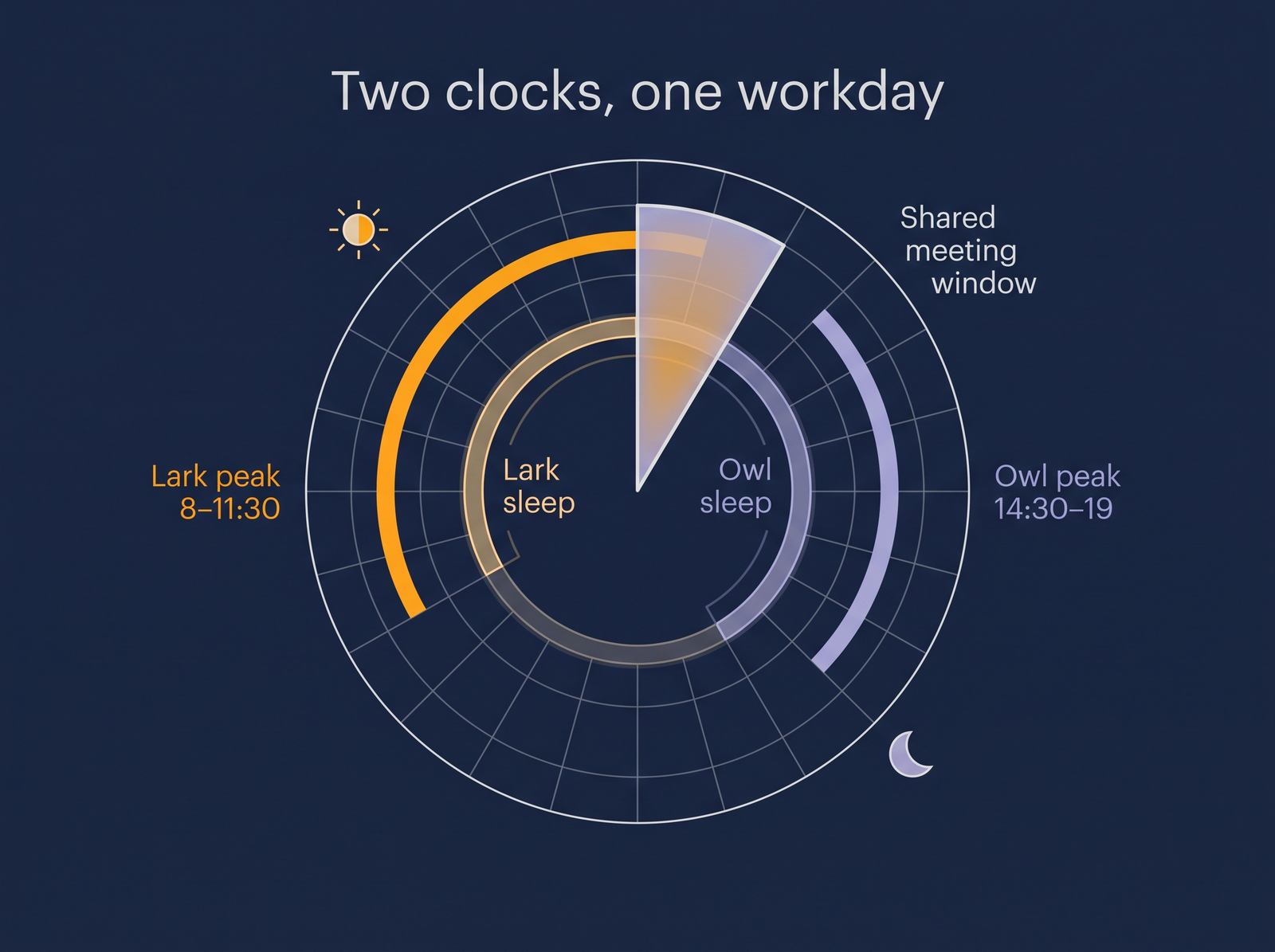
Same day, two clocks. The only hours both people are reliably good in sit between 11 and 1.
The placement rules I actually use:
- The deep block goes into the calendar first. Meetings fill around it, never the other way round. That’s time blocking with one extra constraint: the block has a fixed address, set by your clock.
- Your hardest task gets your best hour, not your first hour. “Eat the frog” assumes a morning peak. For an owl, frog-first means frog-at-your-worst. Keep the principle, move the slot — the eat-the-frog piece covers the exceptions.
- Swap tasks, not times. When an owl gets a 9am slot anyway, it becomes admin and the deep work moves to the afternoon. Don’t burn the slot trying to force something it can’t hold.
- Nothing irreversible in the trough. Hiring calls, pricing decisions and difficult emails can wait for a better hour.
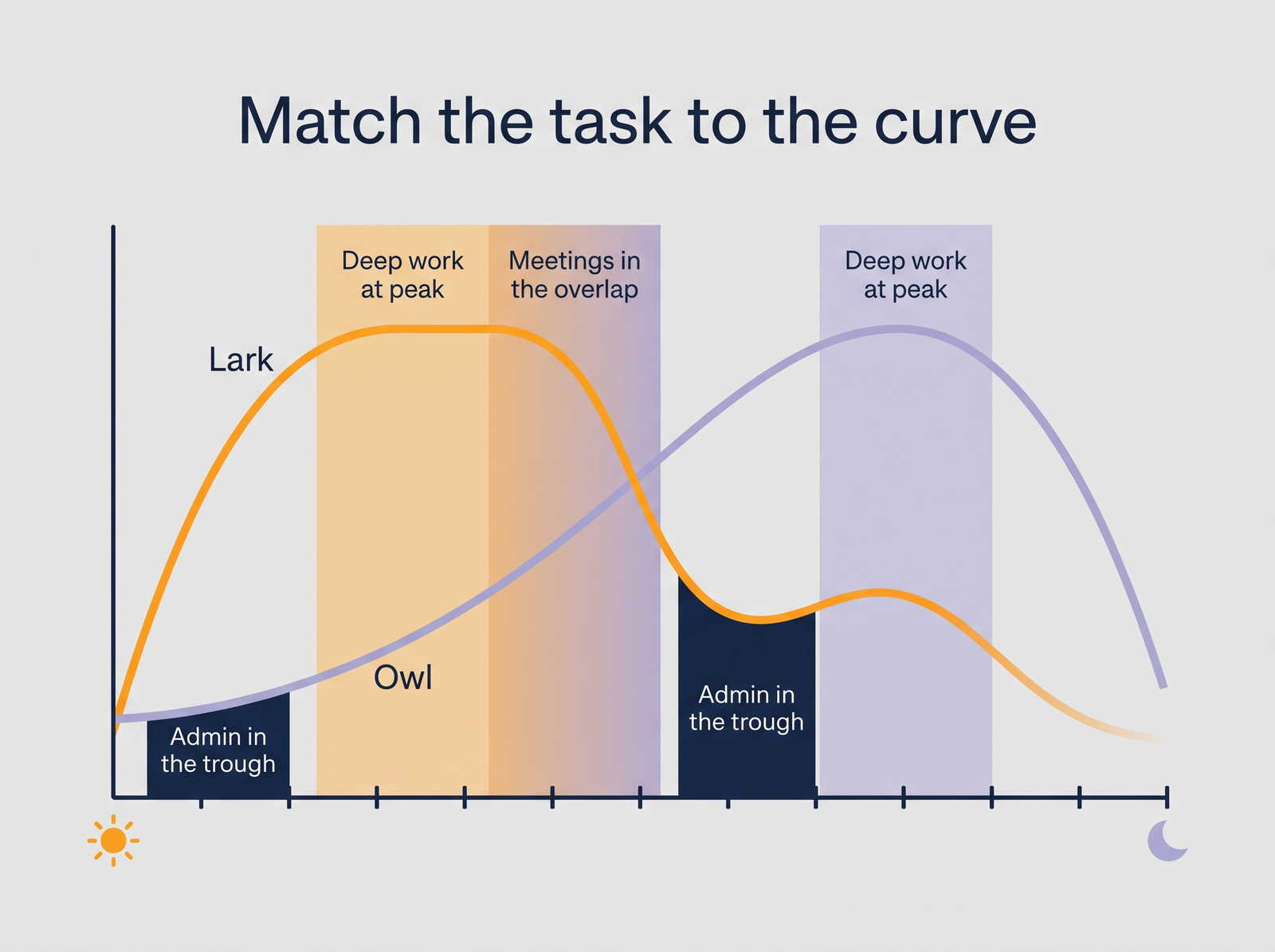
Match the task to the curve. Deep work follows your peak, meetings follow the overlap, admin fills the trough.
Being an owl in a lark-scheduled workplace
This is the part the ranking articles skip, and it’s the one that matters most if you’re an owl. Most workplaces run on lark time: the 9am standup, the 8:30 all-hands, the “quick call before your day gets busy”. Owls pay twice: once in social jetlag, and again by being seen at their slowest in the meetings where reputations get made.
What actually works, in the order I’d try it:
- Negotiate a meeting floor, not a start time. “No recurring meetings before 10” is a far easier ask than “I start at 11”, and it removes most of the damage. Keep showing up; just stop being required to think out loud at 9.
- Move deep work to the late afternoon and defend it. Your 3pm–6pm block is valuable, so the 4pm “quick sync” is the lark’s version of an 8am meeting for you. Decline it the same way.
- Schedule visibility later in the day. Presentations, one-to-ones with your manager, anything where you need to be quick on your feet — put them at 11 or after.
- Use the morning ramp on purpose. Inbox, reading, admin. Useful work that doesn’t need you sharp.
- Get daylight early. Roenneberg’s review is clear that stronger light pulls late types earlier and weak indoor light pushes everyone later. A morning walk outside is the cheapest lever available. Anything beyond that, such as light devices, is worth a conversation with a doctor.
- Shrink the weekend gap. Social jetlag is a difference. Pulling free days a little closer to work days reduces it from the other end, which is often easier than getting up earlier during the week.
If you manage a mixed team, treat chronotypes like time zones. Name a core collaboration window — something like 11:00–15:00 — put recurring meetings inside it, and let people own the edges. An owl and a lark two desks apart are effectively a few hours apart.
If you’re a lark: the problems nobody mentions
Larks get the good press, but they have their own version of the mismatch.
- Your peak is exactly when everyone else schedules the admin meetings. Standups, status checks and inbox triage land between 9 and 11, which is your best thinking time. Protect it with the same force an owl uses on their afternoon.
- Late decisions catch you in your fade. Evening leadership calls, launches at 7pm, dinners where things get agreed. If a decision matters, ask for it to land in your day, or write down your position in the morning and hold to it.
Can a night owl turn into a morning lark?
Partly, temporarily, and with effort. The evidence in the Roenneberg review points one way: stronger light exposure shifted late types earlier by roughly two hours, and they drifted back once it stopped. Age also nudges most people earlier over decades.
So you can move along the dial, most reliably with morning light and consistent sleep timing. But a pronounced owl rarely becomes a genuine lark, and trying usually just produces a sleep-deprived owl. A better target is lower social jetlag: smaller gaps between your work-day and free-day sleep, whichever direction you close them from. If you want a wake-up routine built around that consistency rather than an early hour, the realistic morning routine guide covers it.
Are night owls smarter? And is midnight to 7 okay?
Both show up in Google’s “People also ask”, so, briefly.
Are high-IQ people night owls? One explainer ranking for this term cites a University of Madrid study of around 1,000 teenagers in which evening types scored higher on inductive reasoning. That’s a correlation in adolescents — an age group the Roenneberg review describes as the latest on the whole dial anyway. It is not evidence that becoming an owl makes you smarter or that your owl colleague is brighter. I wouldn’t build anything on it.
Is it okay to sleep from midnight to 7am? It’s seven hours, the bottom of the 7–9 range most sources cite, with a mid-sleep of 3:30 — squarely in the middle of the dial. Whether it works for you depends on one test: on free days, without an alarm, do you wake up near 7? If free days slide to 10, the 7am alarm is costing you sleep, and that gap is your social jetlag.
Where a planner fits
Finding your chronotype takes one honest week of logging: find your peak, block it, move meetings into the overlap.
Keeping that plan intact once the week starts moving is a planner’s job. I set working hours and a peak-productivity window in Fokus to match my energy log, and its auto-scheduling uses those windows when placing tasks, so the heavy work lands in my good hours and the rest fills around meetings. When a meeting lands on top of a deep block, one “Optimize Schedule” rebuilds the day instead of me reshuffling it by hand.
You set your peak windows once, from the week log above, and the energy-aware auto-scheduling uses them every day after that: deep work goes into your peak, and the rest is placed around your meetings. Each morning the Morning Briefing walks you through the day’s plan, surfaces what matters and scores the plan, which for an owl means the slow first hour starts with a decided day instead of an open inbox. Fokus is free during its public beta, with no credit card.
The short version
Owls and larks are the two ends of a continuous dial, not two personality types. Find your spot from one week of real sleep times: your corrected mid-sleep on free days. Find what it costs from the gap between free days and work days — your social jetlag. Then put deep work in your peak, meetings in the window you share with your team, and admin in your trough.
Your chronotype isn’t a flaw to fix or a badge to wear. It’s a scheduling constraint, and the only mistake is planning as if you didn’t have one.

Fokus Team
The Fokus Team
The team behind Fokus — building the smart productivity platform.