The Signs of Job Burnout Your Calendar Shows First
Get the next article and product update in your inbox
Short product notes, fresh blog posts, and focus systems. No noisy sequence.

The signs of job burnout that show up before the feelings do
Almost every list of the signs of job burnout describes the same three things: exhaustion that sleep doesn’t touch, a cynical or detached attitude toward work you used to care about, and a drop in what you actually get done. Those descriptions are accurate. They’re also late — by the time you can feel all three, it has been building for months.
The earlier evidence is already in your calendar and your task list, and it’s countable. In the months before people start using the word burnout about themselves, five things tend to move in the same direction:
- Meeting hours per week creep up — an extra standup here, a recurring sync that outlived its project there — until half the week is booked before you’ve decided anything.
- The longest unbroken block in your week shrinks. Not total free time, the longest contiguous piece of it. Two hours becomes ninety minutes becomes a forty-minute gap between calls.
- The same tasks roll over day after day. Not many — a handful of specific ones, usually the thinking-heavy ones, moved forward so often you’ve stopped seeing them.
- Work drifts into the edges. First activity earlier, last activity later, weekends absorbing overflow that used to fit inside the week.
- The gap between planned and actually done widens. You still write the plan. You just stop finishing it, and it gets more optimistic as the finishing gets worse.
Then a sixth, later signal: you stop planning altogether. When the plan has been wrong for six weeks running, writing it feels like a small humiliation, so you quit and work off whatever is loudest. That’s the most reliable single sign I know that something has tipped — and nobody lists it, because it looks like a productivity failure rather than a health one.
None of these is a diagnosis. Any one can just mean a hard quarter. But they’re observable, they move first, and unlike a feeling you can put a number on them and compare this month to March.
A note before we go further: this isn’t medical advice
I plan workloads for a living. I am not a clinician, and this article is not medical advice.
Burnout isn’t a formal medical diagnosis. Mayo Clinic makes this point plainly, and adds that the symptoms people call burnout can also be attributable to other conditions, including depression. The World Health Organization — as Cleveland Clinic summarises it — treats it as a syndrome resulting from unmanaged workplace stress, outside official diagnostic categories.
So if what you’re feeling has gone on a while, doesn’t lift on a genuinely light week, or has spread past work into the rest of your life, please talk to a doctor or a mental health professional. Nothing here replaces that. What’s here is the one thing a planner can honestly help with: measuring the load.
What the clinical sources agree on — and why that list starts too late
They converge more than you’d expect. Boston University reduces it to three symptoms: energy depletion, depersonalization, and reduced efficacy. Cleveland Clinic lists eight signs, including exhaustion that persists after rest, declining efficiency, cynical thought patterns, irritability, and avoiding work. Mental Health America adds concentration problems and more errors, plus headaches, digestive trouble and muscle tension.
On causes they also agree. Mayo Clinic points to lack of control over your schedule, assignments or workload; unclear expectations; conflict; work that is either monotonous or overwhelming; insufficient support; work-life imbalance. Cleveland Clinic, citing the American Psychological Association, adds heavier workloads, unsupportive culture and values misalignment — plus the APA figure that 79% of workers report job-related stress.
The most useful line on any of these pages is Cleveland Clinic’s distinction, from psychologist Dr. Joseph Rock: healthy pressure energizes, burnout depletes. And Mental Health America draws the clearest line between burnout and depression — burnout is usually tied to specific roles or responsibilities and can improve with rest or reduced demands, while depression affects broader areas of life and doesn’t lift through breaks alone.
Here’s the gap. Every symptom on those lists is something you feel — appropriate for clinical sources describing a clinical presentation, but it means the earliest thing you can act on is a mood. Moods are terrible instruments. You can talk yourself out of one for a year. You can’t talk yourself out of seventeen hours of meetings a week.
Six workload signals you can actually count
Here are the thresholds I use. They’re working thresholds, not clinical cutoffs — nobody has validated them, and they differ by role: a support lead lives in interruptions, a researcher doesn’t. Compare against your own baseline from six months ago, not mine.
1. Meeting hours per week. The trend matters more than the number. A quarter-over-quarter rise of more than about 25%, with no matching drop in delivery expectations, is the precursor I see most often.
2. Longest unbroken block. Total free hours can look fine while the shape of them collapses. Below about 90 minutes of uninterrupted time in a normal week, deep work has effectively stopped happening whether or not it’s still on your list. Time blocking rebuilds those — but only after you’ve cut something.
3. Rollover count. How many tasks have moved forward three or more days this month? Two or three is ordinary. Consistently in double digits and you’re carrying more work than the week has room for — usually because the prioritisation decision has stopped happening and everything gets deferred equally.
4. First and last activity of the day. Track when work actually starts and stops, phone included. A day that has quietly stretched from nine hours to eleven and a half is a real change in your life, and it happens gradually enough that nobody registers it. This is where the work-life boundary usually goes first.
5. Planned vs. actually completed. If you used to finish 75–85% of a day’s plan and now finish under half, something structural changed — either interruptions grew or the estimates stopped being honest.
6. Whether you’re still planning at all. Have you opened your planner this week? Abandoning planning isn’t laziness. It’s what people do when the plan has become a daily reminder of a gap they can’t close.
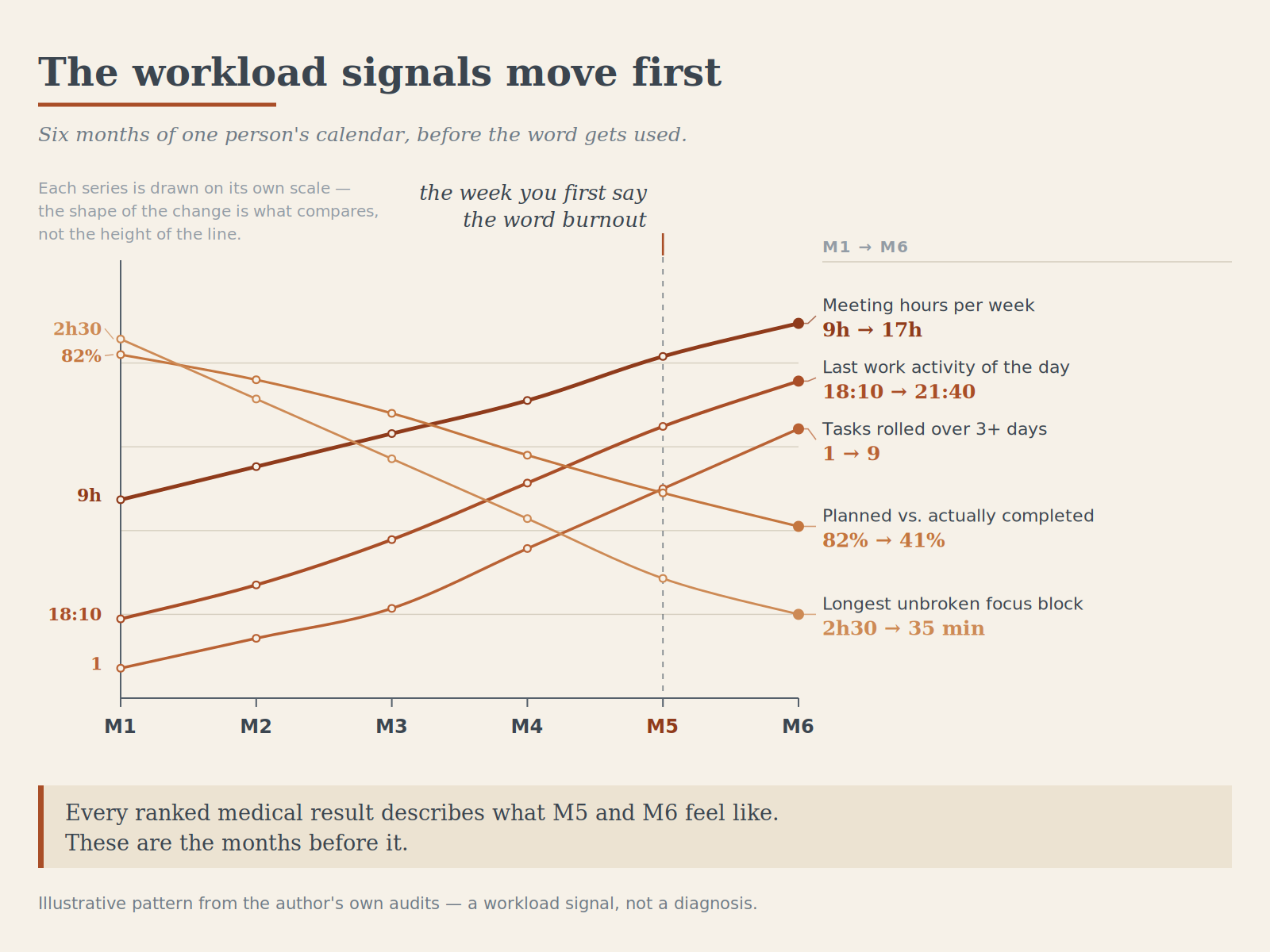
The countable signals move months before the feelings do. This is what the clinical checklists cannot show you.
The 30-minute audit I run at the end of every month
It’s the last thing I do on the final Friday of the month, and it takes half an hour because the data already exists — I run my week in Fokus, so meeting hours, rollovers and the planned-versus-done ratio are already recorded. Any calendar plus any task list will do; a spreadsheet with six rows works fine.
- Write down this month’s six numbers.
- Put last month’s beside them, plus the same month two quarters ago if you have it.
- Circle anything that moved more than 25% in the wrong direction.
- For each circled number, write one sentence about what changed — a new project, a departure nobody backfilled, a reorg, a client.
- Decide one thing to cut, not one thing to optimise.
Step five is where most audits quietly fail. Reshuffling a week that holds fifty hours of committed work produces a very tidy fifty-hour week. If you already run a weekly review, the monthly version costs almost nothing on top.
The signs other people see before you do
None of the ranked results cover this, and it’s often how people find out. What colleagues and managers notice first:
- Replies get shorter and slower, and the tone flattens.
- More small errors — a wrong date, a missed thread, a number that doesn’t tie. Mental Health America lists this explicitly, and it’s visible from outside long before it feels like anything inside.
- You stop showing up to the optional things: the guild, the mentoring, the hallway conversation.
- Deadlines get renegotiated rather than met — reasonably, every time, but every time.
If someone raises it with you, the useful reply isn’t reassurance. It’s “which of those have you seen, and when did it start?” Dates line up with your six numbers. And if you’re the one noticing it in a teammate, ask about workload before you ask about wellbeing — it’s an easier question to answer honestly, and it points at something a manager can actually change.
”Overloaded this quarter” or burned out? Three questions that separate them
Most people separate these on instinct. Three tests I’d use instead:
The recovery test. After a genuinely light week — real time off, not a quiet week with a laptop open — do you come back restored? Overload lifts with rest; Mental Health America makes the same point about reduced demands.
The duration test. Has this been the shape of things for more than a quarter, across more than one project? A brutal launch is a season. Three seasons in a row is a pattern.
The spillover test. Dr. Rock’s description is the clearest I’ve found: when we carry the burden of job stress home, it spills into the rest of our lives — relationships, parenting, interest in hobbies. Overload mostly stays inside work hours. Once it has crossed over, that’s a reason to talk to a professional rather than to redesign your calendar.
What are the 4 stages of burnout? (And the 42% rule, and the 5 C’s)
People search all three, and none of the clinical sources ranking for this topic defines any of them. So, honestly:
The 4 stages usually circulated are honeymoon (high energy, high commitment, boundaries already slipping), onset of stress (some days noticeably harder, focus time getting eaten), chronic stress (rollovers pile up, weekends absorb overflow, cynicism appears), and burnout (exhaustion rest doesn’t touch, detachment, reduced efficacy). It’s a condensation of Freudenberger and North’s twelve-phase model — a useful narrative, not a clinical staging system. Nobody is officially “in stage 3.”
The 42% rule says you should spend about 42% of your time — roughly ten hours a day — on rest and recovery, sleep included. It comes from wellness and productivity writing, not from any medical body in these results. As a sanity check on whether your week leaves room for a life, fine. As a rule, no.
The 5 C’s has no consistent definition; different coaching sources give different lists. Skip it and use the WHO’s three dimensions, which Boston University echoes: energy depletion, depersonalization, and reduced professional efficacy. Three things, one source, no mnemonic.
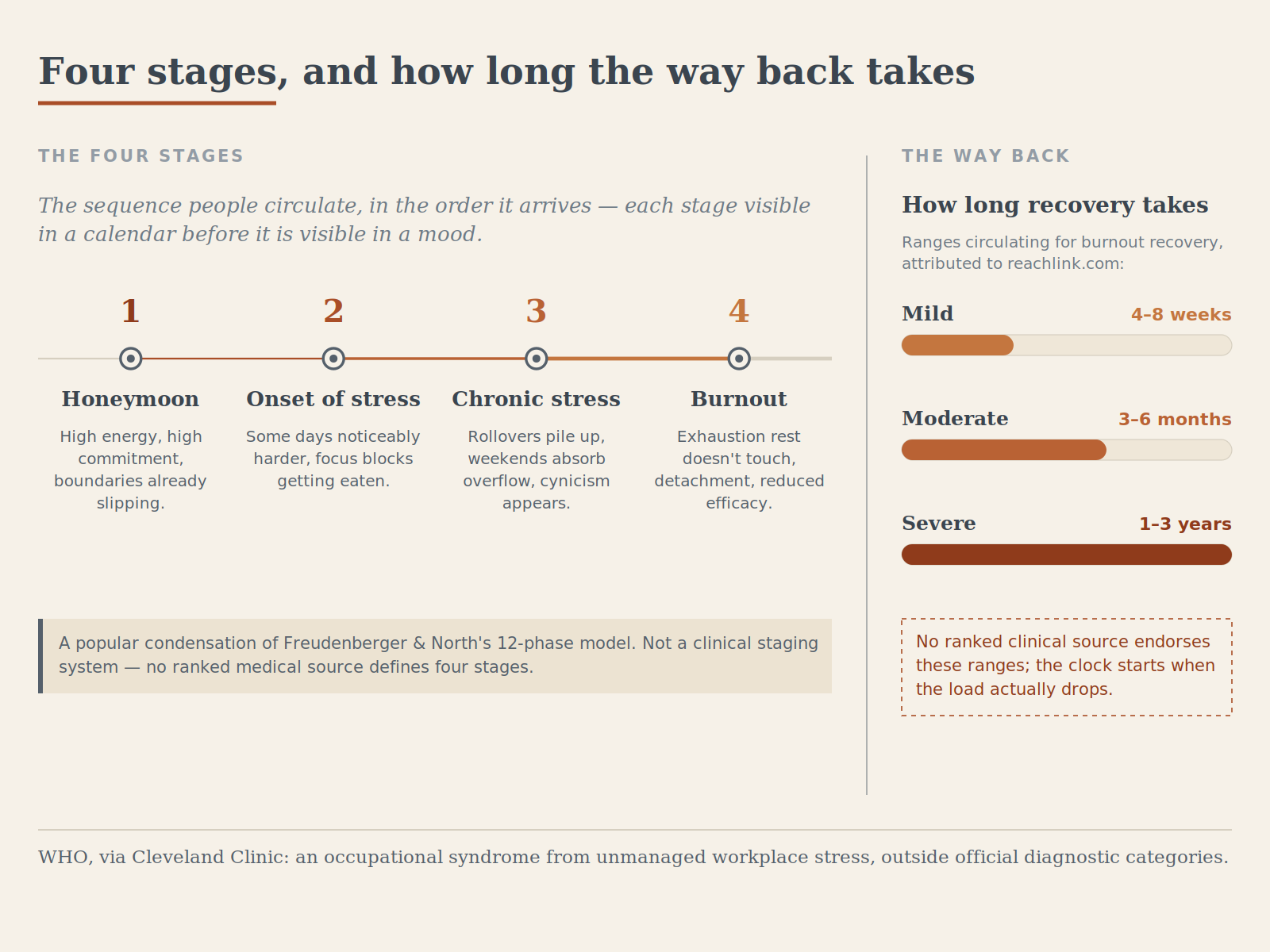
Widely repeated, weakly sourced. Useful as a shape, not as a prognosis.
How long does it take to recover from job burnout?
The clinical sources decline to give a number, which tells you something. The figure Google currently surfaces for this question comes from reachlink.com: roughly 4–8 weeks for mild cases, 3–6 months for moderate burnout, and 1–3 years for severe burnout.
Treat those as orders of magnitude, not a prognosis — no ranked medical source endorses them. Two things I’d add from watching people go through it: recovery isn’t linear, and the clock doesn’t start when you decide to recover. It starts when the load actually drops. Six weeks of good intentions inside an unchanged workload is six weeks at the same numbers.
How to beat burnout without quitting your job
This is the search behind the search, and it deserves numbers rather than a list of attitudes. Six weeks, one change per week, in this order:
- Cap meeting hours at a specific figure and decline past it. Say the number out loud to your manager so it’s a shared constraint, not a secret one.
- Protect two blocks a week and defend them like external meetings. Two kept blocks beat five scheduled ones.
- Cut the daily list to three. Everything else is a backlog, not a plan. This attacks the rollover count directly.
- Set an end time and hold it. Dr. Rock advises setting limits on how many hours you’ll let yourself work, and not answering work email at home. The least comfortable item here, and the one that moves the numbers most.
- Use micro-boundaries when full breaks aren’t available. Mental Health America suggests 15-minute quiet periods and 30-second stretches — small, unglamorous, better than nothing on a week you can’t control. They also note that not every day needs to be productive.
- Take the numbers to your manager. Not “I’m overwhelmed” but “meeting hours went from 9 to 17, rollovers from 2 to 11, and here are three things I want to hand off.” Mayo Clinic’s first suggestion is to talk to your supervisor, and support genuinely protects — feeling like you belong is one of the few well-evidenced buffers.
Two caveats. Cleveland Clinic notes that quitting without addressing your own habits and thought patterns tends to carry the susceptibility into the next job. And the reverse: if you run this for six weeks and the numbers haven’t moved, the problem is the design of the role, not your discipline. That’s information, not failure — and it’s the point where “should I leave” becomes a reasonable question rather than a dramatic one.
What a planner can and can’t do here
Plainly: a planner does not fix burnout. Nothing you schedule will. Rescheduling cannot fix a job with more work in it than a person can do — it just redistributes the same impossible week into neater rectangles. When I use Fokus to reschedule what didn’t get done, I’m choosing where the overflow lands, not removing it.
What a planner does is keep the receipts. It gives you an unsentimental record of when your week changed, and turns “I feel underwater” into six numbers you can show someone with authority over your workload. That’s clarity and an argument, not a cure — and if you’re already past the point where numbers help, the numbers can wait.
And if things ever feel worse than tired: in the US you can call or text 988 (988lifeline.org), or text HOME to 741741 for the Crisis Text Line. Both are free, confidential, and available around the clock.

Fokus Team
The Fokus Team
The team behind Fokus — building the smart productivity platform.