Eat the Frog: How It Works — and When It Backfires
Get the next article and product update in your inbox
Short product notes, fresh blog posts, and focus systems. No noisy sequence.

Eat the frog is the bluntest instrument in productivity: identify the task you’re most likely to avoid — the biggest, ugliest, most important one — and do it first, before anything else gets a vote. The name traces to a quip usually pinned on Mark Twain (almost certainly misattributed, and the method doesn’t care): if you have to eat a frog, do it first thing in the morning, and nothing worse will happen to you all day. Brian Tracy built the bestselling book on it. Most articles stop at “do the hard thing first.” This one covers the parts they skip: how to actually choose the frog (harder than it sounds), how to survive eating it, the cases where frog-first genuinely backfires — including the ADHD caveat almost nobody prints — and what a team’s frogs look like.
Why it works (two mechanisms, not one)
Willpower runs downhill. Whatever you believe about the ego-depletion literature, the practical observation survives: your capacity for hard, aversive work is best early and erodes through a day of decisions and meetings. Frog at 9 AM costs less than frog at 4 PM — same frog, different price.
It kills the avoidance economy. The deeper mechanism: an avoided task doesn’t sit quietly in the queue. It taxes everything — you do six easy tasks as avoidance, checking email with special enthusiasm, productive procrastination at its finest. Eating the frog first doesn’t just complete one task; it refunds the anxiety-tax on the whole rest of the day. That 10 AM feeling of “the worst is already done” is the method’s real product.
Picking the frog (the step everyone botches)
“Do the hardest task first” fails when you pick wrong, and there are two classic wrong picks. The biggest task isn’t the frog if it’s not important — reorganizing your files is hard and worthless. And the most urgent task isn’t the frog either; urgent tasks don’t need the method, they enforce themselves. The frog is specifically the important-and-avoided task: high stakes, no deadline screaming, and a little dread attached. Two tests find it fast. The wince test: scan your list and notice which item you skip over slightly faster — that flinch is data. The 80/20 test: which single task, done today, would make the rest of the week lighter or more valuable? Where the two tests agree, that’s your frog. One more rule: one frog. A list of three frogs is a prioritization failure wearing rain boots — if everything is the hardest task, you’ve refused to choose.
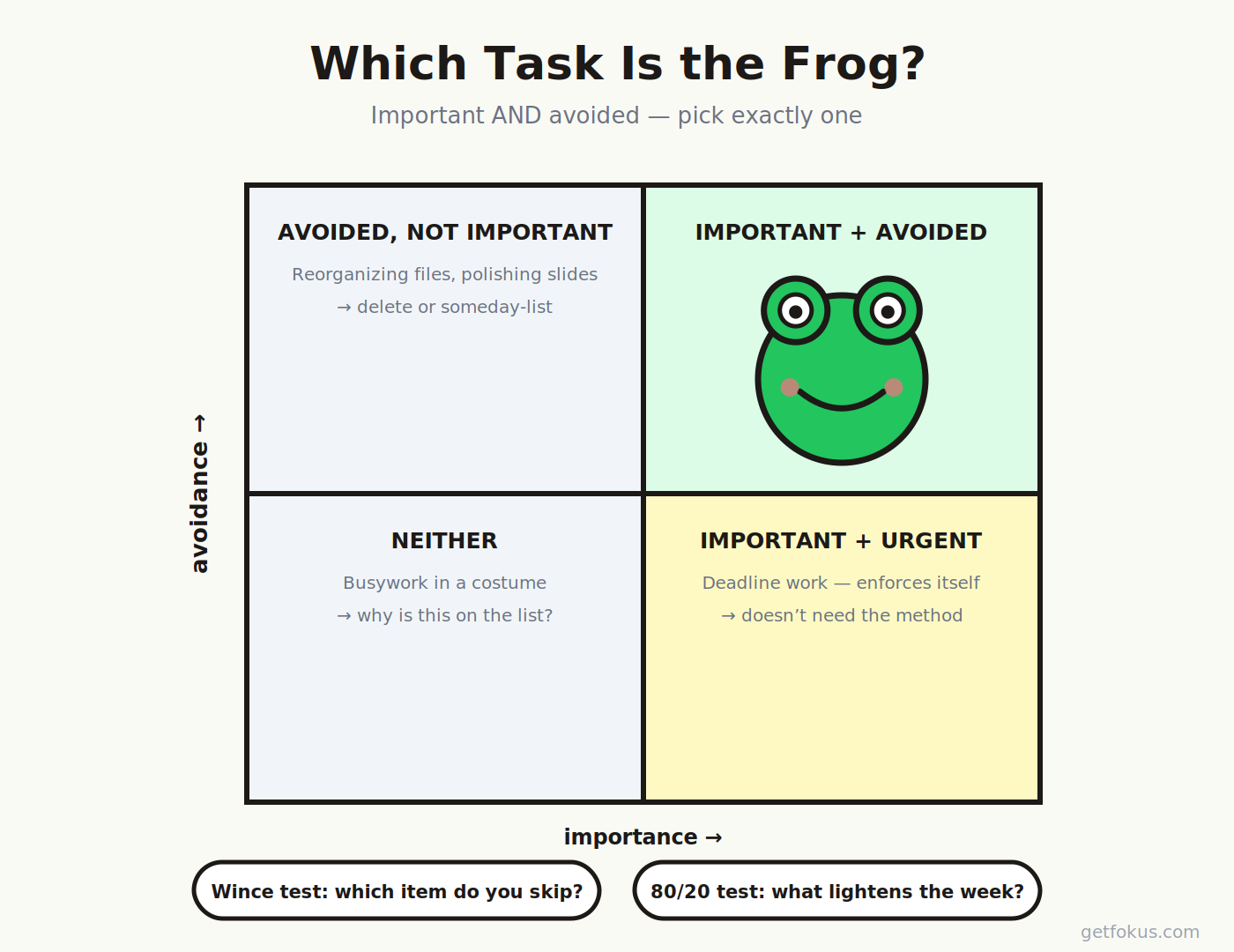
The frog is important AND avoided. Big-but-worthless doesn’t count. Pick exactly one.
Eating it: the mechanics
Choose it the night before. Morning-you will negotiate; evening-you decides while the day’s evidence is fresh, during the evening shutdown. The frog written down at 6 PM is a decision; the frog “decided” at 8:55 AM is a debate.
Give it a block, not a hope. “First thing” means an actual calendar block — 60 to 90 minutes, before email opens. The email rule is load-bearing: the inbox is where frogs go to be traded for tadpoles.
Shrink the first bite. Frog-sized dread responds to the same medicine as all dread: a concrete first move. Not “do the presentation” — “open the file and write the three section headers.” A 10-minute pomodoro start gets you past the worst of it; frogs are almost always smaller from the inside.
If the frog is too big to finish in one sitting, Tracy’s own rule applies: cut it into frog-legs — daily 90-minute bites, same block every morning, until it’s gone. A frog that takes two weeks isn’t a task, it’s a poorly-sliced goal.
When frog-first backfires (the honest section)
The ADHD caveat. The advice that circulates quietest and matters most: for many ADHD brains, frog-first is a proven disaster. Executive function is often at its worst against a cold start on the most aversive task — the frog becomes a wall, the wall becomes shame, the morning dies. What frequently works better is the reverse ramp: two or three quick wins to build activation momentum, then the frog in slot two or three, with the wins time-boxed so they don’t expand into a whole morning of warm-up. If that’s your brain, the principle to keep is “the frog gets prime energy, early-ish, in a protected block” — and the ordering dogma can go.
Night owls. Frog-at-dawn assumes morning peaks. If your cognitive prime is 8 PM, frog-first means frog-at-your-worst. Keep the principle, move the slot: the frog gets your best hour, whenever that is.
Reactive roles. If your job is genuinely interrupt-driven until 10 AM, a 9 AM frog block is fiction. Put the frog in the first island you control and buffer the plan honestly.
Fragile-day types. Some people find that a failed frog poisons the whole day — the miss cascades. If that’s you, pair the frog with a minimum fallback (30 focused minutes counts as eaten) so a hard morning bends instead of breaking.
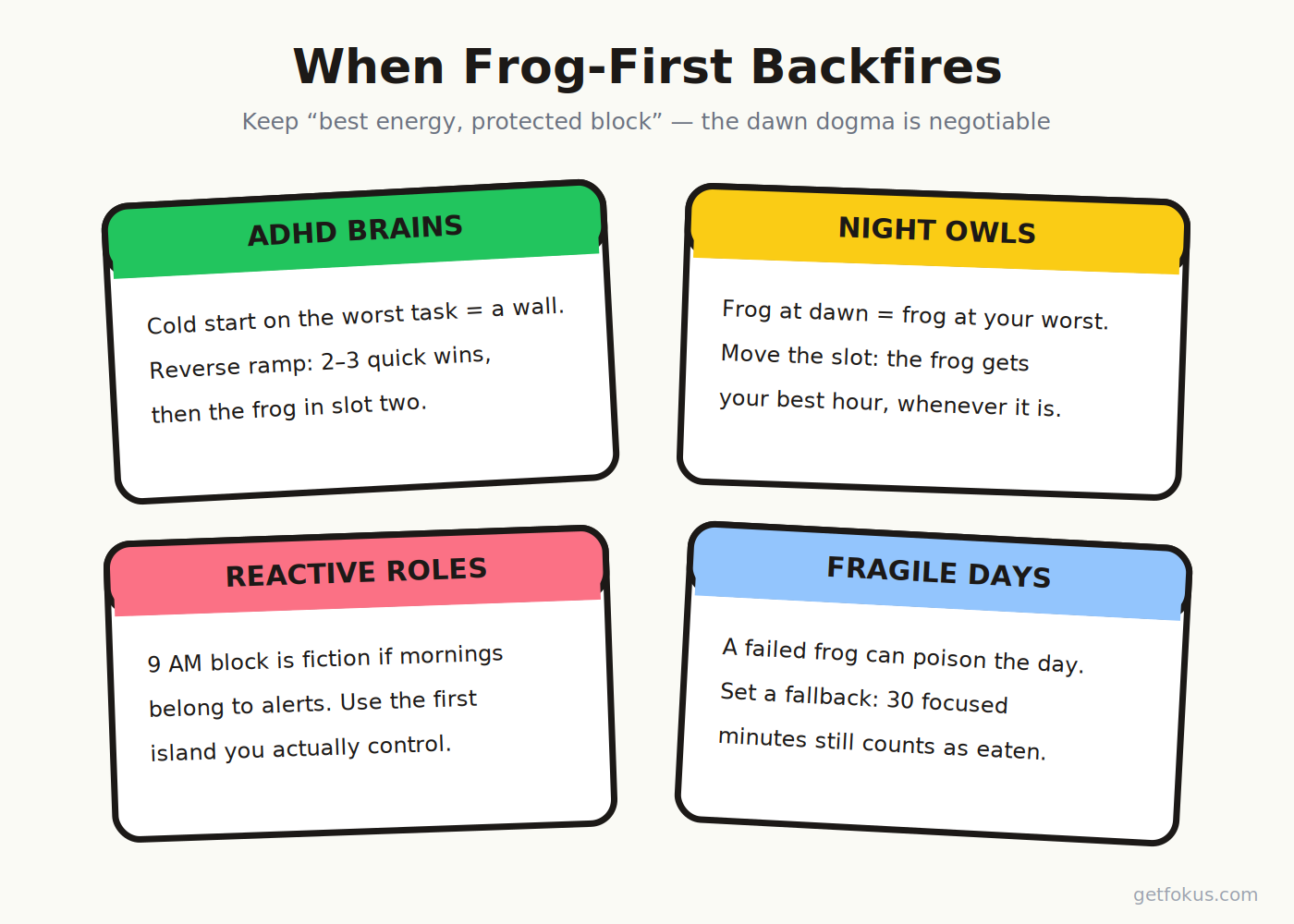
Keep the principle — best energy, protected block. The dawn dogma is negotiable.
Frogs at work: the team version
Teams have frogs too — the migration nobody starts, the awkward pricing conversation, the postmortem that keeps slipping. Team frogs hide better than personal ones because avoidance looks like busyness at scale: a team can sprint energetically around its frog for a quarter. Two practices help. Name the frog in planning — “what’s the thing we’re all quietly not doing?” is a startlingly productive standup question. And give it an owner and a block, same as a personal frog: shared frogs get eaten by exactly one person with calendar time, never by “the team” (one owner per goal, always). In Fokus this is just how scheduling works — the frog gets top priority, and smart scheduling places it in your first free block of the day automatically, which quietly enforces the method without the morning debate.
Eat the frog FAQ
What does “eat the frog” mean? Do your most important, most-avoided task first — before email, before easy work — so the day’s best energy goes to the thing that matters and the avoidance tax stops compounding.
Did Mark Twain really say it? Almost certainly not — the frog quip circulated in various forms long before it was pinned on him. The attribution is folklore; the method works anyway.
What if I have two frogs? Tracy’s rule: eat the ugliest one first. In practice, two daily frogs usually means priorities need an honest ABCDE pass — the method’s power comes from the singular.
Does eat the frog work with ADHD? Often not in its strict form — a cold start on the most aversive task can wall an ADHD brain. Try quick wins first, then the frog in a protected second slot. Keep “best energy, one block”; drop “first, always.”

James Okafor
Team Collaboration Writer
James focuses on remote work, team dynamics, and collaboration strategies. He brings firsthand experience leading distributed teams across four continents.