A Realistic Morning Routine: Science, Not a 4 AM Miracle
Get the next article and product update in your inbox
Short product notes, fresh blog posts, and focus systems. No noisy sequence.

Morning routine content has a credibility problem. Half of it is billionaire cosplay — up at 4:30, ice bath, journaling by candlelight — and the other half is 22-item checklists that would take until noon to complete. Both miss what a morning routine is actually for: not virtue, but setting up the day’s energy and first decision. The science on mornings is real but small — a handful of things matter a lot, and everything else is decoration. This guide covers the few things with evidence behind them, a realistic 30-minute template, why the routine’s most important step happens the night before, and an honest section on whether you need to wake up early at all. (Spoiler: no.)
What actually matters (the short list)
Light, first. Your circadian clock sets itself by morning light, and it’s the highest-leverage habit on this list: a few minutes of outdoor daylight soon after waking anchors your sleep phase, sharpens daytime alertness, and makes tonight’s sleep easier. A window helps; outside is better. Everything else in the wellness stack is optional compared to this.
Movement, some. Not a workout unless you want one — a walk, stretching, anything that raises your pulse gently. The point is signaling “day has started” to a body that regulates energy by rhythm.
Delay the scroll. The strongest don’t on the list. Reaching for the phone in the first minutes hands your attention to an inbox and a feed before you’ve made a single decision of your own — you start the day in reactive mode, and reactive mode is sticky; it tends to own the whole morning. Thirty phone-free minutes is a bigger productivity upgrade than any supplement.
Water and unhurried caffeine. Hydrate on waking; coffee works fine whenever you enjoy it — the “delay caffeine 90 minutes” rule has thinner evidence than its virality suggests. Have it when you like.
One planned first task. The single most productivity-relevant item, and the one wellness listicles skip entirely: know, before the day starts, what your first block of real work is. A morning that opens with “let me check email and figure out what to do” has already lost its best hour to the choosing-moment paralysis we’ve written about before.
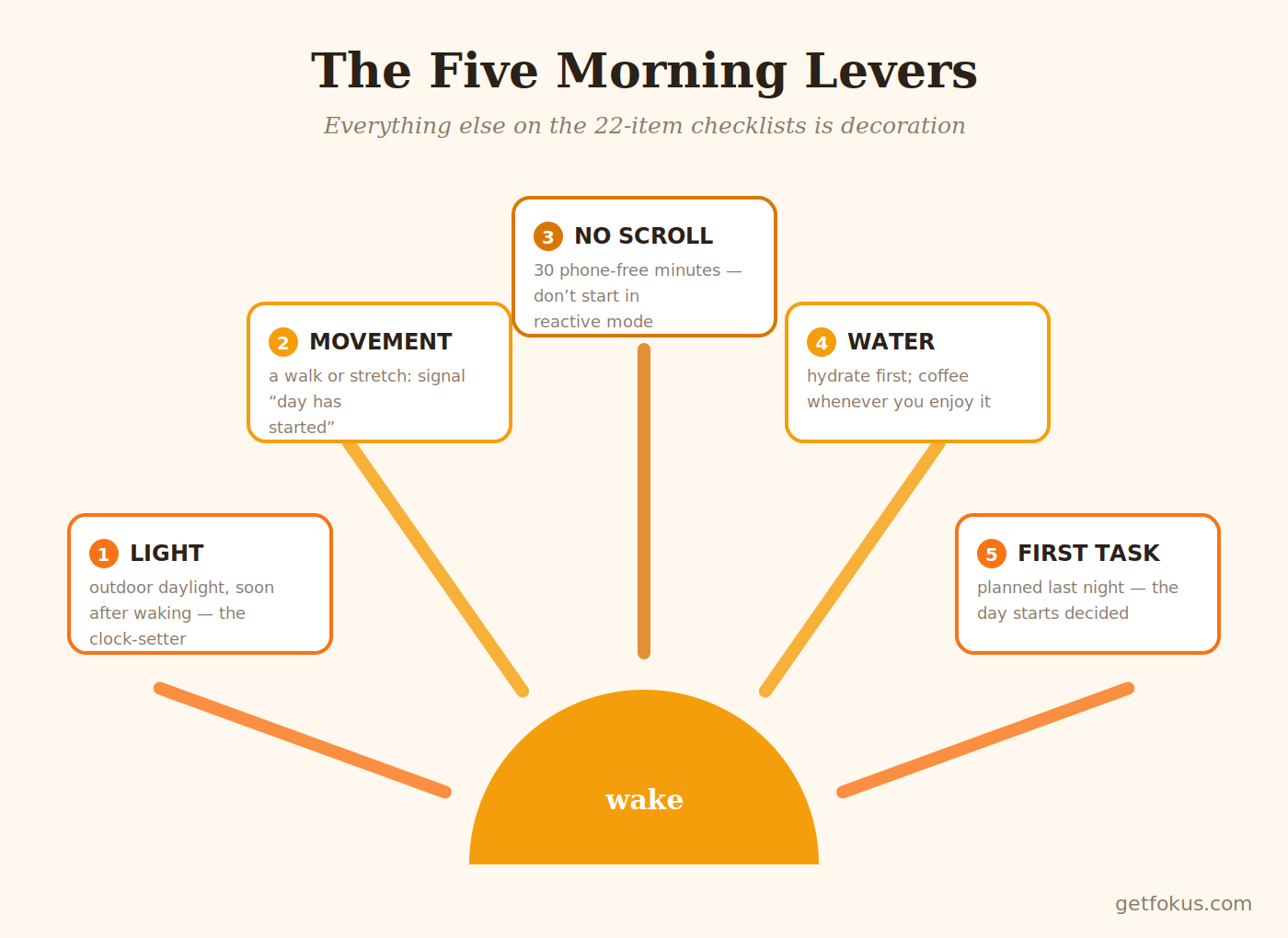
Five levers with evidence. The other seventeen checklist items are decoration.
The 30-minute realistic template
For a normal human with a job, not a monk with a book deal:
- 0–5 min: Up, water, curtains open or straight outside. No phone — it charges outside the bedroom, which is 90% of winning the no-scroll battle.
- 5–15 min: Shower, dress, coffee — the mechanical part, phone still down.
- 15–25 min: Breakfast if you eat it, plus daylight — eat by the window, step onto the balcony, or walk part of the commute.
- 25–30 min: Glance at the plan: today’s blocks, today’s first task, the one thing that must survive the day. Not planning — reviewing a plan that already exists.
That last distinction is the hinge of this whole article, so let’s give it its own section.
The best morning routine starts the night before
Morning-you is not the right person to plan the day. Morning-you is groggy, time-pressed, and optimistic in all the wrong ways. Evening-you, looking back at what today actually was, plans better — which is why the highest-leverage “morning” habit is a ten-minute evening shutdown: tomorrow’s priorities picked, the first task chosen, the calendar blocks laid. Then the morning routine’s job shrinks to something achievable: wake the body, protect the attention, and start — no decisions required. This is also where Fokus quietly earns its keep in the morning: smart scheduling builds tomorrow’s block plan from your tasks and priorities, so the 25-minute mark of your routine is a glance at a schedule that already exists, not a negotiation with an empty calendar. Your first frog is sitting in its block (more on frogs here), and the day starts decided.
Do you have to wake up early? No.
The 5 AM club deserves an honest paragraph. Chronotypes are substantially genetic: some people are wired to peak early, others late, and forcing a night owl into a 5 AM routine mostly produces a sleep-deprived night owl. What the successful-people-wake-early literature actually shows is that successful people protect their best hours — and for many of them those hours happen to be early, before the world starts pinging. If your best hours are 9 PM, protect those instead; the principle transfers completely. What is non-negotiable is consistency: a stable wake time (weekends included, roughly) does more for energy than an early one. The 30-30-30s and 4-AM rules floating around are packaging, not science — the levers underneath are always the same five above.
When the routine breaks (because it will)
A routine that only works on perfect days is a decoration. Sick kid, early flight, terrible night — the failure mode isn’t missing a day, it’s the “streak is broken, why bother” spiral. Two defenses. First, define a minimum viable morning: water, one minute of daylight, glance at the plan — 3 minutes, survives any chaos, keeps the identity intact. Second, judge the routine weekly, not daily: five decent mornings out of seven is a system that works, and the weekly review is where you notice patterns (Thursdays always break → Thursday needs a different morning).
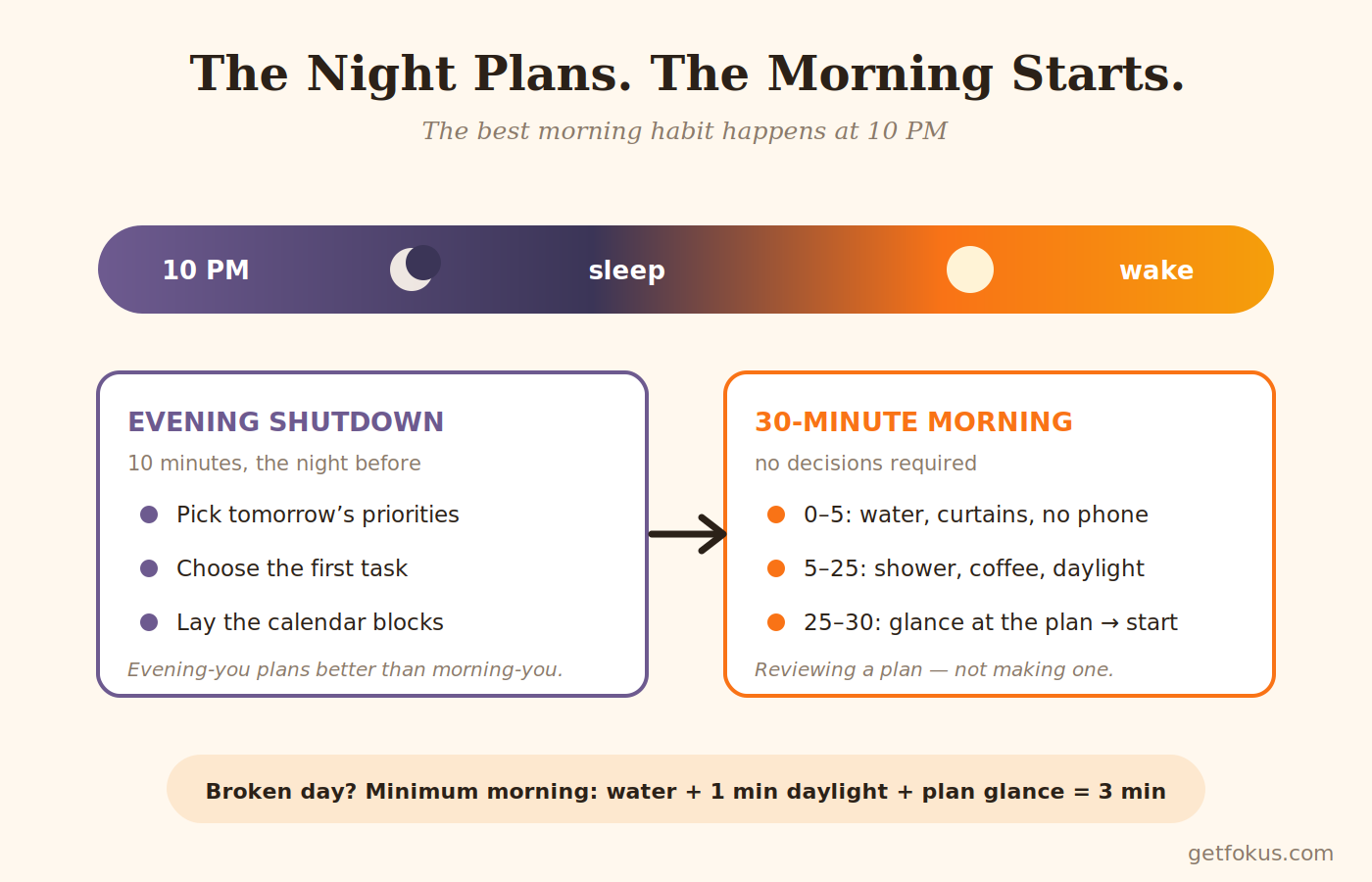
The night plans, the morning starts. And a 3-minute fallback beats a broken streak.
Morning routine FAQ
What is the best morning routine? The one you’ll repeat: daylight early, some movement, no phone for 30 minutes, water, and a pre-planned first task. Length and hour matter far less than consistency.
What is the 30-30-30 morning routine? A packaged formula — 30g protein within 30 minutes of waking, then 30 minutes of gentle exercise. The movement part is well-supported; the protein timing is looser science. Fine if it helps you start; not magic.
Is waking up at 4 AM or 5 AM worth it? Only if you’re naturally early-peaked or your life demands it. The transferable principle is protecting your best hours and keeping a consistent wake time — not the specific number on the alarm.
How long should a morning routine be? 20–40 minutes covers everything with evidence behind it. Past that you’re trading sleep or work time for ritual — and sleep, frankly, outranks every item on the list for what it does to your focus.

Lina Hayek
Productivity & Workflow Writer
Lina writes about time management, deep work, and building sustainable routines. She has helped thousands of professionals rethink their relationship with productivity.