Flow State: How to Get in the Zone on a Real Workday
Get the next article and product update in your inbox
Short product notes, fresh blog posts, and focus systems. No noisy sequence.

Flow state — “being in the zone” — is the mental state where you’re so absorbed in a task that action feels effortless, time goes strange, and the work seems to do itself. Psychologist Mihaly Csikszentmihalyi spent decades studying it in surgeons, climbers, and chess players, and his conclusion holds up: people are at their best, and report being happiest, when body or mind is stretched to its limits on something difficult and worthwhile. What the flow literature rarely admits is that almost all of it was written about people whose days allow flow — and yours probably doesn’t. This guide covers what flow actually is and the conditions that trigger it, then spends its energy on the unglamorous part: engineering flow into a calendar full of meetings, pings, and other people’s emergencies.
What flow is (and the myth to drop)
Csikszentmihalyi’s research identified a recognizable cluster: complete absorption where action and awareness merge, distorted time (hours feel like minutes), loss of self-consciousness — the inner critic goes quiet — and intrinsic reward, meaning the doing itself feels good regardless of outcome. Neuroscience adds a note: flow involves reduced activity in prefrontal self-monitoring regions. Flow isn’t trying harder; it’s the supervisory brain stepping aside because the task has taken over.
The myth to drop: flow is not a switch you flip with the right playlist or supplement. It’s a state that emerges when specific conditions are met — which is excellent news, because conditions can be engineered even by people who don’t feel especially disciplined.
The three conditions (and the one that’s about your calendar)
1. Challenge slightly above skill. Too easy produces boredom, too hard produces anxiety; flow lives on the ridge between them. Practically: if a task bores you, add a constraint (tighter deadline, higher standard, do it a new way); if it scares you, shrink the first step until it’s startable. You tune the task, not yourself.
2. Clear goals with immediate feedback. “Work on the report” cannot produce flow — the brain needs to know what the next move is and whether it worked. Writers get this from sentences appearing; programmers from tests passing. For fuzzy knowledge work, manufacture it: define done for this session, work against a visible outline, keep a scratch log. Vague tasks don’t flow; sliced ones do.
3. Unbroken attention — the calendar condition. Flow takes roughly 10–20 minutes of sustained attention to enter, and a single interruption resets the clock. This is the condition modern work systematically destroys, and it’s why reading flow tips changes nothing while your day is diced into 25-minute gaps between meetings. Protecting this condition isn’t a mindset; it’s schedule architecture — which is the next section.
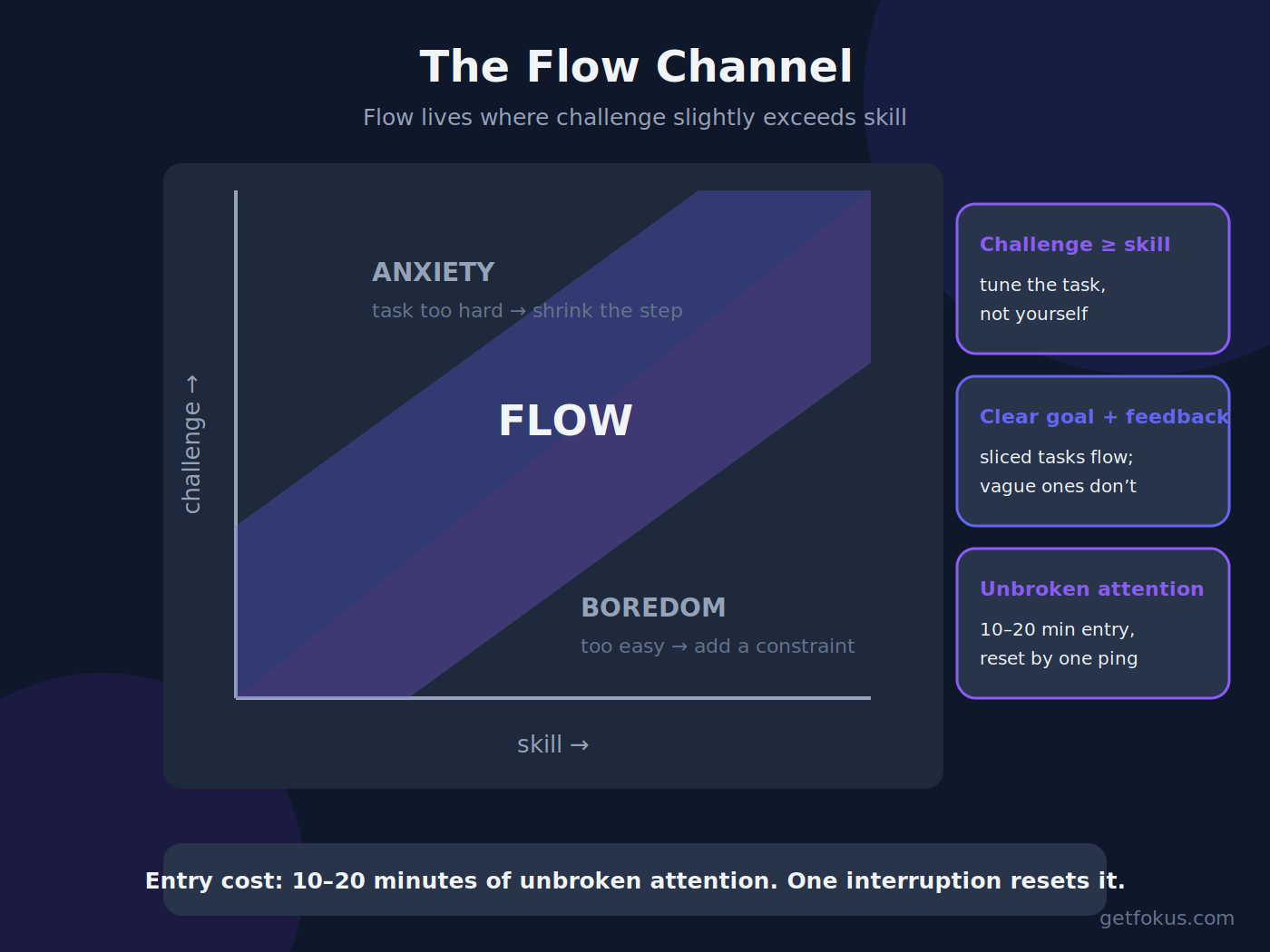
Flow lives where challenge slightly exceeds skill — and dies every time attention resets.
Engineering flow into a workday
Book flow windows like meetings. A flow window is 90–120 minutes — long enough that the 15-minute entry cost pays off, short enough to sustain. One per day is a strong day; five 20-minute fragments are worth almost nothing for deep work, which is the brutal arithmetic time blocking exists to fix. Put the window at your peak-energy hours, and treat it as an appointment someone else booked: it can be moved, never deleted.
Pay the entry toll deliberately. The first ten minutes will feel bad — scattered, itchy, “I should check email first.” That discomfort is the entry, not a sign it isn’t working. A consistent start ritual (same drink, same playlist, phone in another room, one sentence stating the session’s goal) shortens the toll over time by classically conditioning the state.
Kill the interruptions in advance, not in the moment. Willpower loses to notifications; environment wins. Status set, notifications off — actually off, not flipped-phone off — and colleagues told when you’ll resurface. Messages age astonishingly well for 90 minutes, and the reactive work belongs batched in its own blocks where it can’t perforate the window.
Plan the exit too. Note the next move before stopping (“resume at section 3, the argument needs a counterexample”) — tomorrow’s entry toll drops by half when the door is left ajar. Then take a real break; flow is expensive, and back-to-back windows without recovery turn day three into sludge.
This is, not coincidentally, the shape we built Fokus around: the smart scheduling engine reserves long blocks for high-priority deep tasks around your meetings and re-plans when the day shifts — so the flow window exists before the day starts, instead of depending on you finding a gap and defending it by hand at 10am, mid-temptation.
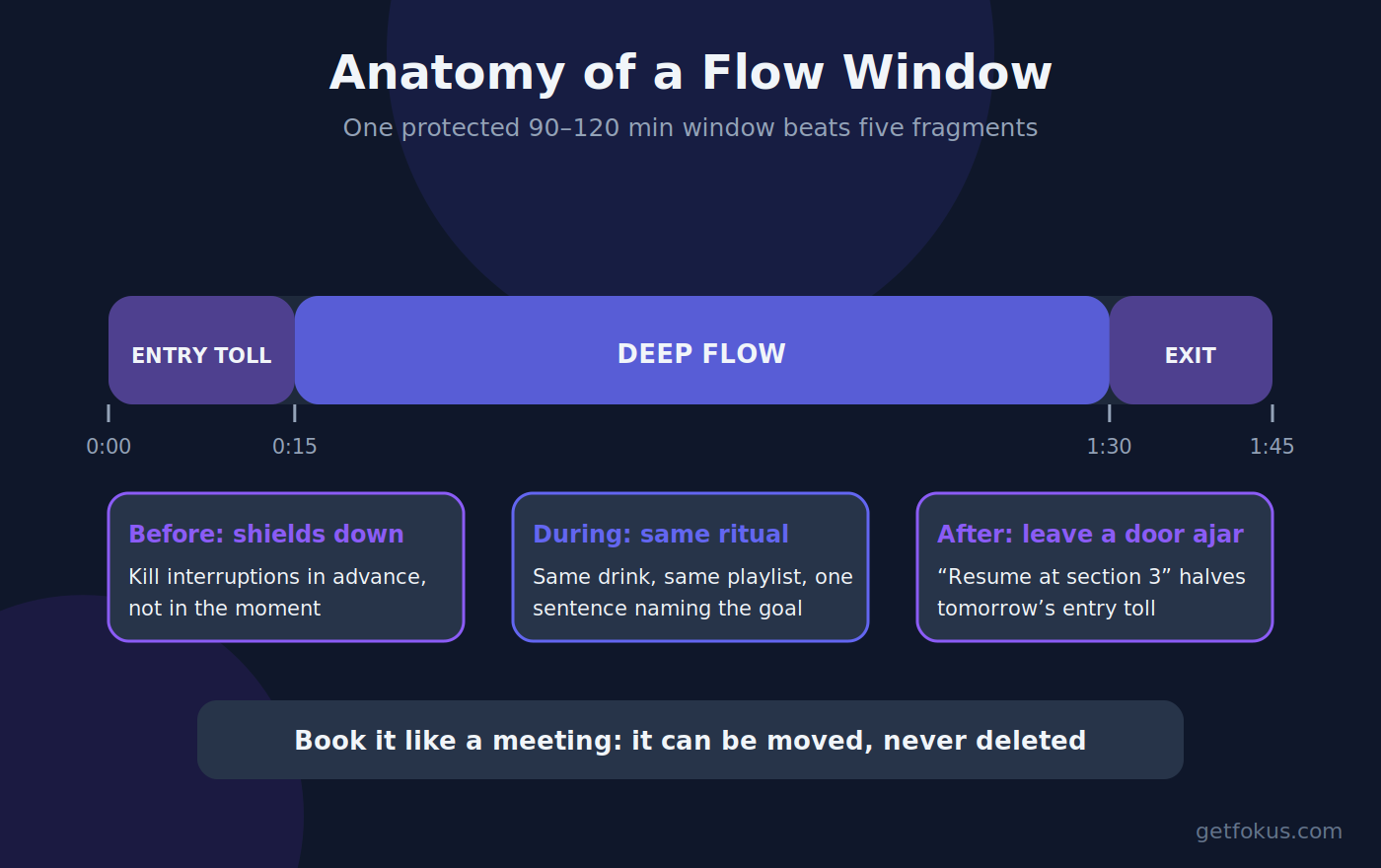
One protected window beats five fragments — flow is schedule architecture, not mood.
Flow and ADHD
Frequently asked, and the answer is more interesting than yes/no. Many people with ADHD know flow intimately — as hyperfocus, the hours-vanish lock-in on something interesting. The difference is steering: neurotypical flow is somewhat schedulable, while hyperfocus tends to pick its own targets and resist exit. What tends to help: use interest as the entry point (route the boring-but-important task through its most interesting angle), externalize the session goal on paper where it can re-anchor you, set an exit alarm with a physical transition (stand up, leave the room) because hyperfocus ignores polite beeps, and be generous with recovery. If attention regulation is a daily struggle beyond productivity tweaks, that’s clinician territory, and a good one is worth more than any technique list.
What flow is not (honest caveats)
Chasing flow can quietly become its own procrastination: not every valuable task can flow, and plenty of important work is boring maintenance that just needs a timer and a start. Flow is also not a moral state — you can flow for three hours on the wrong task entirely, which is why the choosing layer (prioritization, weekly planning) sits above the focusing layer, and no amount of zone makes up for pointing it at the wrong target.
Flow state FAQ
What does flow state mean? A psychological state of total absorption in a challenging task: attention fully engaged, self-consciousness quiet, time distorted, the activity intrinsically rewarding. Coined and studied by Mihaly Csikszentmihalyi.
How long does it take to get into flow? Typically 10–20 minutes of unbroken attention — which is why interruptions are fatal and why flow needs 90-minute-plus protected windows, not gaps between meetings.
Can people with ADHD enter flow? Yes — often intensely, as hyperfocus. The challenge is directing it at chosen targets and exiting cleanly; interest-based entry, external goals, and physical exit cues help.
What’s the difference between flow state and deep work? Deep work is the practice — scheduled, distraction-free effort on cognitively demanding tasks. Flow is the state that sometimes arises during it. You can’t command flow, but you can run deep work sessions that make it likely.

Nadia Amari
Focus & Well-being Writer
Nadia writes about mindful productivity, work-life balance, and the science of focus. She believes the best tools should help you do less, better.