Deep Work: A Practical Guide Beyond the Book Summary
Get the next article and product update in your inbox
Short product notes, fresh blog posts, and focus systems. No noisy sequence.

Search “deep work” and you get book summaries — a hundred rewordings of Cal Newport’s 2016 definition: professional activities performed in distraction-free concentration that push your cognitive capabilities to their limit. The definition holds up. What’s missing from the summary economy is everything after the definition: how much deep work a human can actually do (less than you think), what the philosophy gets wrong (the criticisms are real), how to practice it inside a job with eleven meetings a week, and what changes now that AI can do a growing share of the shallow work that used to fill the gaps. This guide is the part after the summary.
The idea in one paragraph (and why it’s aging well)
Newport’s argument has two halves. First, deep work is valuable and getting more so: the economy increasingly rewards people who can learn hard things fast and produce at an elite level, and both depend on sustained concentration. Second, deep work is rare and getting rarer: open offices, chat tools, and phones have made fragmented attention the default, so the people who can still concentrate hold an appreciating asset. A decade later the thesis has aged almost embarrassingly well — with one twist Newport didn’t fully anticipate, which we’ll get to: the arrival of AI that handles shallow work has made the deep half of the split more valuable, not less.
The 4-hour ceiling (the number the summaries skip)
How many hours of deep work can a person do? The research and practitioner consensus converge on roughly 3–4 hours a day of genuinely limit-pushing concentration — elite performers across fields (musicians, chess players, researchers) cluster there, and pushing past it produces diminishing, often negative returns. This number should change how you plan more than any other fact in this article. It means a realistic great day is one or two protected 90-minute blocks, not an eight-hour concentration marathon. It means the other four-plus hours of your workday are legitimately for shallow work — meetings, email, coordination — and scheduling them as such isn’t failure, it’s design. And it means if you currently get zero deep hours, the target is one, not six; the ceiling is a budget to spend deliberately, and most knowledge workers spend almost none of it.
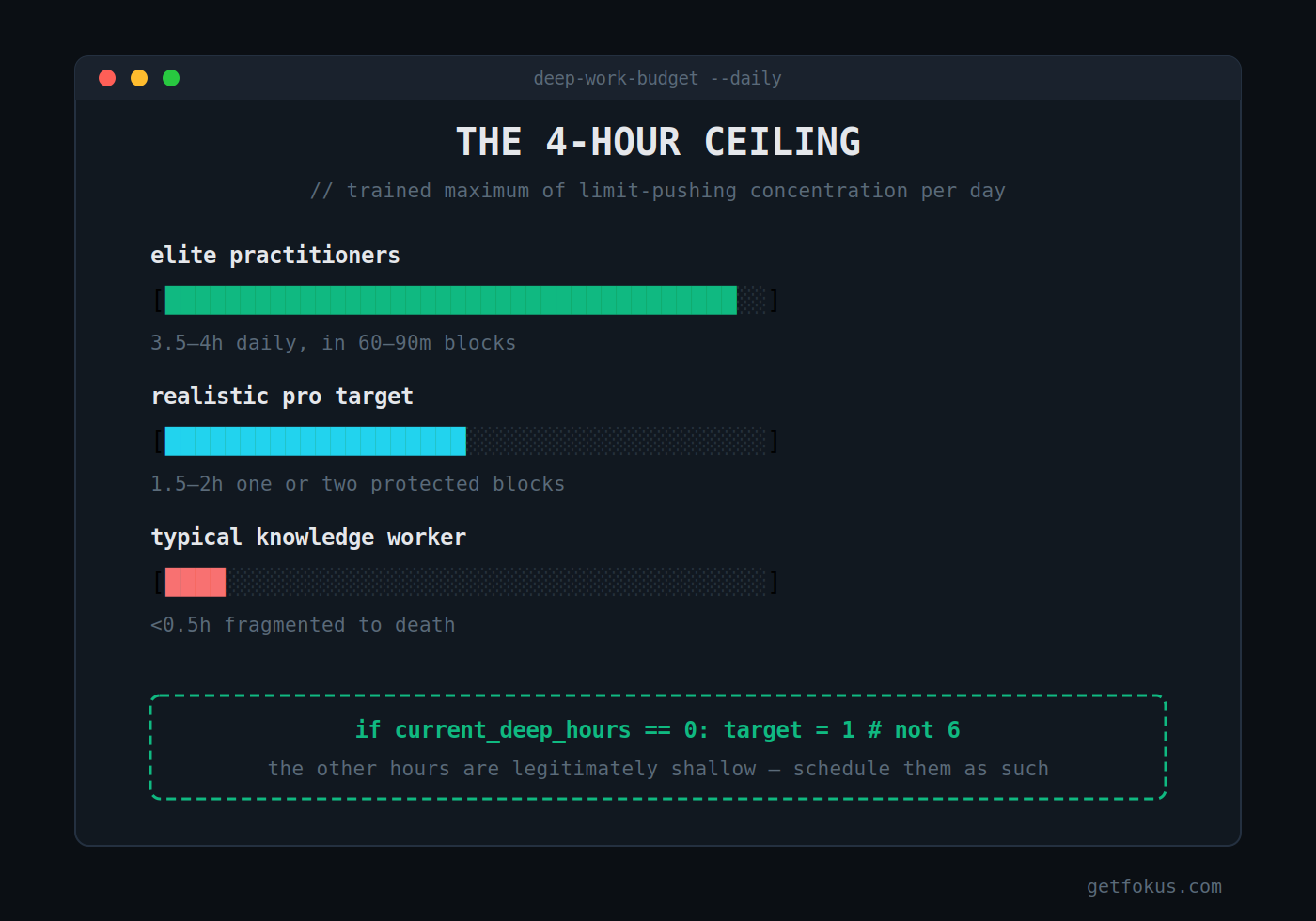
Four hours is the ceiling. The real scandal is how few of them get spent.
The honest criticisms
People ask what the criticisms of deep work are, and the summaries never answer, so here are the three with substance.
It underweights collaborative work. The philosophy reads as if value comes only from solo concentration — but plenty of high-value work happens in the messy, interruptible space between people: mentoring, coordination, the hallway conversation that kills a doomed project. A fair reading treats deep work as one mode to protect, not the only mode that counts.
It assumes schedule control. “Quit social media and schedule four-hour blocks” is advice calibrated to professors and authors. Support engineers, managers, and parents of small children read it and reasonably conclude the book wasn’t written for them. (The next section is for them.)
Rigidity can become its own procrastination. The ritual-building, app-blocking, cabin-booking apparatus around deep work can turn into elaborate preparation-to-work instead of work. The apparatus is scaffolding; if the scaffolding is heavier than the building, something’s inverted.
All three criticisms are fair — and none of them touch the core claim, which is simply that some work only happens with unbroken attention, and modern defaults allocate it zero hours unless you intervene.
Deep work in a meeting-heavy job
The practical translation for people whose calendars belong to others:
Count your real ceiling first. Not four hours — the honest number your role allows. For most managers it’s 60–90 minutes a day, and one protected hour beats the fantasy of four. Find it by auditing a week instead of guessing.
Anchor one recurring block. Same time daily if possible — recurrence turns negotiation into default, and colleagues learn the pattern surprisingly fast. Guard it like a client meeting; it can move, never vanish. This is time blocking at minimum viable scale.
Batch the shallow. Deep hours die by a thousand two-minute cuts. Collect the cuts — email and messages in dedicated blocks — and the deep block stops leaking.
Make depth visible. Status, headphones, a team norm (“focus blocks are on the shared calendar”). Half of interruption culture is nobody knowing focus was happening.
The scheduling layer is where we’ve pointed Fokus at this problem: tasks marked as deep carry real durations, and the smart scheduling engine defends long blocks for them around your meetings — re-placing the block when a meeting lands on it instead of letting it silently evaporate, which is the fate of most hand-drawn focus blocks.
Deep work in the AI era (the part the 2016 book couldn’t write)
Here’s the shift I watch from inside a product team: AI is eating the shallow half of knowledge work — the summarizing, drafting, formatting, first-pass research that used to fill the hours between deep sessions. Two consequences follow. First, the deep/shallow boundary is moving: work that was “deep” in 2016 (a competent first draft, a literature scan) is now shallow, because delegating it to an assistant takes minutes. What remains deep is the judgment layer — deciding what’s true, what matters, what to build, what the draft should have said. Second, the ceiling matters more than ever: if AI compresses your shallow work from five hours to two, the differentiating question becomes what you do with the reclaimed three — and the honest answer for most people is “more shallow work expands to fill it,” Parkinson’s Law wearing a new coat. The winners of this transition will be the people who convert reclaimed hours into deep ones deliberately. That’s a scheduling decision, not a talent.
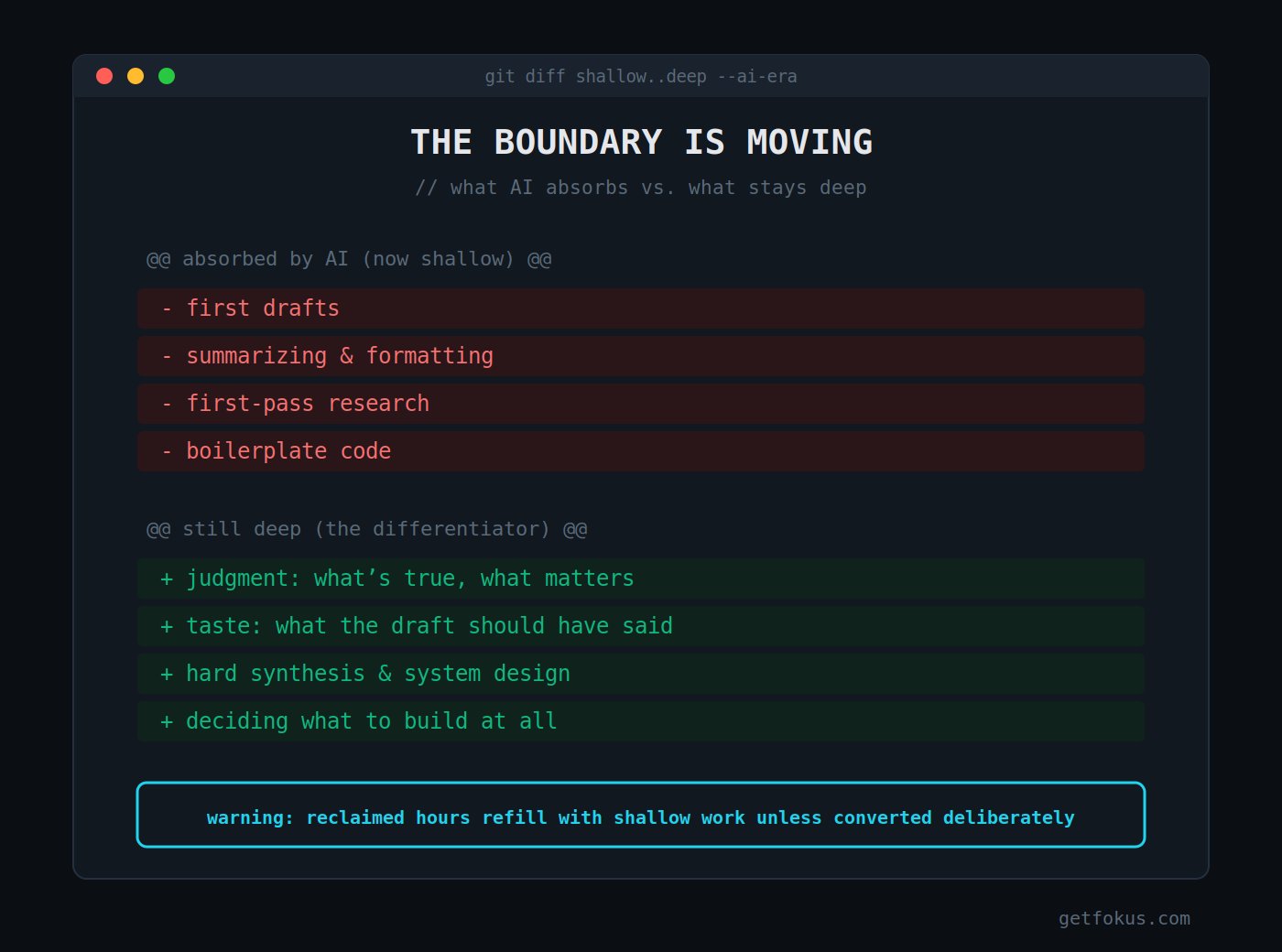
AI moves the boundary. What you do with the reclaimed hours is the new differentiator.
Deep work FAQ
What is deep work in simple terms? Working on one cognitively demanding thing with zero distractions for a sustained stretch — the kind of effort that produces work you couldn’t produce in fragments.
How many hours of deep work per day is realistic? Three to four at the trained maximum; one to two for most people with normal jobs. Consistency beats heroics — five daily 90-minute blocks a week compound into something remarkable.
What are examples of deep work? Writing anything hard, designing a system, debugging a gnarly problem, studying new material, strategic analysis. The test: does an interruption destroy ten minutes of rebuilt context? Then it’s deep.
Is the Deep Work book still worth reading? Yes, with the criticisms above in mind — read it for the argument and the rules, then adapt the implementation to a calendar Newport didn’t have. The pomodoro and flow-state guides here cover the session-level mechanics the book leaves abstract.

Sarah Chen
AI & Product Writer
Sarah explores the intersection of AI, product design, and personal productivity. She writes about how intelligent tools are reshaping the way we work.