How to Prioritize Tasks When Everything Feels Urgent
Get the next article and product update in your inbox
Short product notes, fresh blog posts, and focus systems. No noisy sequence.

The feeling is universal. You open your laptop, and it hits you immediately: a tidal wave of emails, Slack messages, pending project tasks, and the one big, intimidating goal you have been avoiding for days. Your to-do list is no longer a list. It is a backlog where everything looks equally important.
When you hit that state of overwhelm, the default reaction is rarely strategic. Most people either freeze or start knocking out the smallest, easiest, most visible tasks. That creates a brief sense of momentum, but it often leaves the most meaningful work untouched.
For years, professionals have relied on manual systems to create order from this chaos. Those systems still matter, but constant connectivity and information overload expose their limits. At Fokus, we ran into the same problem ourselves. The team was spending too much mental energy organizing work instead of moving it forward.
That led to a better question: what if technology could do more than host a task list? What if it could actively help you prioritize it?
This guide explores the classic principles of prioritization, the psychology that makes it so difficult, and the role AI can play in helping modern professionals focus on what matters.
What prioritization actually means
Prioritizing is not just making a list or color-coding tasks. It is the deliberate act of directing your most limited resource, attention, toward the work that creates the greatest outcome in line with your goals.
In other words, prioritization is a trade-off engine. It is the decision to say no to many reasonable things so that you can say yes to a smaller number of truly meaningful ones.
A well-prioritized day is not necessarily the busiest day. It is the day where the right work gets real time.
Why prioritizing feels so hard
If prioritization feels difficult, that does not mean you are disorganized or undisciplined. It means your brain is dealing with predictable cognitive friction.
Decision fatigue
Your ability to make strong decisions is finite. The more choices you make throughout the day, the more your brain looks for shortcuts. That often means defaulting to whatever is easiest, newest, or loudest instead of what is most important.
The urgency trap
Humans are wired to react to what feels immediate. A new email marked urgent or a Slack ping with a red badge triggers an instant sense that something must be handled now. That creates a feedback loop where quick reactions feel productive even when they do very little for long-term outcomes.
Analysis paralysis
When too many tasks appear equally important, the fear of choosing the wrong one can become its own blocker. Instead of committing to a direction, you drift into avoidance or low-stakes work.
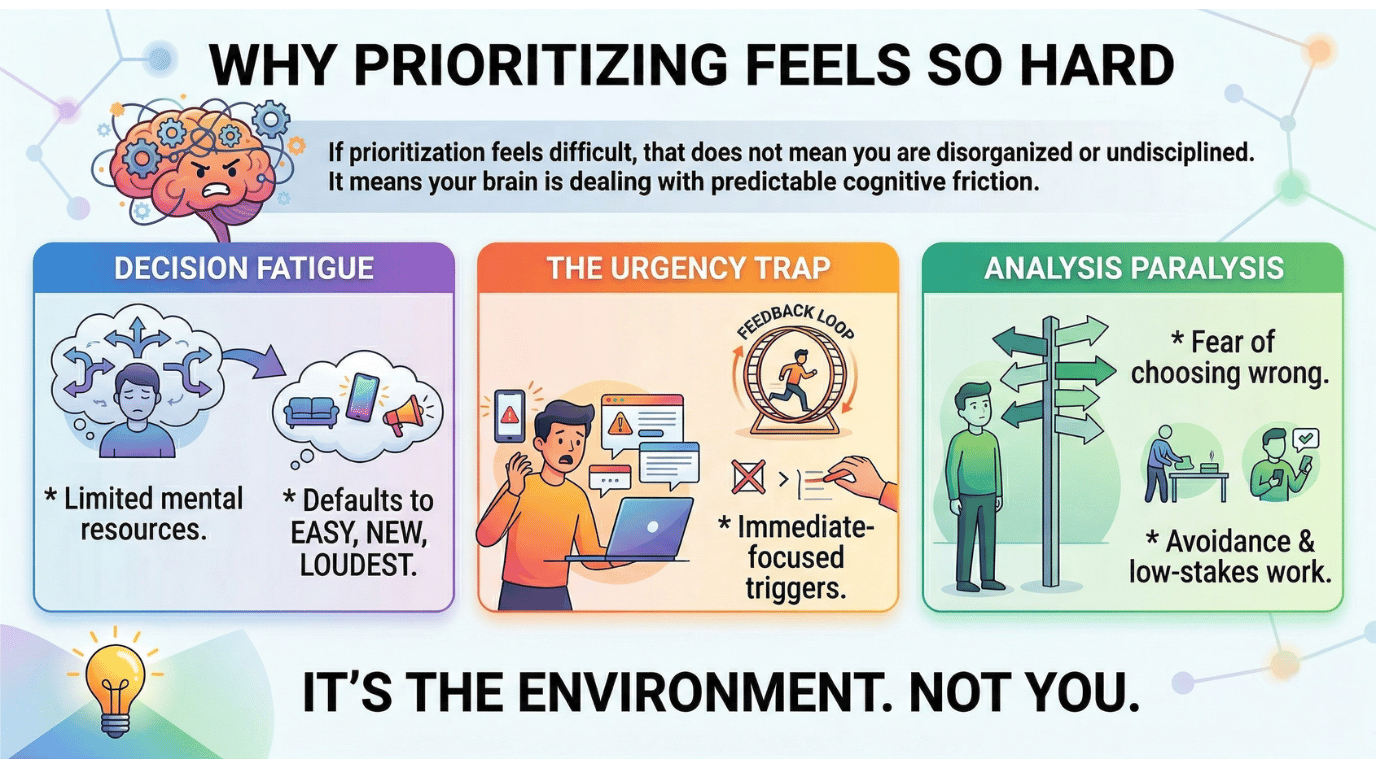
Why prioritizing feels so hard: decision fatigue, urgency-driven reactions, and analysis paralysis all make clear choices harder than they should be.
Understanding these patterns matters because it changes the frame. The problem is not that you are bad at prioritization. The problem is that the environment is optimized for distraction and urgency.
A quick case study: Sarah the project manager
To see how much a prioritization system changes the day, consider a familiar example.
Before: reactive mode
At 8:30 AM, Sarah logs in to 45 unread emails. A designer pings her with a quick question, and half an hour disappears. By 10:00 AM, she finally opens the Q3 report she is supposed to draft, only to get another urgent request from a stakeholder. After lunch, she remembers a meeting she forgot to prepare for. By the end of the day, Sarah has answered dozens of messages and resolved several fires, but the Q3 report is still basically untouched.
She was busy all day. She just was not effective.
After: prioritized mode
At 8:30 AM, Sarah opens her planner before her inbox. She already knows her top three priorities because she identified them the day before. Priority one is drafting section one of the Q3 report. She blocks 90 minutes for it and snoozes Slack. Later, she spends a short window triaging messages, delegating what she can and scheduling the rest. By 5:30 PM, the important project has moved, communication has been handled, and the day feels under control instead of chaotic.
The difference is not time. It is structure.
Four classic prioritization methods worth knowing
These frameworks remain the foundation of effective task management. Even if you eventually use AI to support prioritization, you still need to understand the logic underneath it.
1. The Eisenhower Matrix
The Eisenhower Matrix helps you distinguish between urgency and importance.
Tasks fall into four quadrants:
- Urgent and important: Handle immediately.
- Important but not urgent: Schedule and protect.
- Urgent but not important: Delegate or contain.
- Not urgent and not important: Delete.
This method is especially useful when everything appears urgent on the surface. It forces you to stop asking, “What is shouting the loudest?” and start asking, “What actually matters?”
For a deeper breakdown, see our Eisenhower Matrix guide.
2. The Ivy Lee Method
The Ivy Lee Method is simple and effective. At the end of the day, write down the six most important tasks for tomorrow, rank them, and work them in order the next day.
Its power comes from removing the decision of what to do next. You do not spend the morning negotiating with your list. You start.
3. The Big Rocks method
The Big Rocks idea comes from the jar metaphor: if you fill the jar with sand and pebbles first, the big rocks will never fit.
Your big rocks are the major goals and meaningful projects. The pebbles are routine responsibilities. The sand is the minor admin and constant noise.
The lesson is simple: schedule the important strategic work first, and let the smaller items fit around it. This idea pairs especially well with time blocking.
4. The MoSCoW Method
The MoSCoW Method is ideal for project and team prioritization.
It separates work into:
- Must have
- Should have
- Could have
- Won’t have for now
This is one of the most useful frameworks when multiple stakeholders are all convinced their request is top priority.
If you need a simple decision rule, use the Eisenhower Matrix when urgency is distorting judgment, Ivy Lee when the problem is sequencing, Big Rocks when strategic work keeps getting crowded out, and MoSCoW when competing requests need a shared language.
Why manual prioritization starts to break down
Classic methods are powerful, but they all have the same operational weakness: they are manual.
Every time you sort tasks into quadrants, re-rank a list, or decide what to move after an interruption, you are spending cognitive energy. That is the same energy you need for meaningful work.
This is exactly where AI becomes useful. A modern AI-powered daily planner does more than store tasks. It can analyze deadlines, dependencies, stated goals, and even your personal work patterns to suggest a more realistic order of execution.
Instead of asking you to re-decide everything from scratch each day, it helps answer the highest-friction question in knowledge work: what should I do next?
The practical shift is not from human judgment to full automation. It is from manually re-sorting your workload all day to letting software handle the repetitive planning overhead after you decide what matters.
How Fokus supports smarter prioritization
We built Fokus to act as more than a digital list. The goal was to create a system that helps reduce the overhead of planning itself.
Here is what that looks like in practice:
- Contextual analysis: Fokus does not just see a task title. It sees due dates, estimated effort, related projects, and where that work sits relative to larger goals.
- Pattern recognition: Over time, the system learns when you tend to do your best deep work and can place demanding tasks in those windows.
- Goal alignment: By tying daily work to larger objectives, Fokus helps keep your day connected to the outcomes that matter most.
- Intelligent suggestions: Instead of leaving you alone with a flat list, Fokus can offer intelligent task suggestions to keep momentum on the right work.
A practical weekly prioritization workflow
If you want a system that actually sticks, use this simple weekly rhythm:
- Weekly review: Do a brain dump and capture every task, idea, open loop, and commitment.
- Identify your big rocks: Choose the one to three outcomes that matter most this week.
- Set daily priorities: Each evening or each morning, decide on the top three to five tasks for the next day.
- Schedule the work: A priority without time on the calendar is mostly a wish. Reserve blocks for the important tasks.
- Review and adjust: At the end of the day, check what moved, what slipped, and what needs to shift.
This process works manually. It works even better when a tool helps you connect priorities to actual scheduling.
How to re-prioritize when an emergency hits
Real work is messy. A server goes down. A client escalates something. A family issue changes the day immediately. Good planning is not about eliminating surprises. It is about absorbing them without letting the entire day collapse.
Use the Pause, Assess, Decide model:
- Pause: Do not react instantly just because something feels urgent.
- Assess: Run the new task quickly through the urgent-versus-important lens.
- Decide: Act, delegate, or schedule.
If the interruption is a true crisis, make space consciously and decide what now gets delayed. If it is important but not immediate, acknowledge it and place it later in the day or week.
This is another area where Fokus is useful. Re-prioritization is much easier when your plan can adapt instead of forcing you to rebuild everything manually.
Prioritization at the team level
Individual prioritization is only half the problem. In collaborative environments, the larger risk is misalignment.
Teams stay sane when they have:
- Shared goals: Everyone understands the quarter’s big rocks.
- Visible priorities: Work is labeled clearly and consistently across tools.
- A shared definition of urgent: Not every request deserves emergency treatment.
Without that alignment, every individual can optimize locally while the team still loses globally.
Take control with intelligent prioritization
Feeling overwhelmed is not a permanent condition. If you want a system that helps sort, rank, and schedule your work with less manual overhead, try Fokus.
Start using Fokus for free and experience what a clearly prioritized day feels like.
Frequently asked questions about prioritization
What is the best method for prioritizing work?
There is no universal best method. The Eisenhower Matrix is great for sorting overload, Ivy Lee is excellent for daily focus, Big Rocks is strong for long-term alignment, and MoSCoW works well for collaborative planning. The best method is the one that matches your real workflow and gets used consistently.
How do you prioritize when everything seems urgent?
Start by challenging the assumption. Most overloaded lists mix real urgency with loud but low-value work. Use a framework like Eisenhower or MoSCoW to force clearer distinctions, then rank by consequence: what creates the biggest downside if left undone?
What is the difference between urgent and important?
Urgent tasks demand immediate attention. Important tasks contribute to long-term goals, outcomes, and values. The most effective people do not ignore urgent work, but they avoid letting urgency define the whole day.
How can I stop procrastinating on important tasks?
Break the task into a smaller first step, reduce the friction to begin, and use methods like Ivy Lee or Eat the Frog to make the decision once in advance. Procrastination is often a response to ambiguity or overwhelm, not laziness.
Your path to focused work
The goal of prioritization is not to create a rigid schedule that cannot survive the real world. It is to build a reliable system that cuts through mental fog, reduces decision fatigue, and helps you invest time with intention.
Once you understand the psychology behind overwhelm, learn the core frameworks, and start using intelligent tools to support the process, the day stops feeling like a stream of interruptions and starts feeling like something you can actually direct.
That shift, from reactor to architect, begins with one good priority decision.

Nadia Amari
Focus & Well-being Writer
Nadia writes about mindful productivity, work-life balance, and the science of focus. She believes the best tools should help you do less, better.