The 80/20 Rule: Find the 20% of Work That Matters
Get the next article and product update in your inbox
Short product notes, fresh blog posts, and focus systems. No noisy sequence.

The 80/20 rule says that a small share of causes produces a large share of results — roughly 80% of your outcomes from roughly 20% of your efforts. It’s probably the most quoted idea in productivity, and one of the least applied: everyone can recite it, almost nobody can name their own 20%. That’s the gap this guide closes. Quick tour of what the rule actually claims (and the misconceptions that quietly break it), then the part that’s hard to find anywhere: a concrete weekly routine for identifying your vital few tasks, and what to do with the 80% you’re supposed to care less about — which is where most advice gets hand-wavy and most people get stuck.
Where it comes from, what it claims
Around 1896, Italian economist Vilfredo Pareto noticed that about 80% of Italy’s land belonged to about 20% of its population — and that the same lopsided pattern kept appearing in other data. Decades later, management consultant Joseph Juran generalized it into a management principle: in most systems, a “vital few” causes drive most of the results, while the “trivial many” contribute little each. He applied it to quality defects; it has since shown up in revenue (a minority of customers producing most sales), software (a minority of bugs causing most crashes), and — the version we care about — work, where a minority of your tasks produce most of your impact.
The honest caveat: this is an observed pattern, not a law of physics. Your split might be 70/30 or 90/10, and nobody audits whether the ratio is exact. The claim that survives every version is the one that matters: effort and impact are not proportional. Some hours you work are worth twenty times other hours, and your calendar treats them identically.
The misconceptions that break the rule
“80 + 20 must equal 100.” No — the numbers describe two different things (share of causes, share of effects) and don’t need to sum to anything. 30% of your tasks could drive 90% of your results.
“So I should only do 20% of my work.” The rule is a sorting insight, not a deletion order. Plenty of low-impact work is still mandatory — payroll compliance produces no outsized wins and must still happen. The correct conclusion is about sequence and protection, not abandonment.
“The 20% is obvious.” It’s reliably not, because the high-impact work is usually quiet — it doesn’t ping you, nobody chases you for it, and it often feels harder than the busy work. Urgency is loud and impact is silent, which is exactly the mere-urgency trap: we chase deadlines over value unless something forces the comparison. That’s why finding your 20% takes an actual exercise, not a vibe.
Finding your 20%: a weekly routine
Thirty minutes, once a week. Friday afternoon works.
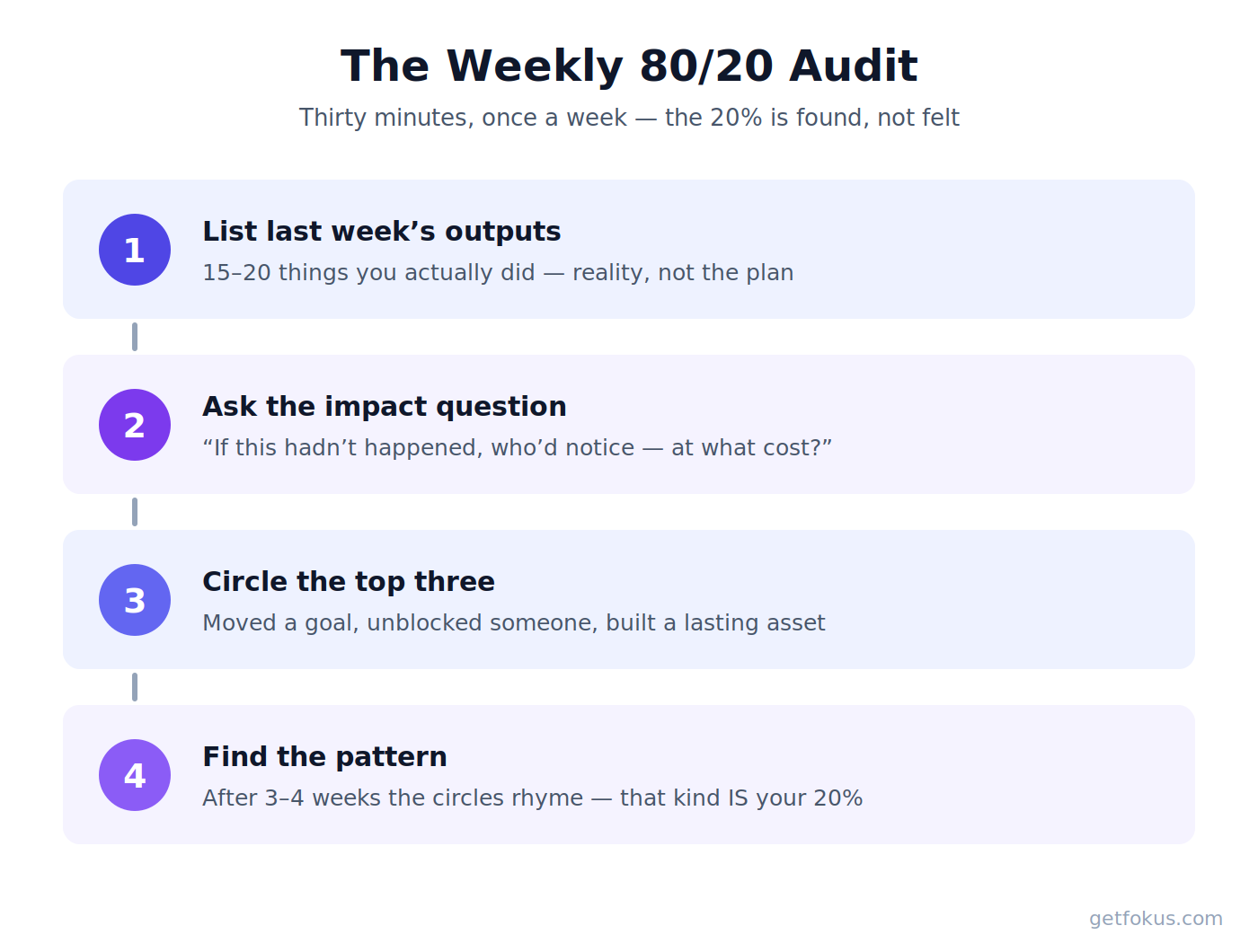
1. List last week’s outputs — the fifteen or twenty things you actually did, from memory and calendar. Not the plan; the reality.
2. Ask the impact question of each: if this hadn’t happened, who would have noticed, and what would it have cost? Be brutal. Most items score “nobody, nothing” — that’s normal, not shameful.
3. Circle the top three. The items that moved a goal, unblocked a person or a decision, or built something that keeps paying (a doc, a system, a relationship). That’s last week’s 20%.
4. Look for the pattern. After three or four weeks, your circles rhyme — the same kind of work keeps showing up: prep before decisions, deep work on the core project, certain conversations. That recurring kind is your personal 20%. Now flip it forward: next week’s plan should schedule that kind first, prioritized properly (a five-minute ABCDE pass or the priority methods here both work), before the trivial many book your best hours.
The 20% is found by audit, not intuition — and it rhymes week to week.
Protecting the 20% (this is where it falls apart)
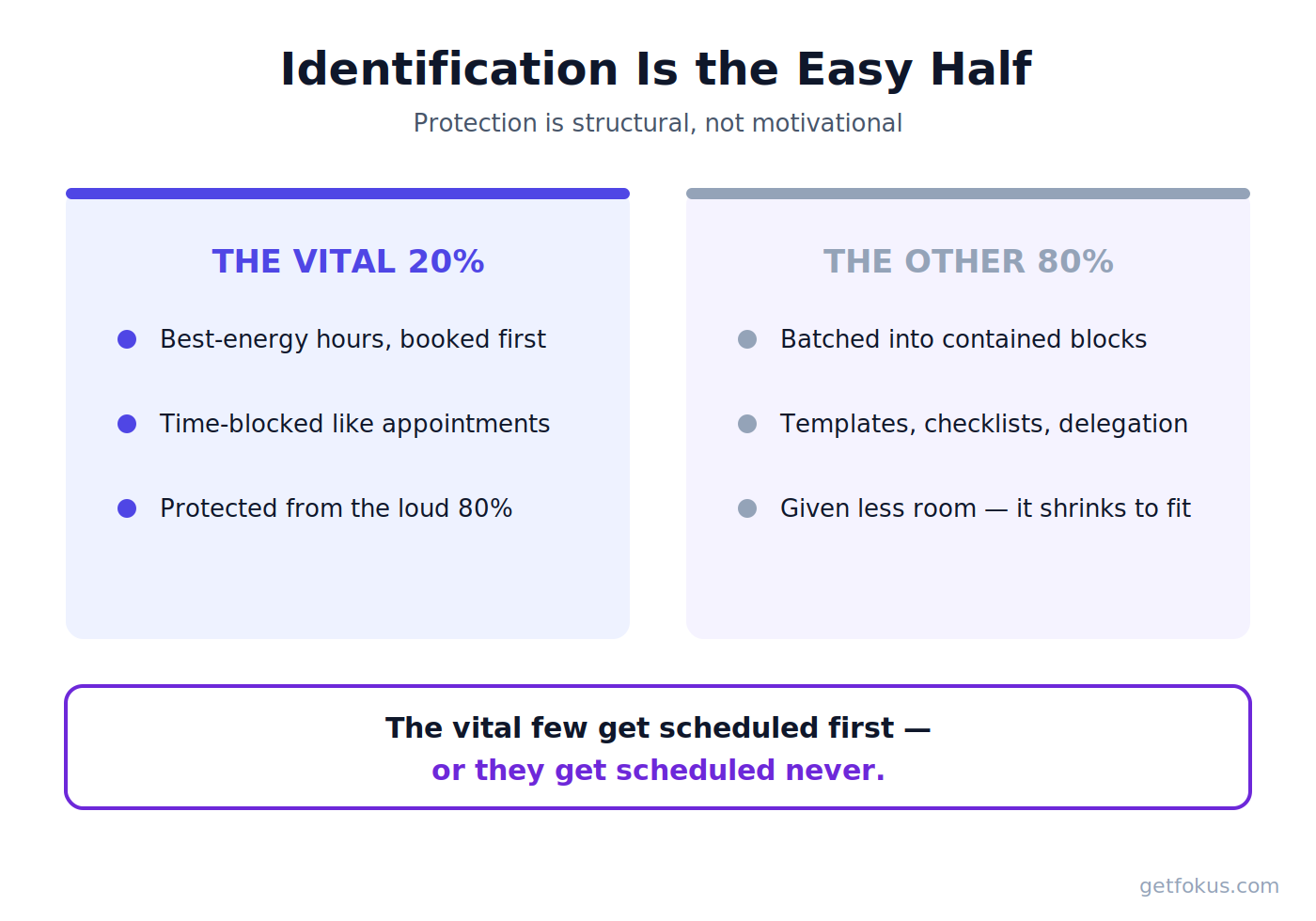
Knowing your vital few changes nothing by itself, because insight doesn’t survive contact with an open calendar. The 80% is aggressive: it arrives by email, pings you on Slack, and books itself into meetings. The 20% just waits. So protection has to be structural:
- Give the vital few your best block. Identify your peak-energy hours and reserve them for 20% work via time blocking — the rule tells you what deserves deep time, blocking decides when. The two techniques are halves of one system.
- Compress the trivial many. Batch the shallow work into contained blocks, use templates and checklists for what recurs, delegate what someone else can do at 80% of your quality, and let genuinely optional low-impact work die politely. Parkinson’s law works for you here: give the 80% less room and it shrinks to fit.
- Re-run the audit forever. Your 20% drifts as projects and roles change. The weekly half hour is the maintenance contract.
This is also the design bet behind Fokus: its smart scheduling exists because the protection step is the one humans reliably fumble — tasks carry priorities, and the engine places the high-priority few into your good hours before the trivial many can fill them, then re-plans when meetings overrun instead of letting the 20% silently fall off the day. Whether software or a paper planner does it, the principle stands: the vital few get scheduled first, or they get scheduled never.
Identification is the easy half. Protection is structural, not motivational.
A team lens: the 80/20 conversation
Applied solo, the rule optimizes your week. Applied to a team, it gets more valuable and more delicate. Most teams have never explicitly agreed on which 20% of their work drives their results — run the audit exercise together once and the misalignment surfaces fast: half the room protects reports that the other half never reads. Two warnings from the trenches. First, don’t weaponize it — “that’s 80% work” lands as an insult when someone owns that work; frame it as sequencing, never worth. Second, remember that some “trivial many” work is load-bearing glue — onboarding, documentation, code review. The audit question for shared work isn’t “does this feel impactful,” it’s “what breaks, and when, if this stops?” Some things pass that test easily and still deserve compression rather than deletion.
80/20 rule FAQ
What is the 80/20 rule in simple terms? Results aren’t spread evenly across efforts: a small share of what you do (roughly 20%) produces most of what you get (roughly 80%). Find that small share and give it your best time.
What are examples of the 80/20 rule in real life? A minority of customers generate most revenue; a minority of bugs cause most crashes; a few of your weekly tasks create most of your impact; a few relationships provide most of your support. The ratios vary — the lopsidedness is the point.
Is the 80/20 rule scientifically proven? It’s a robust empirical pattern across economics, business, and software — not a precise law. Treat the numbers as a caricature of a true thing: effort and impact are disproportionate.
How do I apply the 80/20 rule to time management? Weekly: audit last week’s outputs, identify the few with outsized impact, schedule that kind of work into your peak hours first, and compress or batch the rest. Pair it with a prioritization method and time blocking — the rule is a lens, not a schedule.

James Okafor
Team Collaboration Writer
James focuses on remote work, team dynamics, and collaboration strategies. He brings firsthand experience leading distributed teams across four continents.