How to Stop Procrastinating: A System, Not a Pep Talk
Get the next article and product update in your inbox
Short product notes, fresh blog posts, and focus systems. No noisy sequence.

Almost everything written about how to stop procrastinating is either a pep talk or a shame session. Neither works, because procrastination was never a motivation problem — decades of research agree it’s an emotion regulation problem. You don’t delay the report because you’re lazy; you delay it because starting it feels bad, and delay is the fastest way to feel better. For about ninety seconds.
So this guide skips the motivational speech. It covers why your brain does this, the four causes with a matching fix for each, where the famous 2-minute rule genuinely helps (and where it quietly fails), and the part most articles never reach: a system that removes the decision to start — because the decision is where procrastination lives.
Why you procrastinate (it’s not laziness)
Princeton’s McGraw Center makes a point most productivity writing ignores: procrastinators often work intensely — just late. That’s not laziness; laziness doesn’t pull all-nighters. What’s actually happening is self-protection. If you start late and the result is mediocre, the story is “imagine if I’d had time.” Your ability was never really tested. Add fear of evaluation, and delay becomes a defense of your self-image, not a scheduling error.
That reframe matters practically: if procrastination is emotional, then calendar apps, deadlines, and discipline lectures all miss the target unless they change how starting feels. Every fix below works on exactly that.
The 4 causes of procrastination — and the fix for each
Researchers converge on four properties that make a task procrastination-bait. Diagnose which one is yours; the fixes don’t interchange.
1. Aversiveness — the task feels unpleasant. Fix: shrink the exposure. Commit to ten focused minutes with a hard stop (a single Pomodoro works). Aversion is front-loaded; ten minutes in, the task is nearly always smaller than it looked.
2. Ambiguity — you don’t know what “start” means. “Work on the proposal” is unstartable; “list the three sections in a blank doc” is not. Fix: never leave a task on your list without a concrete next action. This is the single highest-leverage habit in this article.
3. Fear of evaluation — perfectionism. The task is startable; the judgment isn’t. Fix: separate making from judging. Draft ugly on purpose, schedule the editing pass as its own block, and remember that shipped-and-flawed outranks perfect-and-imaginary every time it’s been measured.
4. Distant rewards — the payoff is weeks away. Brains discount future rewards steeply (the technical term is temporal discounting). Fix: import the deadline. Break the project into weekly deliverables someone actually sees — a colleague, a client, a review block on your own calendar.
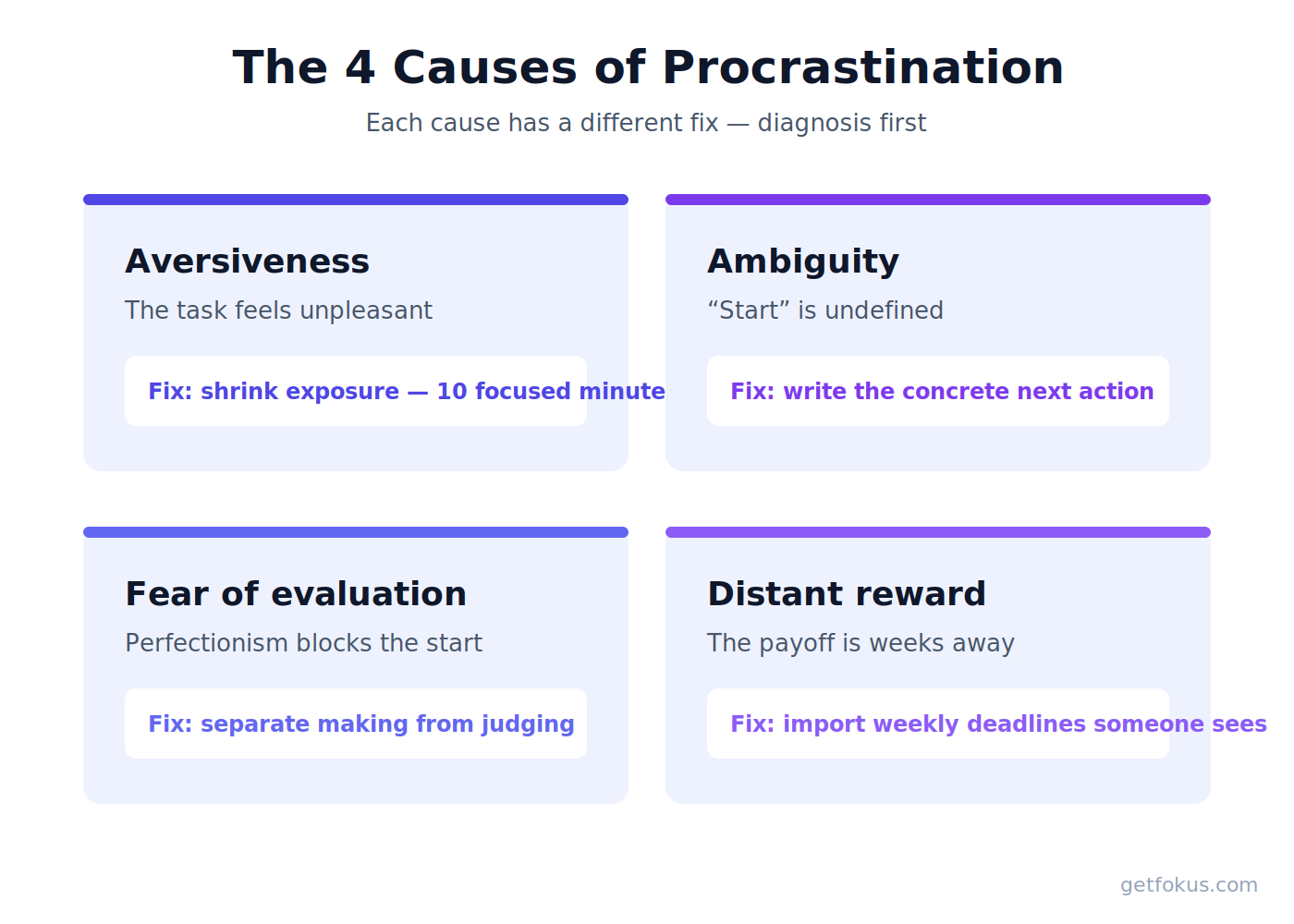
Four causes, four different fixes. Diagnosis first.
The 2-minute rule — and when it fails
James Clear’s 2-minute rule says: scale any habit down until starting takes less than two minutes. Read one page. Open the notes. Unroll the yoga mat. It works because it attacks cause #1 and #2 at once — the exposure is tiny and the action is concrete.
Where it fails is worth being honest about. The rule gets you started; it says nothing about what happens when the two minutes end and the real, aversive middle of the task begins. And for cause #3 — perfectionism — it can even backfire: opening the document was never the problem; being judged on its contents was. Use the rule as a door, not a room: pair it with a scheduled block so that once you’re in, the next 45 minutes are already decided.
Make starting automatic: put it on the calendar
Here’s the pattern behind every fix above: procrastination happens in the gap between intending and starting — the moment you ask “should I do this now?” and your brain, quite reasonably, answers “later.” The system that works is the one that deletes the question.
Research on implementation intentions is unambiguous: people who decide when and where they’ll act follow through at dramatically higher rates than people with identical intentions and no schedule. In practice that means time blocking: the report isn’t “on your list,” it’s Tuesday 9:00–10:30. When the block starts, there’s nothing to decide — deciding was done on Sunday, by a calmer version of you.
Three details make it stick:
- Put the frog in your best hours. The task you’re most likely to dodge goes in your peak-energy block, first — before the day’s willpower is spent. Prioritize honestly first (ABCDE takes five minutes).
- Buffer 15–20%. An over-packed plan dies by 11am, and a dead plan is procrastination’s favorite excuse.
- Batch the escape hatches. Email and messages are where avoided tasks go to hide. Batch them into their own blocks and the hiding place closes.
This is also, frankly, why we built Fokus the way we did: its smart scheduling takes tasks with priorities and deadlines and places them into real calendar blocks itself — and re-plans when a meeting overruns. For a procrastinator, that automation removes the two most dangerous moments: deciding when to start, and re-deciding after the plan breaks. Whether you use software or a paper planner, the principle is identical: the schedule decides, so you don’t have to.
Can you “rewire your brain” to stop procrastinating?
Sort of — but not the way the phrase suggests. There’s no switch to flip; what changes is associations and defaults. Every time starting a task turns out less painful than predicted, your brain updates its forecast slightly. Every scheduled block you keep makes the next one feel more normal. That’s real neuroplasticity, and it’s boring: repetition of small starts, not a mindset breakthrough. Two useful accelerants: keep a visible streak of “days I started the hard thing” (identity evidence), and do a 60-second reflection after each kept block — predicted pain vs. actual — because noticing the gap is what retrains the forecast.
Procrastination and ADHD
If your procrastination comes with time blindness, task-initiation paralysis even for things you want to do, and hyperfocus once started, the standard advice needs adjusting — the barrier is executive function, not avoidance. What tends to help: external cues instead of internal intentions (alarms as block-starts), body doubling, much smaller task grains, and generous 25–30% buffers so one missed block doesn’t cascade into “the day is ruined.” If delay is severely affecting work or study across years, that’s a conversation worth having with a professional rather than a productivity blog.
How to measure progress (streaks beat feelings)
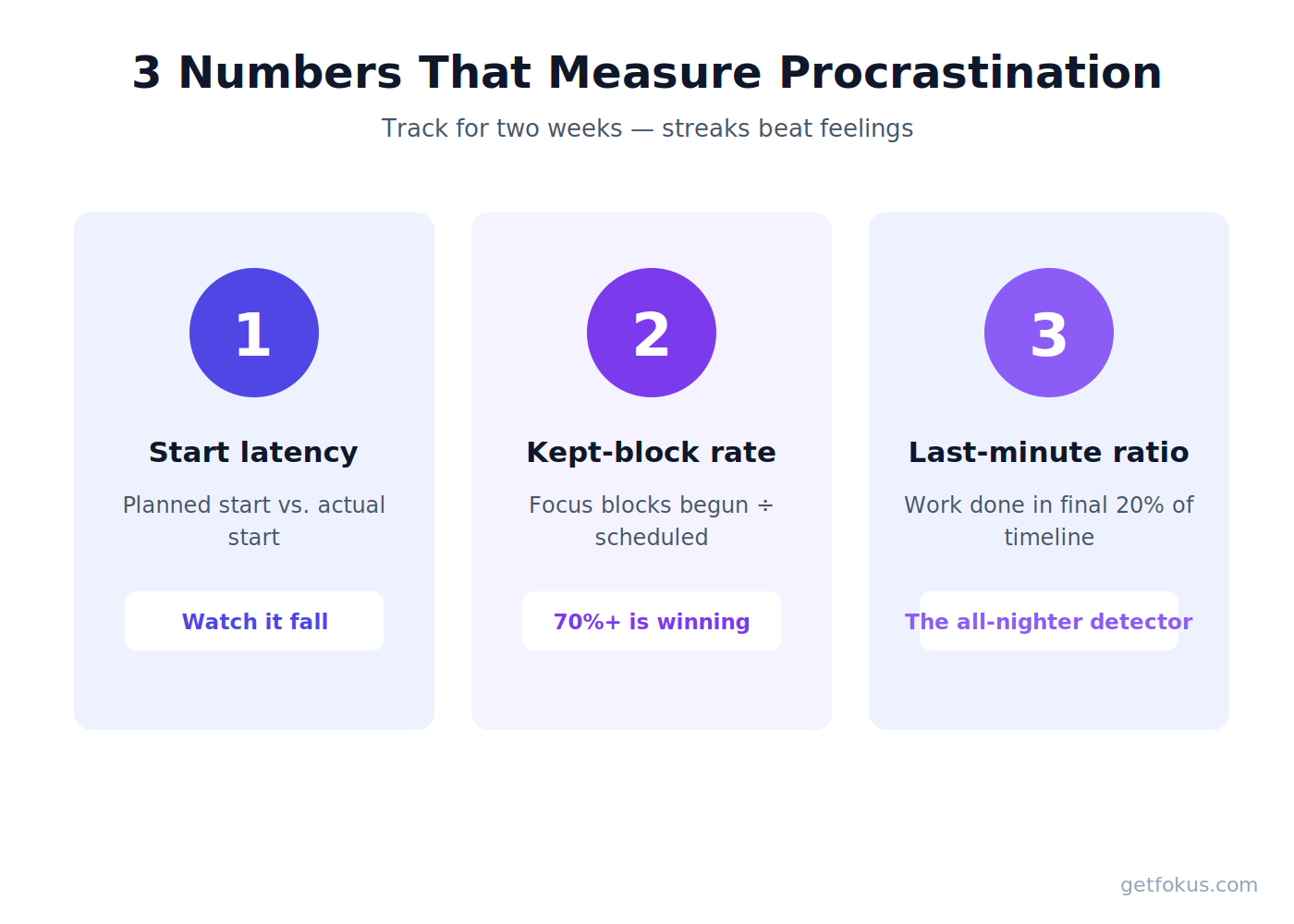
The three numbers that tell you whether the system is working.
Perfection is the wrong metric — you’ll procrastinate sometimes forever, like everyone. Track these instead for two weeks:
- Start latency — planned start vs. actual start on your hardest daily task. This is the procrastination number; watch it fall.
- Kept-block rate — scheduled focus blocks you actually began ÷ scheduled. 70%+ is winning.
- Last-minute ratio — how much of a project happened in the final 20% of its timeline. The all-nighter detector.
FAQ
How do I stop myself from procrastinating right now, today? Pick the avoided task, write its next concrete action, set a timer for ten minutes, and start with the door closed and the phone in another room. Nothing else on this page works until something has been started once.
What is the 2-minute rule for procrastination? Shrink the start of any task below two minutes (open the doc, write one sentence). It defeats the starting barrier — pair it with a scheduled block to survive the middle.
Is procrastination a mental illness? No — it’s a near-universal human behavior. It can co-occur with ADHD, anxiety, or depression, and chronic life-disrupting delay deserves professional support rather than productivity tips.
Does time blocking really help procrastinators? It’s the single most protective structure, because it moves the start decision out of the moment of temptation. The full guide is here.

Nadia Amari
Focus & Well-being Writer
Nadia writes about mindful productivity, work-life balance, and the science of focus. She believes the best tools should help you do less, better.