The Pomodoro Technique: 25/5 Is a Start, Not a Rule
Get the next article and product update in your inbox
Short product notes, fresh blog posts, and focus systems. No noisy sequence.

The Pomodoro Technique is the most famous focus method in the world, and almost every article about it repeats the same five steps and stops. Set a timer for 25 minutes, work, take a 5-minute break, repeat, long break after four. True, and not enough: the interesting questions are the ones the five steps don’t answer. Why does a kitchen timer work on a brain? When is 25/5 exactly wrong? What do you do with interruptions you can’t refuse? And how do pomodoros relate to the calendar where your actual day lives? This guide covers the basics quickly, then spends its time where the other articles end.
The technique in ninety seconds
Francesco Cirillo developed the method as a struggling university student in the late 1980s, using a tomato-shaped kitchen timer — pomodoro is Italian for tomato. The loop: pick one task, set a timer for 25 minutes, work on only that until it rings, mark a checkmark, take a 5-minute break; after four pomodoros, take a longer 15–30 minute break. Two supporting rules do more work than they appear to: a task bigger than four pomodoros gets broken down, and tasks smaller than one get batched together. And the rule everyone forgets — a pomodoro is indivisible. If it’s interrupted, it doesn’t count. That sounds harsh, but it’s the mechanism that makes the technique train focus instead of merely measuring it.
Why a kitchen timer beats willpower
Three reasons the trick works, none of them magic. First, it shrinks the start: committing to 25 minutes is psychologically cheap compared to “write the report,” which is why the technique is a first-line fix for procrastination — aversion lives at the beginning of tasks, and the timer buys you past the beginning. Second, the ticking clock makes time visible. Half the pain of focus work is that time is abstract; a countdown turns “working” into a bounded, finishable unit. Third, the enforced break interrupts the slow fatigue slide you don’t notice until 3pm — you rest before you’re spent, which is why four good pomodoros often outproduce an unbroken three-hour grind.
When 25/5 is the wrong interval
Here’s the part the purists skip: 25 minutes is an accident of what Cirillo’s kitchen timer looked like, not a law of cognition. The interval is a variable, and it should fit the work — our free pomodoro timer lets you set all three intervals and keeps your task list next to the clock.
- 25/5 fits shallow-to-medium work, task batches, studying with review breaks, and anyone currently unable to focus for 25 minutes (that’s the training-wheels case — the technique builds stamina).
- 50/10 fits work with real setup cost — writing, analysis, design. If you need ten minutes to load a problem into your head, a 25-minute block gives you fifteen useful minutes. Doubling the interval halves the reload tax.
- 90/20 fits deep work that reaches flow. A timer that fires mid-flow isn’t protecting focus, it’s taxing it. If you regularly hit the 25-minute bell annoyed, that’s not failure — that’s a signal you’ve outgrown the interval for this kind of work. Lengthen it deliberately; keep short intervals for the work that deserves them.
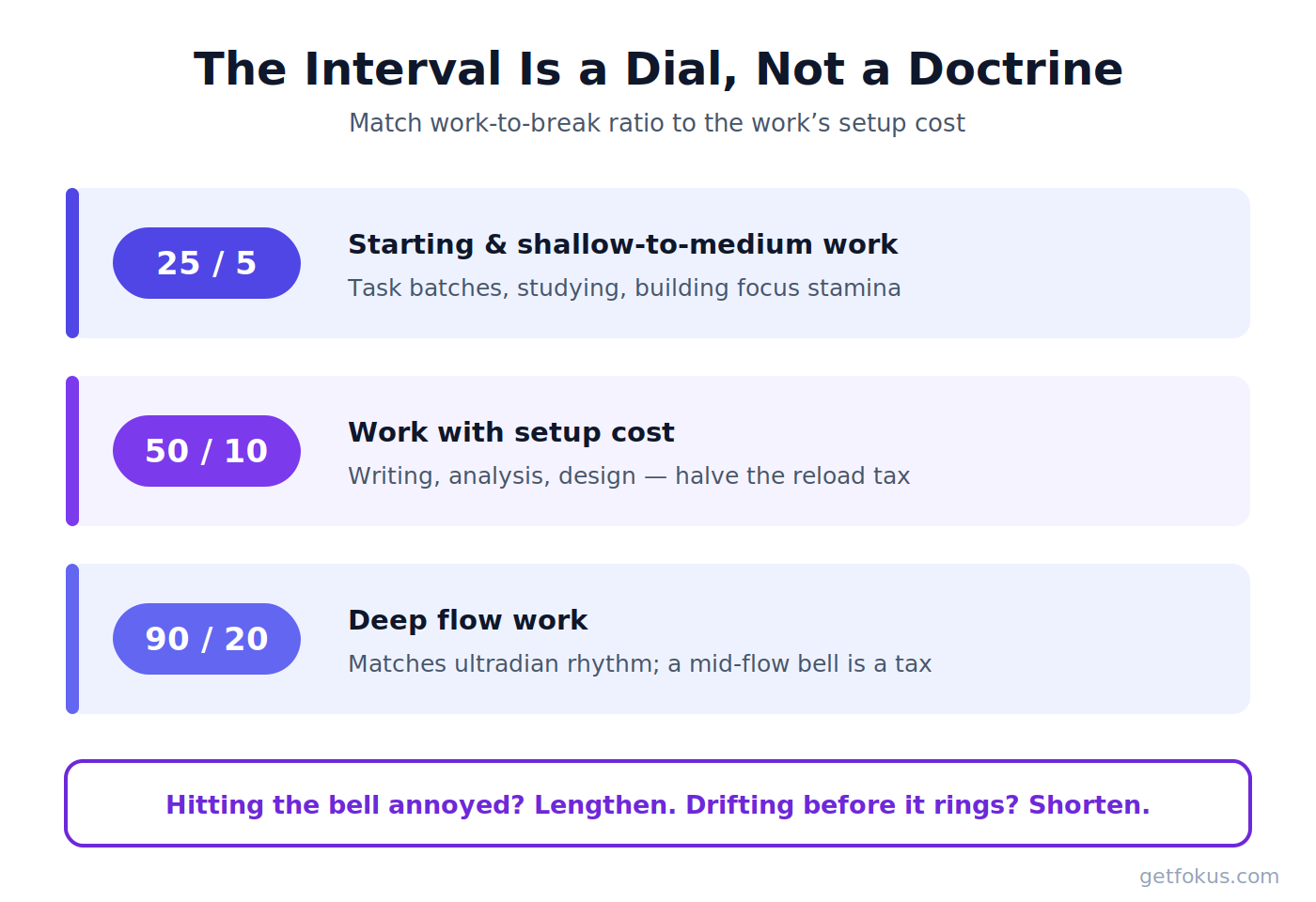
The interval is a dial, not a doctrine. Match it to the work’s setup cost.
One warning in the other direction: don’t promote yourself to 90-minute blocks because 25 feels beneath you. If your last three “90-minute sessions” were 60 minutes of focus and 30 of drift, drop back down. The bell you slightly resent is the one that’s working. And whatever the interval, the break is not optional — skipping breaks is how the technique degrades back into the grind it was designed to replace. Breaks mean stand up, water, window; not email. Email isn’t a break, it’s a context switch with a tax.
The interruption protocol nobody teaches
Cirillo’s original method includes a piece almost every summary drops, and it’s the piece working adults need most. Interruptions come in two kinds. Internal — you suddenly remember an email, want to check something, crave a coffee. The protocol: write it down on a capture sheet and keep going. The urge, once captured, usually dies; you handle survivors in the break. External — a colleague, a message, a call. The protocol is inform-negotiate-callback: “I’m mid-block, can I come to you at 11:30?” Most interruptions accept a 20-minute delay without complaint. A pomodoro that gets truly broken doesn’t count — restart it later, don’t resume it. Strict? Yes. But the count only means something if a checkmark always equals one unbroken block, and the daily count is the single most useful focus metric you can track.
Pomodoros need a calendar (the missing layer)
The technique’s biggest silence: it tells you how to focus but not when or on what. Pomodoros are a unit — something else has to lay them into your day, or you’ll run beautiful 25-minute sessions on work that never deserved the time. That something is time blocking: first prioritize the list (a five-minute ABCDE pass works), then reserve calendar blocks for the priorities, then run pomodoros inside the blocks — a 2-hour deep block holds two 50/10s; an admin block holds a batch of 25/5s. Estimating tasks in pomodoros (“this report is about six”) also fixes the chronic underestimating that wrecks daily plans.
This layering is exactly how we think about it in Fokus: the smart scheduling engine does the laying-in — tasks with priorities and durations become real calendar blocks around your meetings, re-planned when the day breaks — and the timer runs inside those blocks. Method and calendar stop being two systems you reconcile by hand. Paper timer and paper planner work too; what matters is that the unit of focus lives inside a schedule, not instead of one.
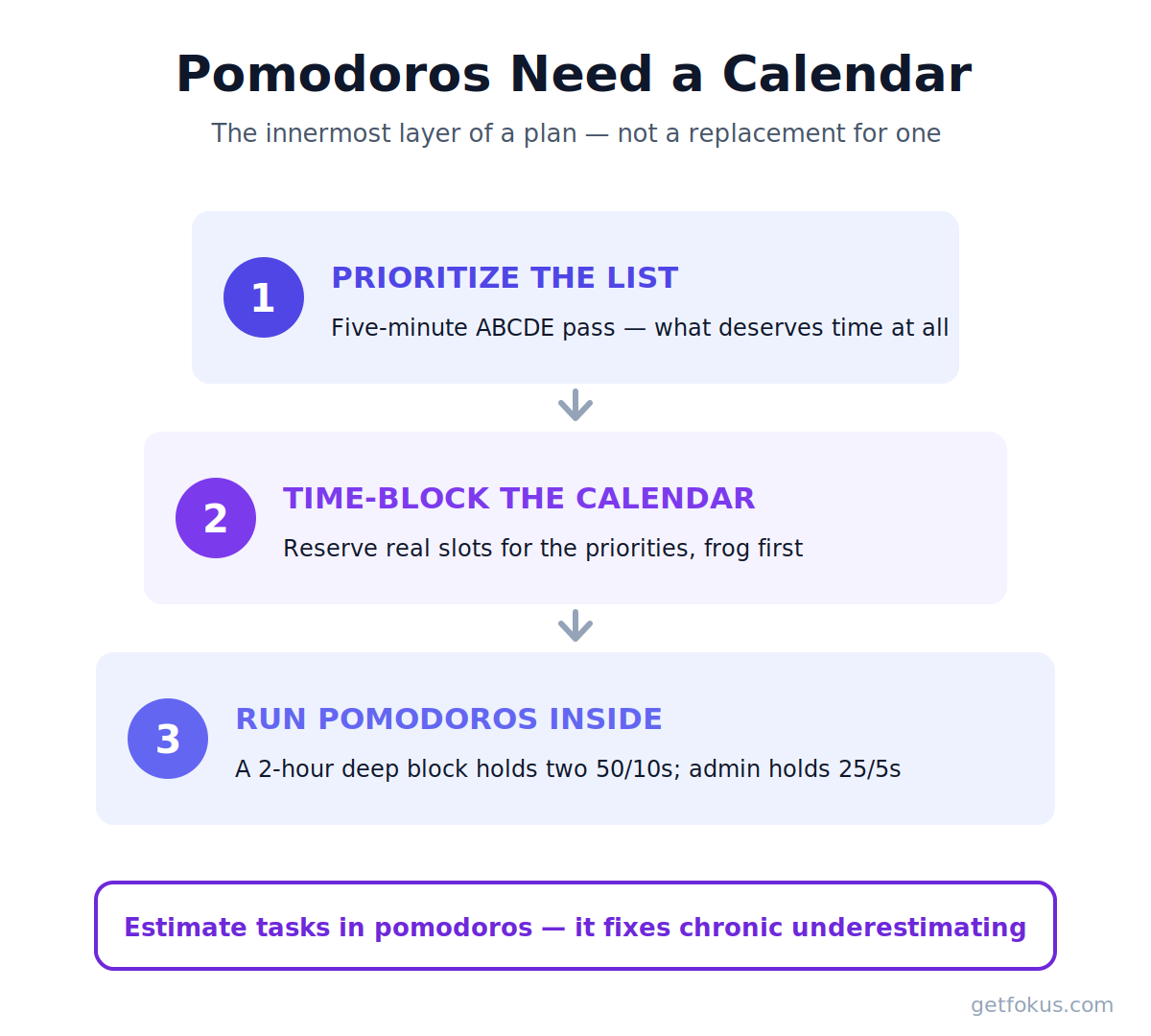
Pomodoros are the innermost layer of a plan, not a replacement for one.
Pomodoro and ADHD
Asked constantly, answered rarely. The technique’s bones are ADHD-friendly: external structure instead of internal discipline, visible time (a countdown makes time concrete, which helps with time blindness), a small start, and scheduled novelty every half hour. But standard advice needs tuning. Interval by task-type, not by rule — many people with ADHD do better with 10–15 minute intervals for aversive tasks and longer ones for hyperfocus work, because a bell mid-hyperfocus is genuinely costly. Use a visual timer where you can see the disc shrink. Make breaks physical and screen-free — a phone break reliably eats the next pomodoro. And put the capture sheet on paper, because for a wandering attention system, writing the intrusive thought down is the difference between a blip and a forty-minute detour. If focus struggles are wrecking work or study long-term, that’s a conversation for a clinician, not a timer.
Pomodoro Technique FAQ
What is the Pomodoro Technique? A time management method: work in focused, timer-bounded intervals (classically 25 minutes) separated by short breaks, with a longer break every four intervals. One interval = one “pomodoro.”
What is the 90/20 rule? A long-form variant — 90 minutes of deep work, 20 of real rest — matched to the brain’s natural ultradian rhythm of alertness. Use it for flow work; it’s overkill for email.
Which is better, 25/5 or 50/10? Neither, universally. 25/5 for starting, shallow work, and building stamina; 50/10 for work with setup cost. Most people end up running both in the same day for different blocks.
Is Pomodoro good for ADHD? Often, with adaptations: shorter intervals for aversive tasks, longer for hyperfocus, visual timers, physical breaks, and a paper capture sheet for intrusive thoughts.
What are the disadvantages of the Pomodoro Technique? The bell can interrupt flow, 25 minutes misfits deep work, strict rules can turn into rigidity, and the method says nothing about priorities — pair it with a prioritization method and a calendar, or you’ll focus flawlessly on the wrong things.

Lina Hayek
Productivity & Workflow Writer
Lina writes about time management, deep work, and building sustainable routines. She has helped thousands of professionals rethink their relationship with productivity.