SMART Goals: The Acronym Is Easy. Execution Isn't.
Get the next article and product update in your inbox
Short product notes, fresh blog posts, and focus systems. No noisy sequence.

Every SMART goals article walks you through the same five letters — Specific, Measurable, Achievable, Relevant, Time-bound — hands you a tidy example about running a 5K or growing app signups, and stops. Which is exactly where the real problem starts. Nobody fails at goals because they couldn’t expand an acronym; they fail in the gap between a well-written goal and an ordinary Tuesday. So here’s the short version of the acronym, an honest section on when SMART doesn’t work (a question people are increasingly right to ask), and then the part the other guides skip: the execution layer that turns a quarterly sentence into weekly calendar blocks.
The acronym in two minutes
SMART dates to a 1981 management paper by George Doran, and its five tests are genuinely useful filters for vague ambition:
- Specific — what exactly, who’s involved, what does done look like? “Get fit” fails; “run a 5K” passes.
- Measurable — what number tells you you’re moving? If nothing is countable, you’ll argue with yourself about progress forever.
- Achievable — possible with your actual resources, not your fantasy January self. A goal you privately don’t believe is a goal you quietly stop working toward.
- Relevant — connected to something bigger you want. Irrelevant goals lose every scheduling conflict against real priorities.
- Time-bound — a deadline. Without one, Parkinson’s Law eats the goal: work — and goals — expand to fill unlimited time.
A worked example, workplace edition: “improve customer response” becomes “cut median first-response time from 9 hours to 4 by end of Q3 by introducing a triage rota and canned answers for the top 10 ticket types.” Specific, countable, plausible, tied to retention, deadlined. That’s the whole trick — and it’s maybe ten percent of what determines whether it happens.
Where SMART honestly fails
The backlash to SMART is real and partly deserved, so let’s not pretend otherwise.
SMART describes a goal, not a system. It’s a formatting standard. A perfectly formatted goal with no execution mechanism is a well-labeled wish — which is why the acronym has such a graveyard of Q1 corpses behind it.
“Achievable” breeds timidity. Teams optimize for hitting the number, so the number shrinks. If every goal lands at 100%, your goals are too small; ambitious cultures (this is the OKR crowd’s core critique) deliberately set targets where 70% is a win. Decide which game you’re playing before you write the number.
Output metrics tempt you to game them. “Close 20 tickets” produces fast, sloppy closes. Measure the outcome you want (response time, satisfaction), not the activity that approximates it.
SMART is silent on “how many.” Five SMART goals at once means zero goals in practice. One to three per period, ruthlessly — the 80/20 lens exists precisely to make that cut.
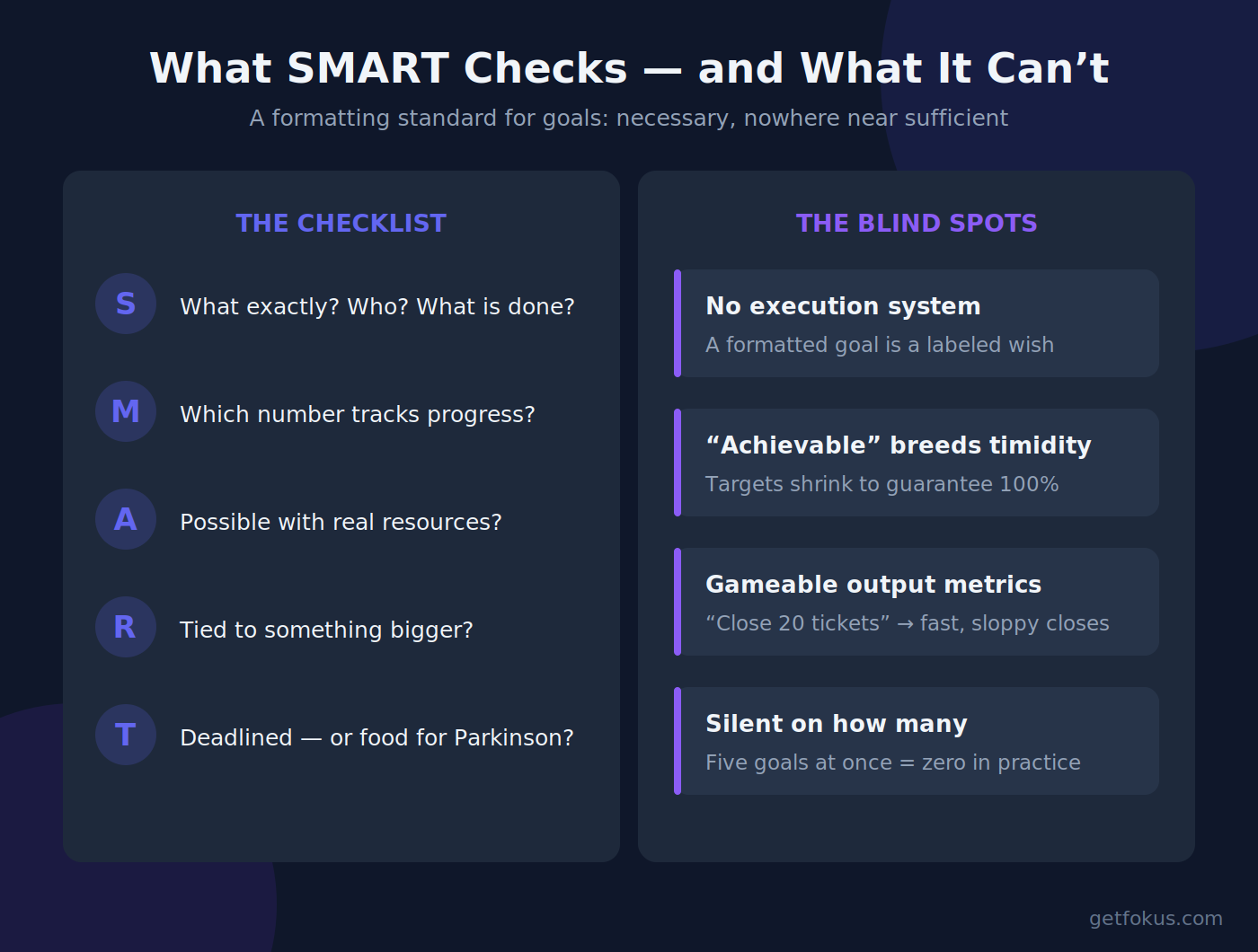
SMART is a formatting standard for goals — necessary, and nowhere near sufficient.
The missing layer: goal → week → day
Here’s the mechanism the listicles never build. A quarterly goal has to survive twelve ordinary weeks, and it only survives if something forces it into each of them.
Step 1: Slice the goal into weekly deliverables. Not “make progress on the response-time project” — a deliverable: “triage rota drafted,” “top-10 ticket types identified,” “canned answers written for 5 of 10.” If you can’t slice it, you don’t understand the goal yet; slicing is the planning.
Step 2: Give the slice a weekly appointment. During weekly planning, the week’s slice goes onto the calendar as real time blocks — before the week fills with everyone else’s requests. Goal work is important-but-never-urgent, which means it loses every open-ended scheduling fight. It only wins fights that were decided in advance.
Step 3: Review weekly, adjust monthly. Five minutes at week’s end: did the slice ship, and what does that say about the pace? Miss two weeks running and the goal doesn’t need more motivation, it needs surgery — smaller slices, a later deadline, or an honest kill. A goal you’re allowed to revise is a plan; a goal you’re not allowed to revise is a slow-motion guilt machine.
This layer is also where we’ve aimed Fokus: Objectives hold the goal and its key results, tasks link to them, and the smart scheduling engine places goal work into real calendar slots around your meetings — so “time-bound” stops being a date you wrote once and becomes blocks that recur weekly. Paper works too; what’s non-negotiable is that the goal claims calendar space every single week, mechanically, without requiring you to re-decide it.
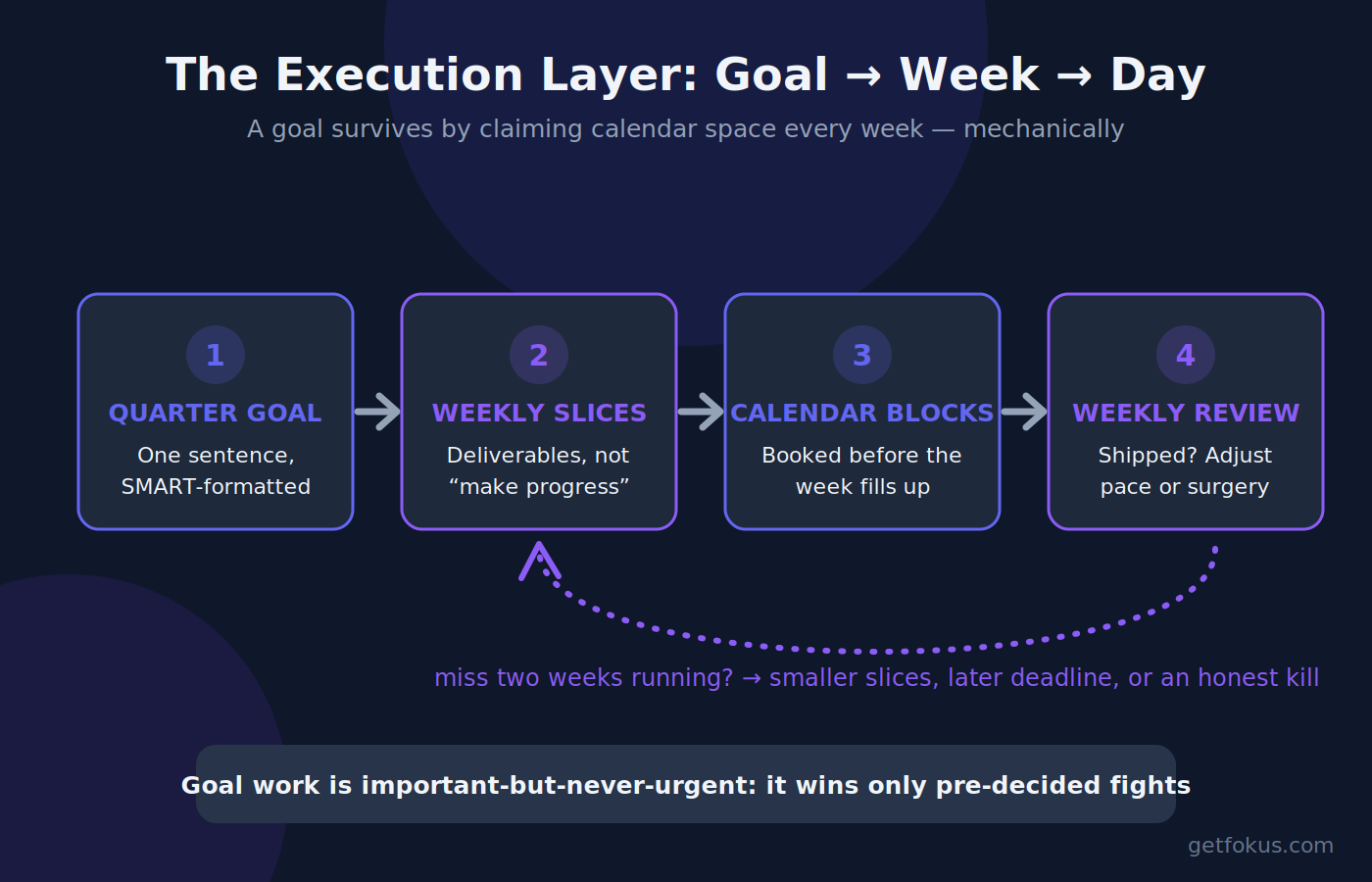
A goal survives by claiming calendar space every week — mechanically, not motivationally.
Writing goals with a team
Team goals fail in their own special ways, so three additions from the trenches. Write the goal with the people who’ll do the work — a SMART goal handed down is a quota, and quotas get gamed, not owned. Give every goal exactly one owner; a goal owned by “the team” is owned by nobody, even when the work is shared. And put the goal where the team already looks weekly — sprint board, dashboard, standing agenda — because a goal that lives in a January document has a January lifespan.
SMART goals FAQ
What are the 5 parts of a SMART goal? Specific, Measurable, Achievable, Relevant, Time-bound. The acronym’s job is to catch vague, unmeasurable, or undated goals before they waste a quarter.
What’s a good SMART goal example for work? “Reduce median support first-response time from 9 hours to 4 by September 30 by shipping a triage rota and canned answers for the ten most common ticket types.” Note it names the mechanism, not just the number.
Why do some people say SMART goals are outdated? Because SMART formats goals but doesn’t execute them, and “achievable” can institutionalize small ambitions. The fix isn’t abandoning the checklist — it’s adding an execution layer (weekly slices on a calendar) and deciding deliberately how ambitious your targets should be.
How many SMART goals should I have? One to three per quarter. Every goal past that subtracts calendar space from the others; prioritize hard, then cut.

James Okafor
Team Collaboration Writer
James focuses on remote work, team dynamics, and collaboration strategies. He brings firsthand experience leading distributed teams across four continents.