How to Stop Distractions: Fix the System, Not Yourself
Get the next article and product update in your inbox
Short product notes, fresh blog posts, and focus systems. No noisy sequence.

Every article about distractions gives you the same twelve tips — silence the phone, close the tabs, wear headphones — and every reader already knows them. Knowing them isn’t the problem. The problem is that distraction advice treats a systems failure as a character flaw: it hands you tips that require constant willpower, willpower depletes, and by 3 PM you’re deep in a tab you don’t remember opening, concluding you’re just an easily distracted person. You’re not. This guide starts where the tip lists end: what distraction actually costs (the research is worse than you think), the difference between the two kinds of distraction — because they need opposite cures — and a layered defense that keeps working when your discipline doesn’t.
The real cost: attention residue
The famous number comes from interruption research: after a significant interruption, returning to full focus on the original task takes around 20 minutes. But the deeper finding is Sophie Leroy’s concept of attention residue — when you switch tasks, part of your attention stays glued to the previous one, and it lingers. The five-second glance at a message is never five seconds: it’s five seconds of glancing plus minutes of your mind processing what you saw while pretending to work. Stack a day of glances and you get the modern default: continuous partial attention, in which no single thing ever receives a whole mind. This is the context-switching tax at its smallest and most invisible scale — and it’s why “I checked it for a second” days feel so inexplicably unproductive. Research on knowledge workers finds mind-wandering and task-switching consuming close to half of working time. The cost isn’t the distractions; it’s the residue between them.
Two kinds of distraction, two opposite cures
The tip lists fail because they lump together two different problems.
External distractions — notifications, pings, colleagues, noise — come from outside, and the cure is environmental: they respond to shields. Turn things off, close things, move things. This is the easy half, and it’s genuinely mechanical.
Internal distractions — the itch to check, the sudden memory, the urge to research something irrelevant, the discomfort-flee reflex — come from inside, and shields are useless against them. Block every site and your brain will generate the urge anyway, because (as Nir Eyal’s work on internal triggers argues) the distraction isn’t the phone — the phone is the relief. Internal distraction is usually an escape from something about the current task: it’s boring, unclear, or slightly scary. The cure is task-side: shrink it, clarify the next step, or ride the urge for ninety seconds — urges crest and pass — with a capture note (“look up X later”) to let it go honorably. That capture pad, one sheet of paper, is the single highest-value anti-distraction tool ever invented, and it costs nothing.
The diagnostic: if focus improves dramatically in airplane mode, your problem was external. If you still drift — reaching for anything, rereading the same paragraph — the problem is internal, and no blocker app will save you.
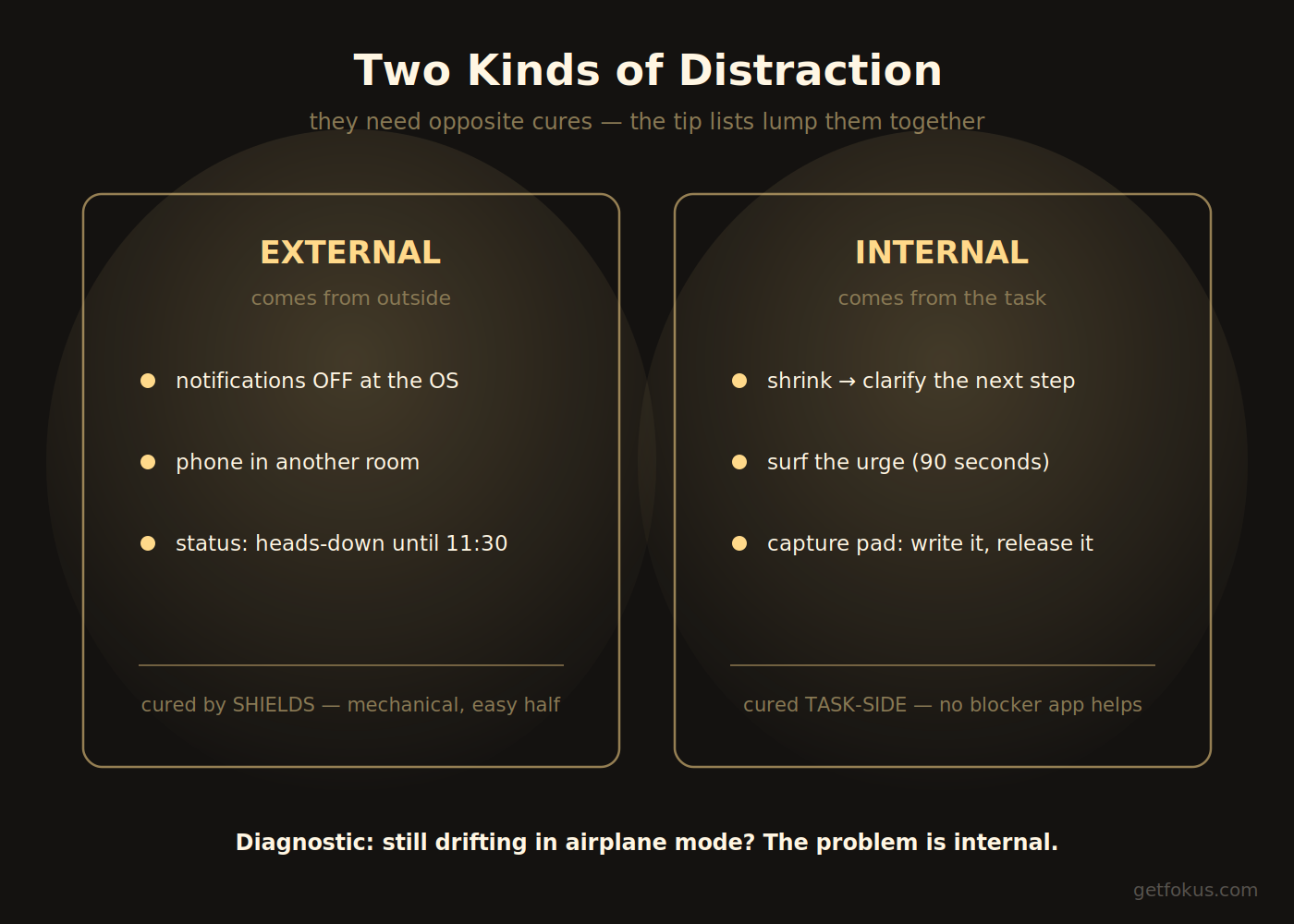
Shields stop the outside. The inside needs a different cure entirely.
The layered defense (willpower is the last layer, not the first)
Structure your defenses so that willpower — the least reliable resource you own — is only ever the final filter, rarely reached.
Layer 1: Remove. Decisions made once, working forever. Phone charging in another room. Notifications off at the OS level — not do-not-disturb-until-I-peek, off for everything that isn’t a human emergency channel. Distracting apps off the first home screen. Each removal is one decision replacing hundreds of daily resistances; this layer does more than the next three combined.
Layer 2: Contain. What can’t be removed gets an appointment. Email and chat live in batched blocks — checking at 11:30 and 3:30 isn’t deprivation, it’s scheduling — and the genuinely reactive parts of your role get explicit reactive blocks so they stop justifying all-day openness.
Layer 3: Protect. The inverse move: your best work gets distraction-proof time — 90-minute blocks with the shields from layer 1 fully up, placed at peak hours, booked as real appointments. A block on the calendar also solves the social distraction problem: “I’m heads-down until 11:30” is a sentence colleagues respect, in a way that vague busyness never earns. This is also where planning software carries weight — Fokus’s smart scheduling places and defends those blocks around your meetings automatically, so protection doesn’t depend on you re-fighting for it every morning.
Layer 4: Recover. You will still get distracted — the metric that matters is return time. Two tools: the capture pad (write the intruder down, return), and a re-entry anchor — one sentence at the top of your notes stating what you were doing and what’s next, so the way back is paved. People who recover in one minute outperform people who never get distracted, mostly because the latter don’t exist.
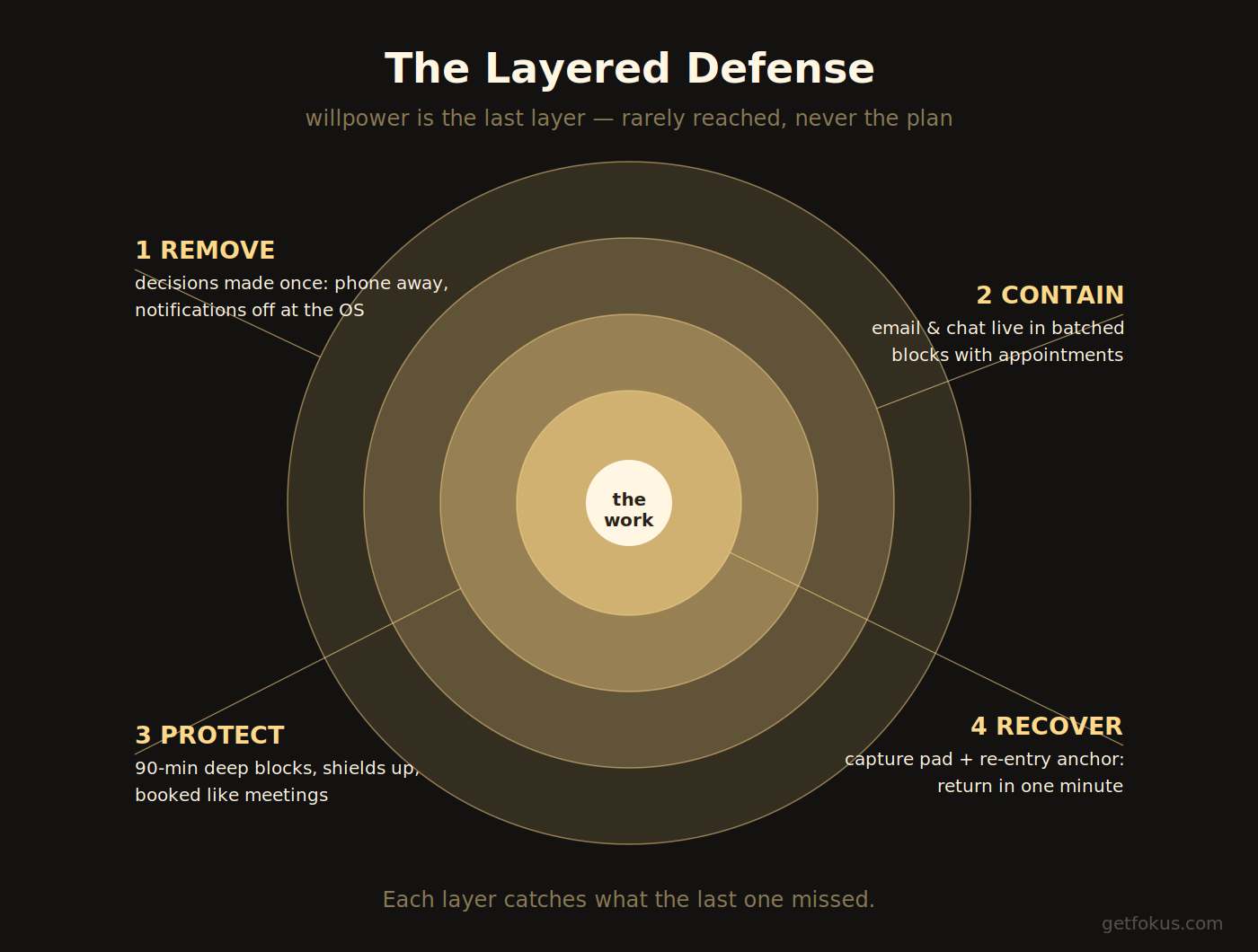
Each layer catches what the previous one missed. Willpower is the last resort, not the plan.
When distraction is a signal, not a failure
An honest coda. Chronic, life-disrupting distractibility — especially with time blindness, starting paralysis, and hyperfocus swings — can be ADHD, and for that brain the layers above help but the framing changes: externalize everything (alarms, visible timers, body doubling), shrink tasks radically, and treat structure as accessibility, not discipline. If focus struggles are wrecking work or study over years, that’s a clinician conversation, and a fruitful one. Distraction can also be honest data: a mind that flees a task every single day may be reporting something true about the task, the role, or an unmet need — burnout whispers before it shouts. This corner of the topic touches on wellbeing more than productivity; if it feels heavy rather than logistical, taking it seriously beats optimizing around it.
Stopping distractions FAQ
Why do I get distracted so easily? Some mix of environment (notifications, interruptions engineered to grab you), state (tired, stressed, under-slept minds wander more), and task (boring, vague, or aversive work invites escape). Diagnose which — the cures differ.
How long does it take to refocus after a distraction? Studies on interrupted work put full re-immersion around 20 minutes, and attention residue lingers even for “quick” checks. That’s why five one-minute checks can hollow out an afternoon.
How do I stop getting distracted by my own thoughts? A capture pad for stray thoughts (write, release, return), clear next steps on the task, and urge-surfing the itch for ninety seconds. Internal distraction responds to task design, not to blocker apps.
Do website blockers actually work? As a layer-1 removal for your known weak spots, yes — they cheaply eliminate whole categories of temptation. Alone, no: they don’t touch internal triggers, which regenerate around any wall you build.

Nadia Amari
Focus & Well-being Writer
Nadia writes about mindful productivity, work-life balance, and the science of focus. She believes the best tools should help you do less, better.