Parkinson's Law: Why Work Expands — and How to Shrink It
Get the next article and product update in your inbox
Short product notes, fresh blog posts, and focus systems. No noisy sequence.

“Work expands so as to fill the time available for its completion.” Cyril Northcote Parkinson wrote that line in a 1955 Economist essay satirizing the British civil service — he was explaining why bureaucracies grow regardless of workload — and it detached from its origin to become the most quoted sentence in productivity. Quoted, but rarely engineered: most articles tell you work expands, advise “set tighter deadlines!”, and leave. That advice is half right and dangerous when it’s wrong. As an engineer I’ve watched Parkinson’s Law inflate two-day tasks into two-week epics, and I’ve also watched naive deadline-tightening produce garbage releases and burned-out teams. This guide covers the mechanism, the honest evidence, deadline design that actually compresses work — and the failure mode where tight deadlines backfire.
Why work expands: the mechanism
Parkinson’s line reads like a law of nature, but the mechanism is mundane psychology, and knowing the parts is what makes it fixable.
Effort calibrates to the container. Given two weeks for a two-day task, you don’t consciously slack — you unconsciously downshift. Attention wanders into polish and periphery, because urgency is one of the brain’s main throttles for effort, and a distant deadline reads as “low priority” no matter what the task is worth.
Scope creeps into the slack. The two-day version answers the question; the two-week version grows an appendix, an extra options section, a refactor nobody asked for. Empty time doesn’t stay empty — it fills with the optional parts of the task, which feel like work and mostly aren’t. (The bloated version often isn’t even better. Cutting the exploratory sprawl is frequently a quality improvement.)
The start migrates toward the deadline. With slack in the schedule, starting feels optional — so the task quietly becomes procrastination with a clear conscience, and the real work compresses into the final 20% of the runway anyway. The two-week allocation didn’t buy two weeks of work; it bought twelve days of low-grade dread plus the same two days of work.
One honesty note: Parkinson’s Law is a robust observation, not a proven constant — the “evidence” is a satirical essay plus decades of everyone recognizing themselves in it, with some supporting research on deadline effects. Treat it as a strong default about human behavior, not physics.
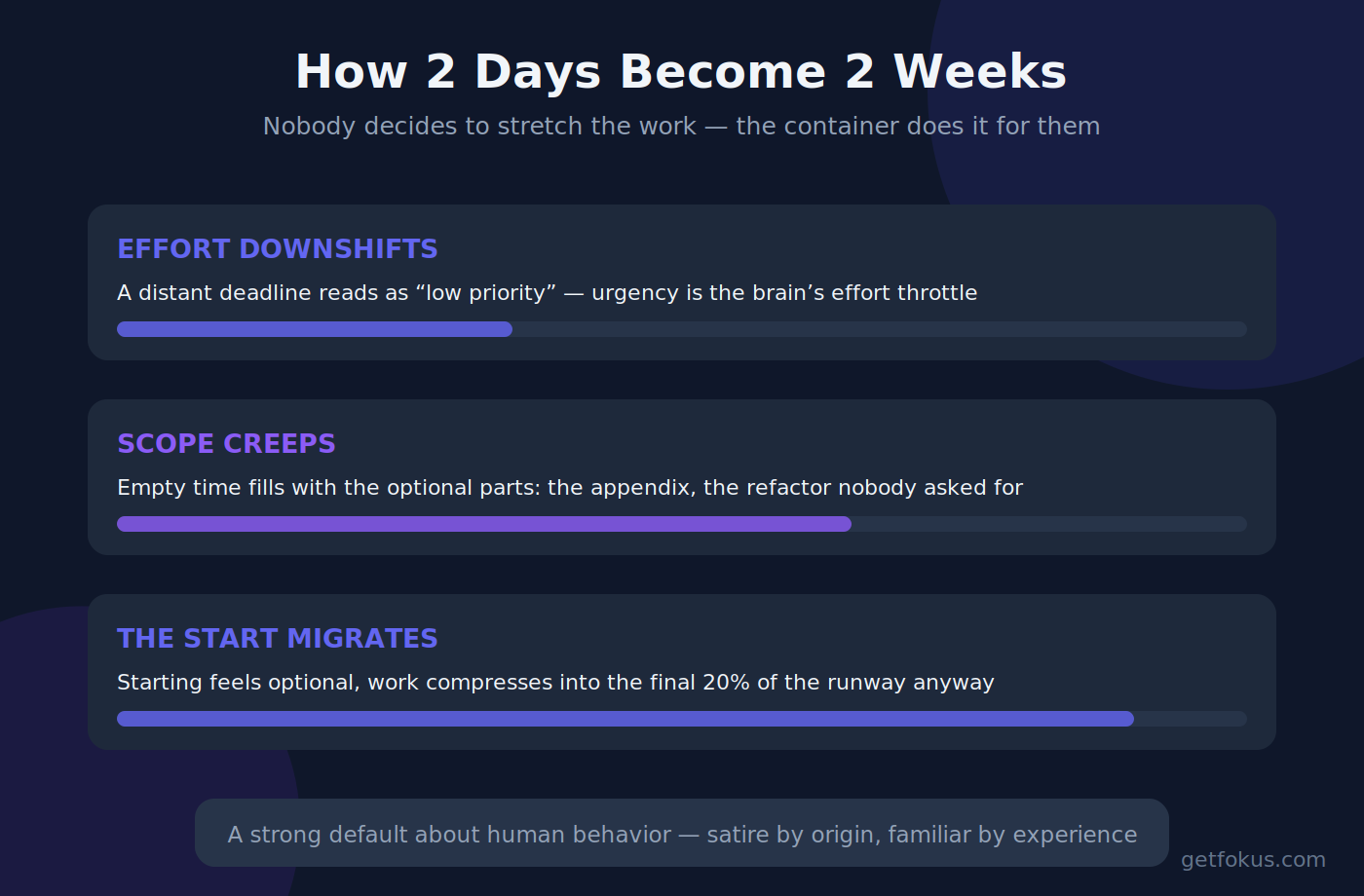
Nobody decides to stretch the work. The container does it for them.
Using the law: deadline design
If work expands to fill its container, the lever is container design. Four practices, in order of impact:
Estimate first, then set the box. You can’t set an honest tight deadline without an estimate. Do it bottom-up: slice the task into pieces small enough to gut-check (pomodoro-sized units work well), sum them, then add explicit contingency you can see — not invisible padding baked into every line, which is exactly the slack Parkinson’s Law feeds on. Visible buffer gets defended; hidden buffer gets absorbed.
Timebox: fix the time, flex the scope. Instead of “finish the analysis” (open-ended), “two hours to reach a defensible recommendation” (boxed). When time is fixed, the essential part gets done first and the optional appendix simply never exists — you’ve made scope creep structurally impossible instead of relying on restraint. The timeboxing vs. time-blocking distinction matters here: blocking reserves time for work; boxing caps it. Parkinson’s Law is the reason boxing works.
Break long runways into short checkpoints. One deadline six weeks out is an invitation — Parkinson’s Law feasts on long runways. Six weekly deliverables, each real enough that someone sees it, convert one distant cliff into six near ones. This is weekly planning doing double duty as deadline architecture, and it’s most of why sprint-based teams ship steadier than deadline-at-the-end teams.
Schedule the box, don’t just declare it. A timebox that lives in your head loses to the first interruption. Put it on the calendar as a block with a hard stop — the stop is what creates the useful pressure. This pairing is baked into how Fokus works: tasks carry duration estimates, the smart scheduling engine places them as bounded calendar blocks, and when a task overruns its box you see it overrun — which turns every week into estimation practice with feedback, instead of a vague sense that things take longer than they should.
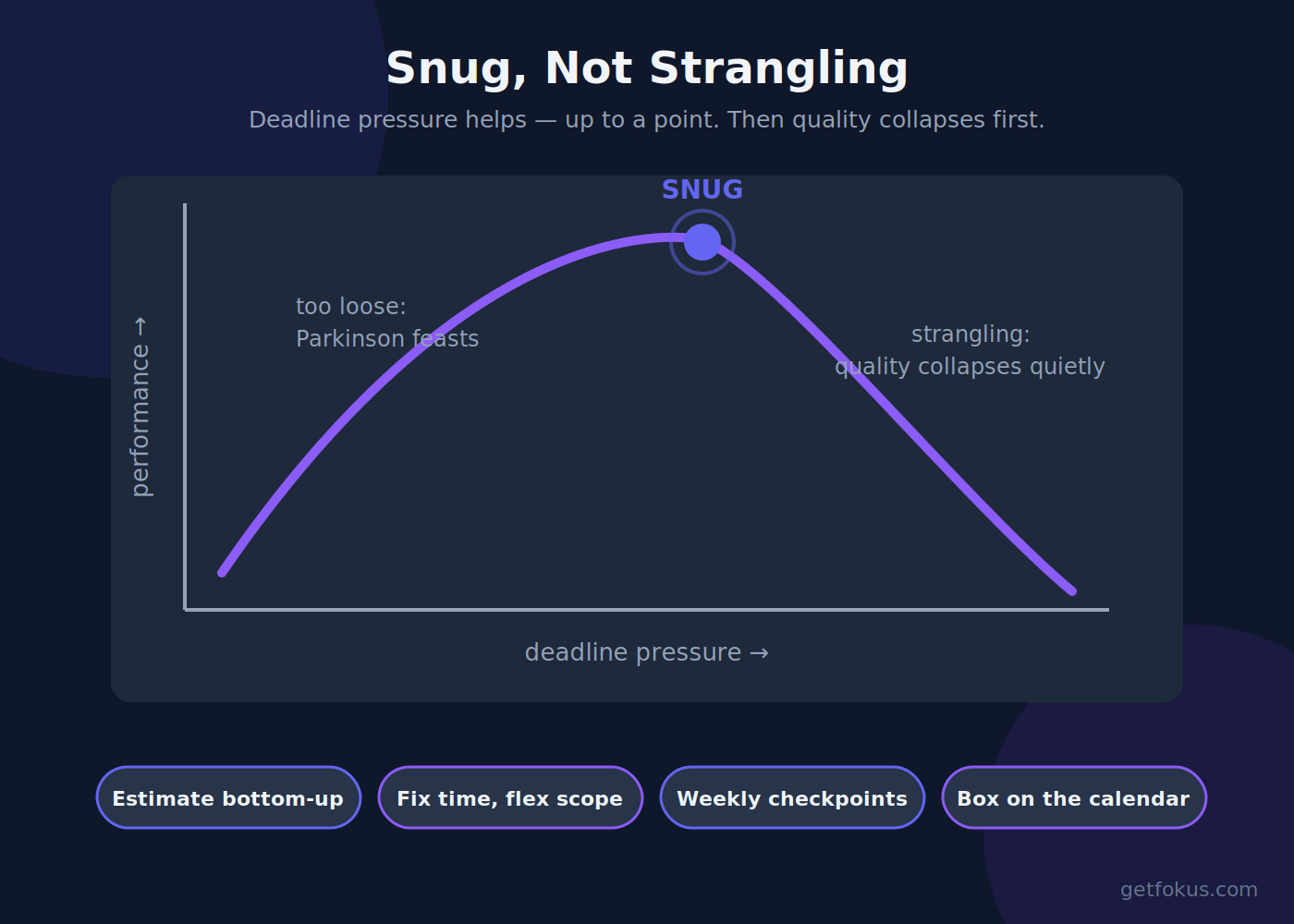
The lever isn’t working harder — it’s designing smaller, harder-edged containers.
When tight deadlines backfire
The productivity crowd sells deadline pressure as a free lunch. It isn’t, and the failure mode is predictable: pressure improves performance only up to a point, after which quality collapses first, quietly — in software that means skipped tests and shortcuts you repay with interest as bugs and rework, so the “fast” version ships slower overall. Chronic tightness also burns people out and, ironically, destroys estimation honesty: teams who get punished by aggressive deadlines start padding everything, and now the slack is back, just hidden and adversarial.
The engineering rule of thumb: deadlines should be snug, not strangling — tight enough that starting today is rational and the optional appendix dies, loose enough that the essential version fits with honest craftsmanship. If you consistently can’t tell the difference, that’s an estimation problem, not a willpower problem; fix it with smaller slices and feedback, not with heroics. And reserve genuinely aggressive boxes for work where a rough draft is acceptable — exploration, internal docs, first passes — never for the load-bearing stuff.
Parkinson’s Law FAQ
What is Parkinson’s Law in simple terms? Work stretches to fill however much time you give it. Allocate two weeks for a two-day task and it will somehow take two weeks — via lower urgency, scope creep, and a late start.
Is Parkinson’s Law real or proven? It began as satire, not science, and it’s an observed tendency rather than a constant. But the underlying mechanisms — urgency-calibrated effort, scope creep, deadline-driven starts — are well documented, and treating it as a planning default pays off.
How do you overcome Parkinson’s Law? Estimate bottom-up, then timebox: fix the time, flex the scope, keep the buffer visible, split long deadlines into weekly checkpoints, and put every box on the calendar with a hard stop.
What’s the connection to the 4-Hour Work Week? Tim Ferriss popularized the law’s inverse: shrink the container and the work compresses to essentials. True — with the caveat above. Compression works until it strangles quality; snug beats strangling.

Marko Berger
Engineering & DevTools Writer
Marko covers developer workflows, engineering culture, and the tools that help teams ship faster. Former senior engineer turned full-time tech writer.