Habit Stacking: Why Stacks Break and How to Build Them
Get the next article and product update in your inbox
Short product notes, fresh blog posts, and focus systems. No noisy sequence.

Every article about habit stacking teaches you the same sentence: After [current habit], I will [new habit]. James Clear’s formula, borrowed from BJ Fogg’s work on tiny habits, and it’s genuinely good — you piggyback a new behavior onto an existing automatic one instead of inventing a new trigger from scratch. Then the articles hand you eleven examples about flossing and stop. Which leaves the actual problem untouched, because nobody fails at writing the sentence. They fail three weeks later, when the stack quietly stops happening and they can’t say why. This guide is about that: what makes an anchor reliable (most chosen anchors aren’t), why chains longer than two links collapse, the honest state of the evidence, and the boundary the listicles never draw — the size of habit that stacking can carry, and what the rest needs instead.
Why it works: you’re borrowing a cue, not building one
A habit is a cue-routine-reward loop, and the hardest part to install is the cue — a new behavior fails mostly because nothing reliably reminds you at the right moment, and “I’ll remember” is not a cue. Habit stacking solves this by renting a cue that already fires: your existing habit becomes the trigger, so the new behavior inherits a reminder that has been working for years.
The evidence underneath is worth stating precisely, because the wellness posts overstate it. What’s strongly supported is implementation intentions — the “when situation X arises, I will perform response Y” format has decades of research showing large effects on follow-through versus intention alone. Habit stacking is essentially an implementation intention where the situation is another habit, which is a sensible extension. What’s thinner is evidence for long chains of stacked behaviors, which is mostly practitioner wisdom rather than tested science. So: strong for one small habit anchored to one solid cue, unproven for the six-item morning ritual. That distinction turns out to explain most stack failures.
Anchor quality: the step everyone skips
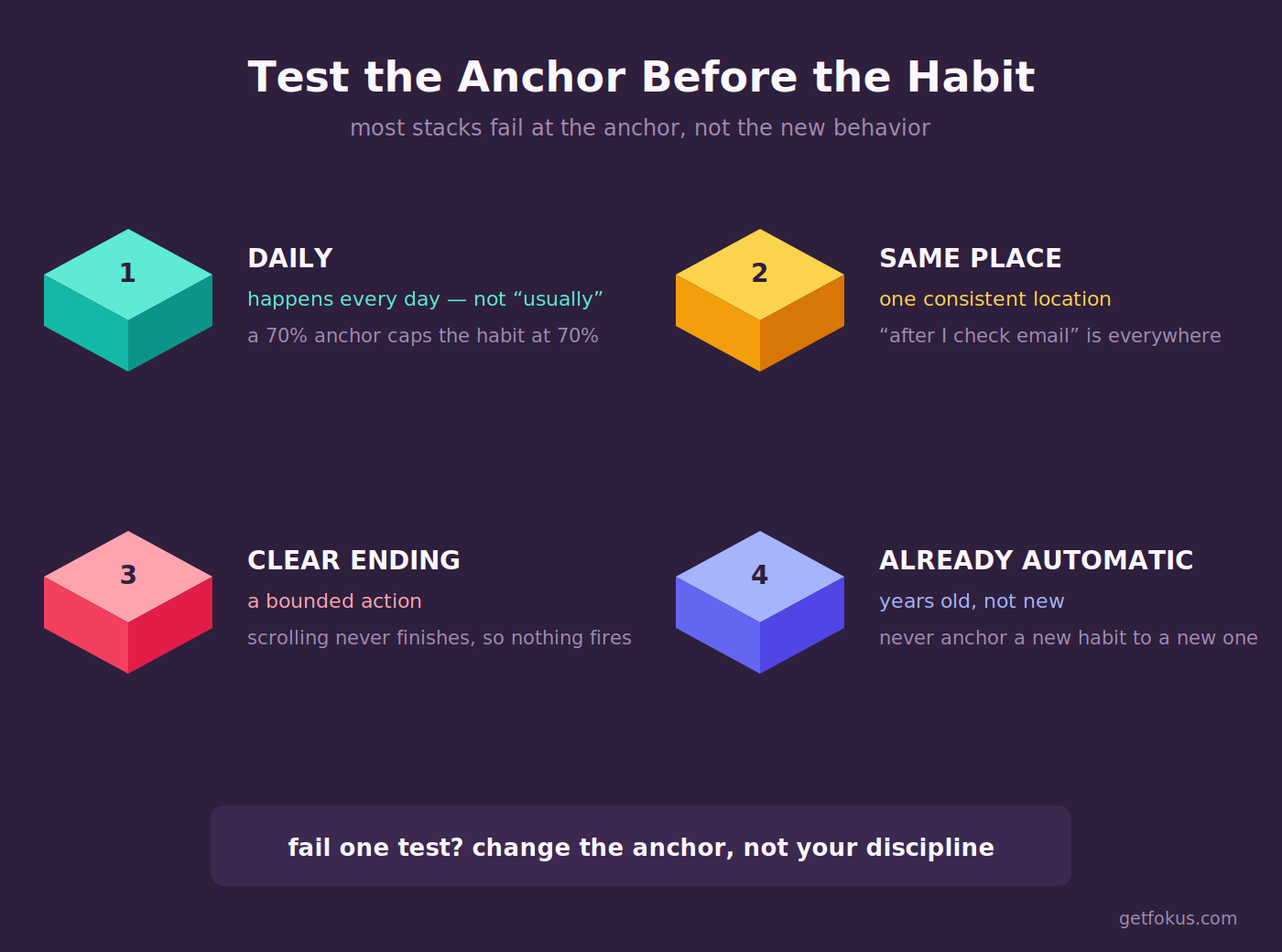
Stacks don’t usually break because the new habit was too hard. They break because the anchor was worse than it looked. A reliable anchor has four properties, and most casually chosen anchors miss at least one.
It genuinely happens daily. Not “usually,” not “on workdays if the morning goes well.” Anchoring to something with 70% reliability caps your new habit at 70% before you begin.
It happens at a consistent place. Cues are strongly environmental. “After I check email” is a bad anchor because it happens on the sofa, at the desk, and in a queue — three different contexts, none of which builds a stable association. “After I sit down at my desk” is a good one.
It has a clear end. Anchors that trail off — browsing, watching, scrolling — never produce the finished feeling that fires the next behavior. Bounded actions (pour coffee, close the laptop, park the car) work; unbounded ones don’t.
It’s already automatic — not itself under construction. The most common self-sabotage: stacking a new habit onto another new habit. Now two fragile things depend on each other. Anchor to something you’ve done without thinking for years.
Test any candidate against those four before writing the sentence. If your anchor fails one, the fix isn’t more discipline — it’s a different anchor.
Most stacks fail at the anchor, not the habit. Test the anchor first.
Keep the chain short (the two-link rule)
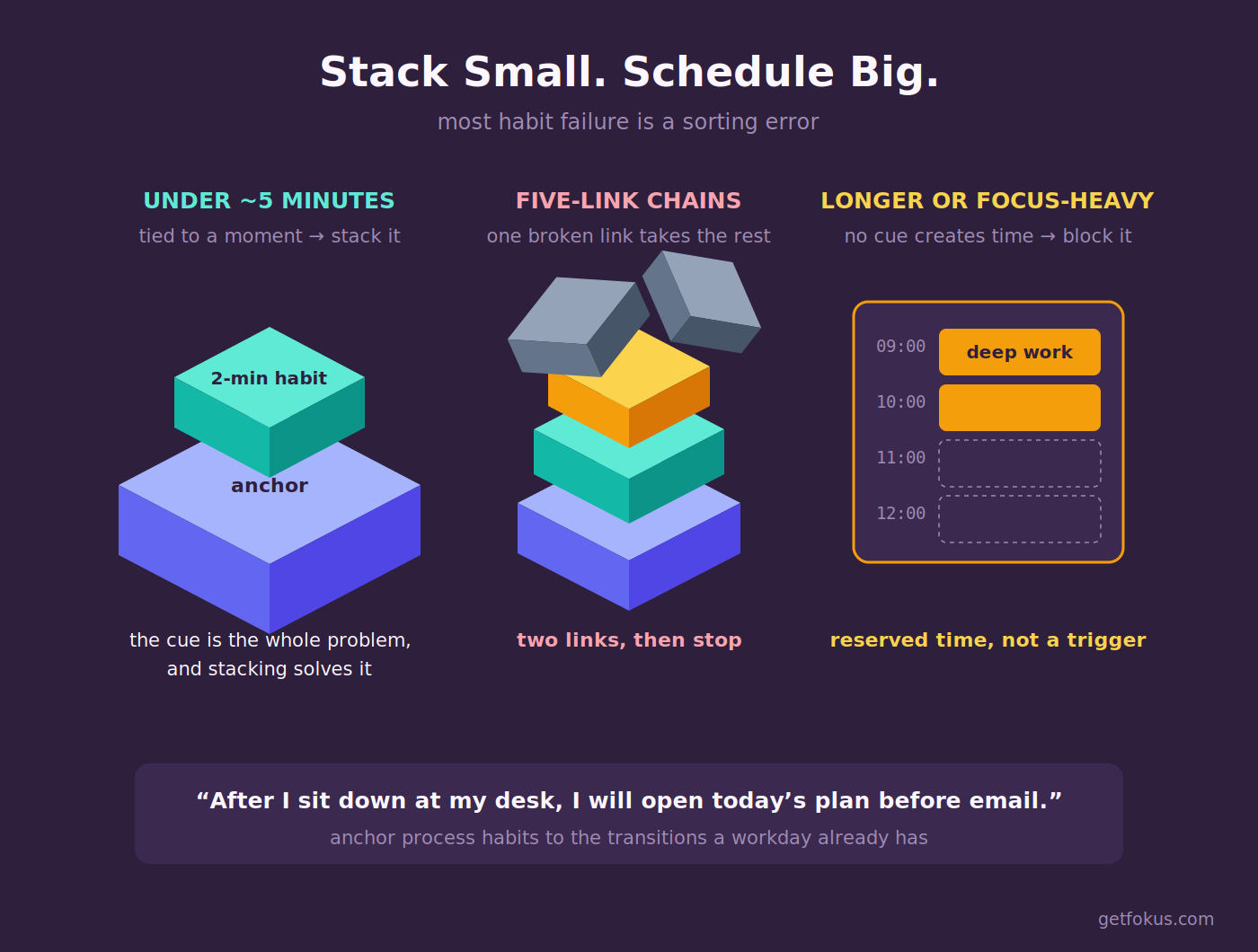
The seductive part of stacking is chaining: after coffee I meditate, then journal, then stretch, then review my goals, then plan the day. It reads beautifully on a Sunday. It fails on the first Tuesday you’re running late, because chains are serial — one broken link takes everything downstream with it, and long chains have more failure points and demand more total time exactly when your morning is compressed.
Practical rule: two links, then stop. Add a third only after the first two have run unbroken for a few weeks. If you want a five-item routine, build it as a routine anchored at one point rather than five behaviors each triggering the next — and shrink each item so that the whole thing survives a bad day. The chain that never breaks is the one short enough to be trivial.
The other half of that rule: keep each stacked habit under two minutes at install time. Not because two minutes is magic, but because the stack’s job is to make the behavior start reliably; the duration can grow later once the cue is solid. “After I sit down, I will open the document and write one sentence” installs. “After I sit down, I will write for an hour” is not a habit stack — it’s a wish with a formula wrapped around it, and it’s the same shrink-the-first-step principle that beats procrastination.
Habit stacking at work (the examples nobody publishes)
Nearly every habit-stacking example in the wild is personal wellness — floss, water, push-ups. But the technique works just as well on the professional habits that quietly determine whether your system holds together, and those examples are missing from the internet. A starter set that has held up for me and for people I’ve coached:
- After I sit down at my desk, I will open today’s plan before opening email. — the highest-leverage stack on this list, because it decides who owns your first hour.
- After my last meeting of the day ends, I will write tomorrow’s first task. — anchors the evening shutdown to something that reliably happens.
- After I close my laptop on Friday, I will run the 30-minute weekly review. — reviews die from having no cue; this gives them one.
- After I leave a meeting, I will move the actions into my task list. — turns notes into commitments while context is still warm.
- After I finish a focus block, I will mark it in the tracker. — habit tracking that piggybacks instead of becoming a second habit to remember.
The pattern: anchor process habits to the transitions that already punctuate a workday. Transitions are the most under-used anchors in professional life — meetings ending, laptops closing, desks being sat down at — because they’re bounded, automatic, and unmissable.
When stacking is the wrong tool
This is the boundary the listicles won’t draw, and it’s the most useful thing here: habit stacking installs small behaviors; it cannot carry big ones. An anchor can reliably trigger two minutes of something. It cannot conjure ninety minutes that don’t exist in your day — no cue creates time. So the sorting rule is size:
- Under ~5 minutes, recurring, tied to a moment → stack it. The cue is the whole problem, and stacking solves it.
- Longer, or needing focus → give it a calendar block, not an anchor. Deep work, exercise sessions, project work, the frog: these need reserved time, and a habit stack is not a time-reservation mechanism.
Most habit-system disappointment traces to that mismatch — people try to stack their way into things that needed to be scheduled, conclude that habits “don’t work for them,” and start over with a new app. In practice the two combine cleanly: stack the small process habits, schedule the substantial work. That’s exactly the division of labor Fokus is built around — recurring small habits ride along in the daily plan, while smart scheduling reserves real blocks for the work that needs hours rather than cues, and re-places them when the day shifts.
Stack small behaviors. Schedule big ones. Most habit failure is a sorting error.
Habit stacking FAQ
What is a habit stacking example? “After I pour my morning coffee, I will write down today’s top task.” The formula is After [existing habit], I will [new tiny habit] — the existing habit supplies the cue you’d otherwise have to invent.
Does habit stacking actually work? For small behaviors anchored to a solid cue, yes — it’s a form of implementation intention, which has strong research support. Long chains of stacked habits are practitioner wisdom rather than tested science, which is why short stacks outperform elaborate ones.
Why does my habit stack keep failing? Usually the anchor: it isn’t truly daily, happens in varying places, has no clear ending, or is itself a new habit. Second most common cause: the chain got too long, so one missed link took the rest down.
How does habit stacking work with ADHD? Anchor to events with strong physical cues rather than times of day, keep stacks to a single link, and make the habit genuinely tiny. If your anchor habits are themselves inconsistent, external cues — alarms, visible objects, a written plan — tend to do the work an anchor can’t.

Fokus Team
The Fokus Team
The team behind Fokus — building the smart productivity platform.