Habit Trackers: Why They Work, When They Backfire
Get the next article and product update in your inbox
Short product notes, fresh blog posts, and focus systems. No noisy sequence.

The habit tracker is productivity’s most seductive artifact: a grid of little boxes that promises transformation at the price of a checkmark. The search results split between app listicles and James Clear’s canonical guide, and both skip the interesting questions: does tracking actually change behavior (the research answer is “yes, with conditions”), why does it work when it works — and why do most trackers die in week three, sometimes taking the habit down with them? I build product for a living, which means I’ve watched tracking mechanics help thousands of people and quietly sabotage others with the same feature. This guide is both halves: the real psychology, the design rules that keep a tracker alive, and the backfire modes nobody puts on the marketing page.
Why tracking works (three real mechanisms)
Measurement changes behavior. The most boring and most powerful fact in this article: self-monitoring is one of the best-evidenced behavior-change techniques in the health literature. Merely recording a behavior — before any streaks or badges — shifts it, because recording forces a daily moment of honest contact with reality. Most habits don’t fail dramatically; they fade unnoticed. A tracker makes fading visible while it’s still cheap to fix.
Visible progress is fuel. Each mark is a small completion — and chains of marks turn an invisible identity claim (“I’m someone who writes daily”) into accumulating physical evidence. This is the Seinfeld “don’t break the chain” effect, and the psychology is sound: motivation follows evidence of progress far more reliably than it follows inspiration.
The tracker relocates the decision. Without a tracker, every day quietly re-asks “am I still doing this?” With one, the default flips — the habit is the norm, skipping is the exception that requires a reason. Defaults, as with every planning structure worth having, do the work willpower can’t sustain.
Why trackers die in week three (design rules)
Tracker abandonment has a predictable anatomy, and each cause has a design answer.
Too many habits. The optimistic Sunday setup — eight habits, color-coded — collapses under its own reporting burden. Track one to three, period. The tracker’s job is to protect your keystone habits, not inventory your aspirations.
Tracking the outcome instead of the behavior. “Lose weight” can’t be checked off today; “10-minute walk” can. Track leading behaviors you fully control, never lagging outcomes you don’t — outcome rows produce guilt on good-behavior days, which is motivational poison.
Friction above zero. A tracker you must remember to open is a second habit stapled to the first, and now both can fail. Put the mark where you already look: tied to an existing routine’s anchor point, on the wall, or in the app you open anyway. (This is the honest reason we put habit-style recurring tasks inside the daily plan in Fokus — the schedule you already check is the one place a tracker can’t be forgotten.)
All-or-nothing marks. Binary boxes punish partial wins — did 5 minutes instead of 30, earn nothing, learn “why bother.” Give yourself a partial mark convention; the habit you’re protecting is showing up, and 5 minutes is showing up.
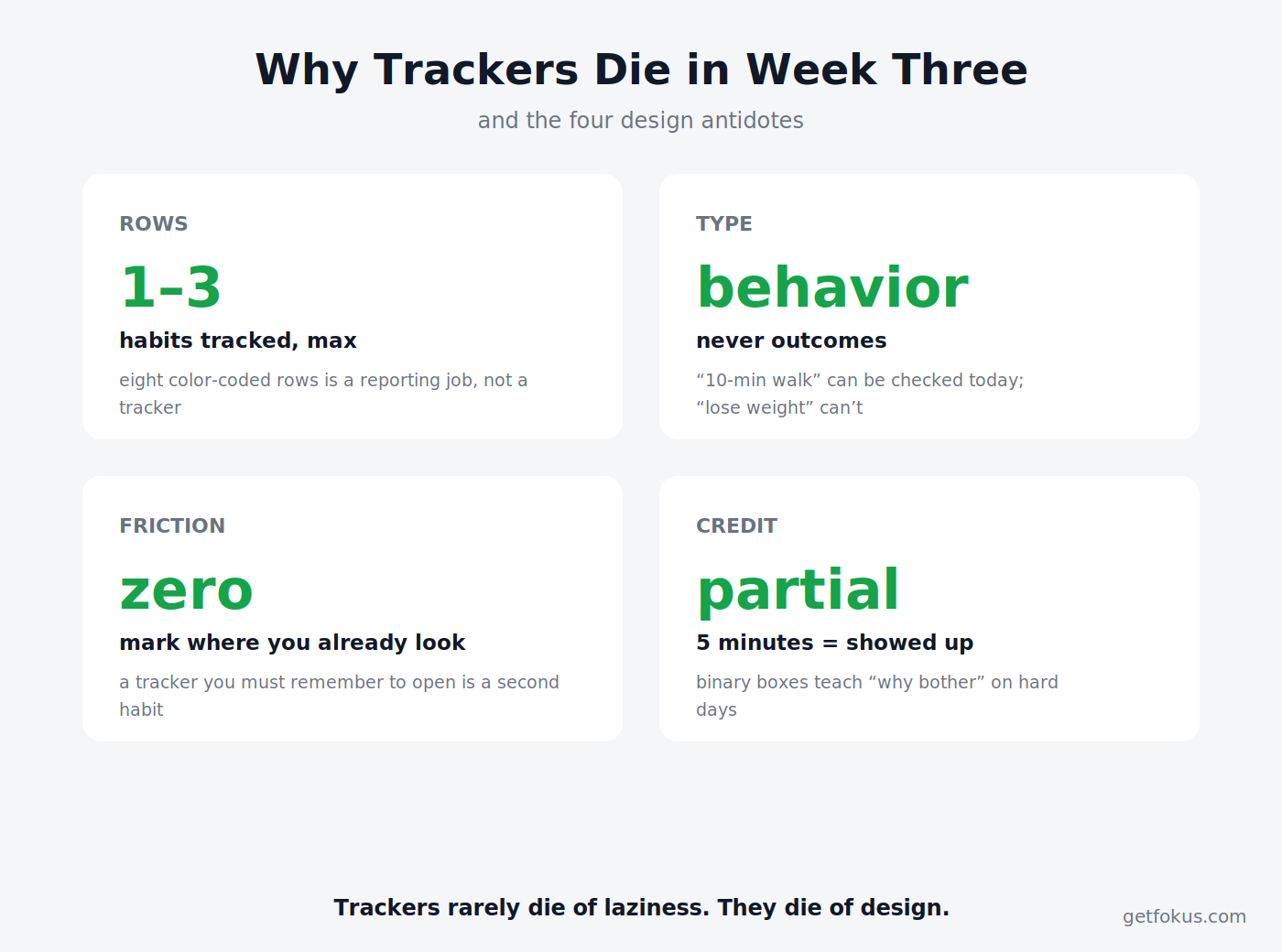
Trackers rarely die of laziness. They die of design: too many rows, wrong rows, too far away, too binary.
When tracking backfires (the part the apps won’t tell you)
Streak anxiety. The chain that motivates at day 12 can tyrannize at day 112 — people do meaningless minimum reps to preserve a number, or spiral out entirely when illness breaks a 200-day chain, because the streak had quietly become the habit. The antidote is the never-miss-twice rule: one miss is noise, two is a pattern — judge yourself only on the second. A tracker that displays “misses this month: 2” is psychologically healthier than one displaying “streak: 214,” and it’s telling which one gamified apps choose.
Goodhart’s law. When the measure becomes the target, it stops measuring. Checking “wrote today” after typing one sentence isn’t hypocrisy — it’s the natural endpoint of optimizing a proxy. Periodically ask the only question that matters: is the underlying thing actually improving? If the boxes are full and the life is unchanged, the tracker has become theater.
Tracking as a substitute for doing. The most subtle failure: elaborate tracker-building — the Notion dashboard with formulas, the color taxonomy — is productive procrastination wearing a lab coat. Setup should take five minutes. If it took an evening, the evening was the hobby.
Permanent tracking. Trackers are scaffolding, not architecture. Once a habit is genuinely automatic — you’d do it anyway, marking feels silly — retire the row and spend the attention on the next habit under construction. Tracking forever signals the habit never internalized, or the tracker became decorative.
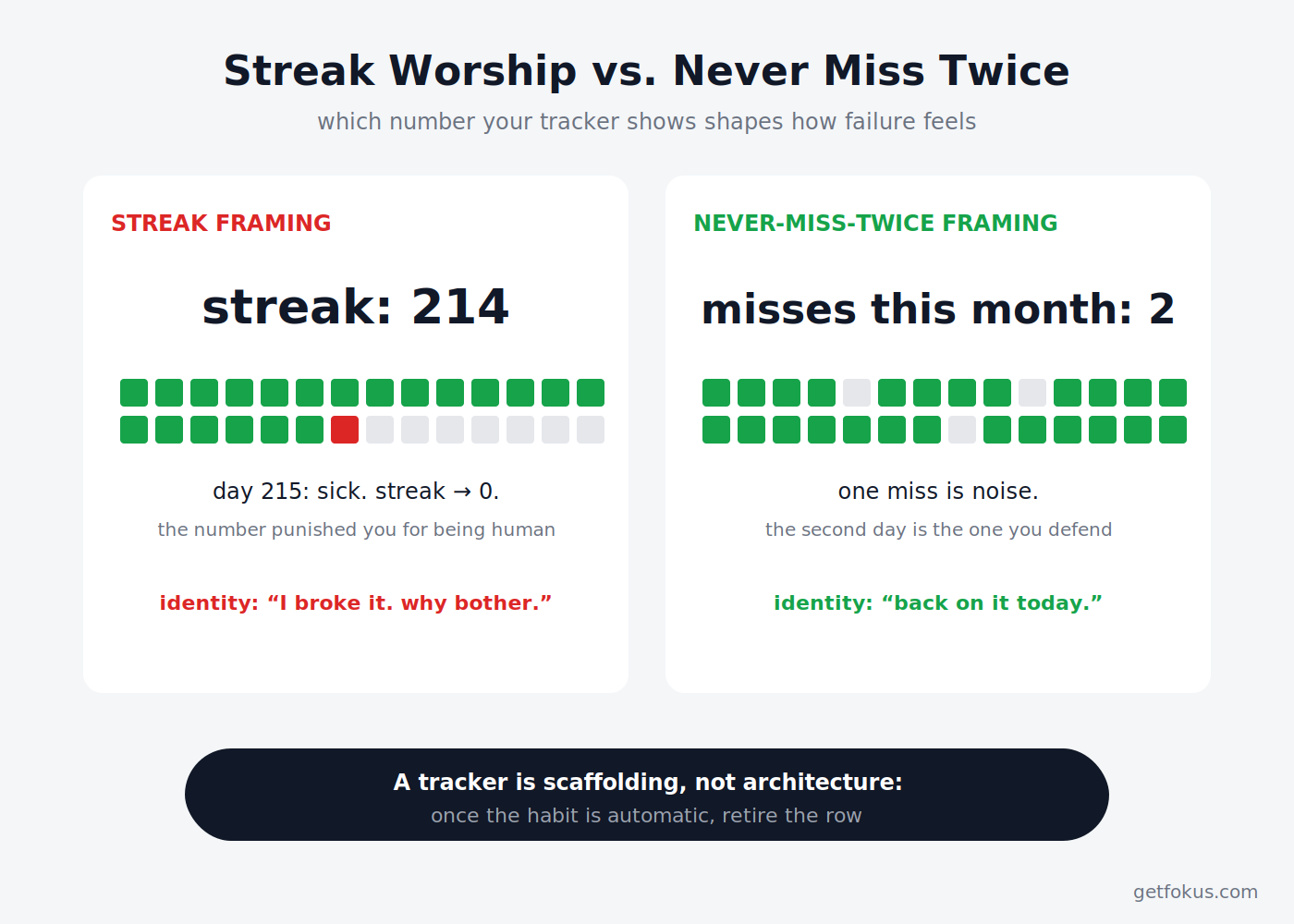
A tracker is scaffolding. If it’s still load-bearing after a year, something didn’t set.
App, paper, or calendar?
The format question, quickly, because it matters less than everything above. Paper wins on friction and ritual (a wall calendar and a marker is the entire Seinfeld method) and can’t send you a push notification about your failure. Apps win on reminders, data, and being in your pocket — pick one with partial credit and misses-framing over streak-worship. The calendar/planner is the underrated third option: if a habit is a recurring block in a daily plan you already review, completion is the tracking, and no separate artifact exists to abandon. Whichever you choose, the system is the same: few rows, behavior rows, zero friction, partial credit, never miss twice — and retirement as the goal.
Habit tracker FAQ
Do habit trackers actually work? Yes — self-monitoring is among the best-evidenced behavior-change techniques — but conditionally: tracking behaviors (not outcomes), few at a time, with low friction. Badly designed tracking can backfire into streak anxiety or box-checking theater.
What is the best habit tracker? The one you’ll still be marking in month two: a wall calendar, a minimal app with partial credit, or recurring blocks in your daily planner. Feature lists matter less than friction and framing.
How many habits should I track at once? One to three. Every additional row taxes the reporting ritual that keeps the whole tracker alive — and the point is protecting keystone habits, not cataloging intentions.
What is the never-miss-twice rule? One missed day is noise — life happens; missing the same habit twice in a row is the start of a new (absent) habit, so the second day is the one you defend. It preserves the tracker’s power without streak tyranny.

Sarah Chen
AI & Product Writer
Sarah explores the intersection of AI, product design, and personal productivity. She writes about how intelligent tools are reshaping the way we work.