Digital Minimalism When Your Job Lives on a Screen
Get the next article and product update in your inbox
Short product notes, fresh blog posts, and focus systems. No noisy sequence.

I write software that is designed to be opened. That is my job — and it is exactly why I take digital minimalism seriously. The philosophy, as Cal Newport defined it in 2019, is not anti-technology: it’s using a small number of carefully chosen tools that strongly serve something you value, and cheerfully missing out on everything else. Sound advice. But almost everything written about it since is either a book summary or a benefits listicle written for someone whose relationship with screens is optional — and mine isn’t, and neither is yours if you’re reading a productivity blog on a work laptop. You cannot delete Slack when Slack is where your job happens. So this guide covers the philosophy quickly, then the version that survives a job: attention minimalism rather than tool minimalism, the 30-day declutter with the parts people skip, and the trap I watch smart people fall into — buying their way to a quieter mind.
The three principles (and what this isn’t)
Newport’s philosophy rests on three claims, and they hold up.
Clutter is costly. Each additional app, feed, and account extracts a small tax — attention, time, a bit of background anxiety — and the taxes compound in a way no single app’s benefit accounts for. Twelve mildly useful tools cost more than the sum of their usefulness.
Optimization matters. Whether you use a tool matters far less than how. Social media used deliberately for twenty minutes to actually reach specific people is a different tool from the same app opened reflexively at red lights. The app is identical; the technology is not.
Intentionality is satisfying. The reward isn’t only recovered hours — it’s the felt difference between choosing your technology and being chosen by it. That’s the part people report as surprising, and it arrives faster than the productivity gains.
And what it isn’t: it isn’t Luddism, and it definitely isn’t the aesthetic. Digital minimalism is a set of decisions, not a device.
Attention minimalism: the knowledge-worker version
Here’s the translation the wellness blogs can’t make. Classic digital minimalism assumes the offending technologies are optional — delete Instagram, ditch the smartphone, done. For work tools, deletion isn’t on the menu. What is on the menu is reducing how many attention surfaces you keep live, which turns out to be the mechanism that mattered all along.
Cut surfaces, not tools. You need Slack; you don’t need Slack on your phone, in your browser, on your watch, and in a desktop notification simultaneously. One tool, one surface, one place it can reach you — that’s most of the win, and it costs nothing professionally.
Make checking scheduled rather than ambient. A tool checked at fixed times is a tool; a tool that can interrupt you at any moment is an owner. This is task batching applied to communications, and it’s the single highest-leverage change available to someone who can’t quit their tools.
Single-purpose modes. Focus modes that expose only the two apps a given block requires beat willpower, permanently. The phone in another room during a deep block isn’t deprivation; it’s the environmental layer of a defense that shouldn’t depend on discipline.
Audit by category, once a quarter. Not “is this app good?” — that question always answers yes. Ask instead: what job is this hired for, and does anything else already do it? Overlapping tools are where digital clutter actually accumulates in professional life, and consolidating them is the productivity-app version of decluttering a closet.
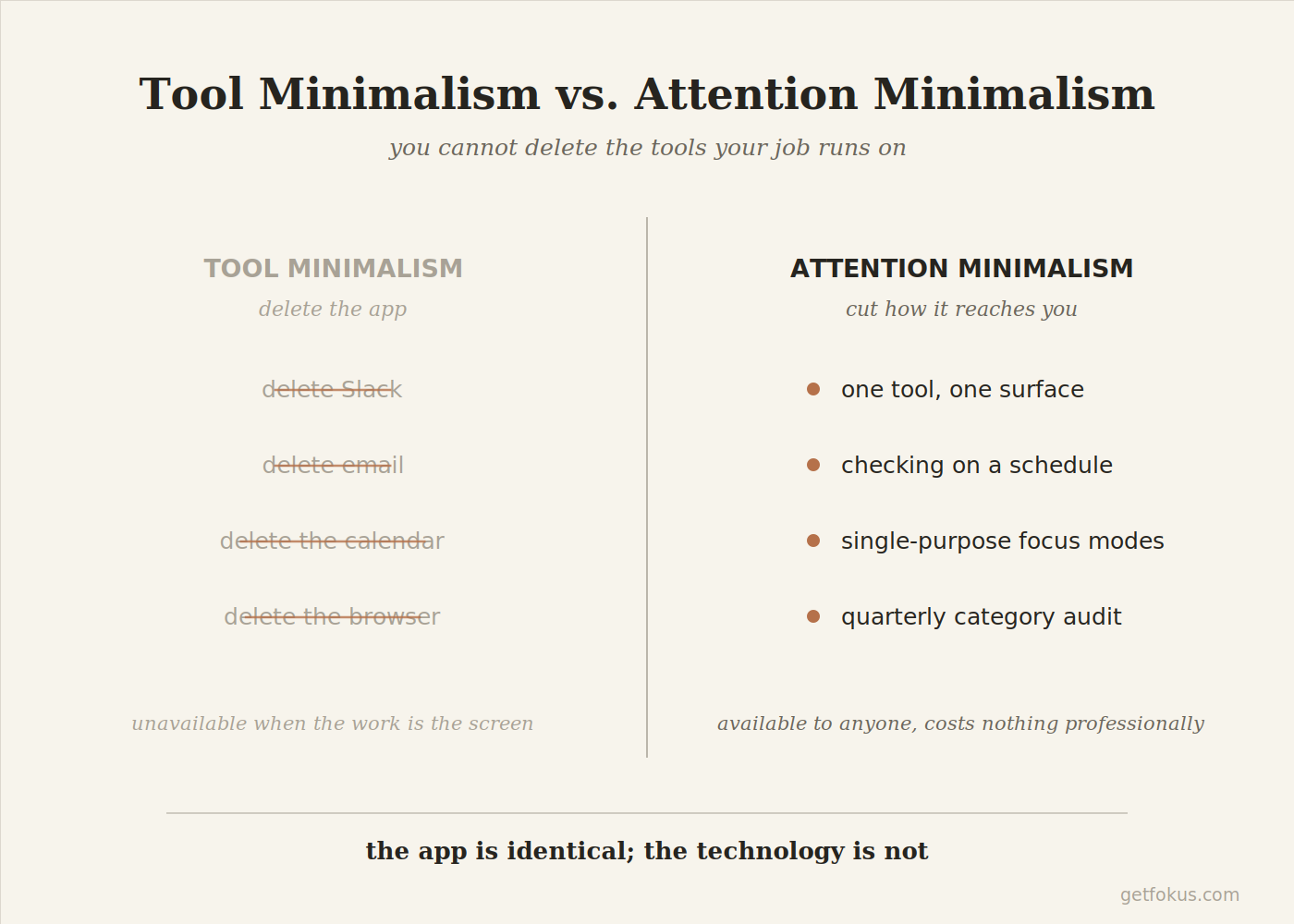
You can’t delete the tools your job runs on. You can absolutely cut how many ways they reach you.
The 30-day declutter, honestly
The signature practice: step away from all optional technologies for thirty days, then reintroduce deliberately. Having done it — and watched a dozen colleagues do it — three honest notes.
Define “optional” before you start, in writing. The rule needs to survive day four’s rationalizations. Work tools stay; anything whose absence doesn’t break a professional or family obligation goes. Ambiguity is where the whole experiment quietly dies.
Week one is genuinely unpleasant, and that’s the data. Reaching for a phantom app forty times a day is uncomfortable — and it’s the most useful information the month produces, because it reveals which reaches were habit loops rather than decisions. Nothing else surfaces that so cleanly.
The reintroduction is the actual experiment. Everyone remembers the deleting; almost nobody does the second half, which is where the value is. For each tool you want back, three questions: does it serve something I deeply value? Is it the best way to serve it? And what specific rules — when, how long, on which device — govern its use? A tool that comes back without rules will be back at full volume within a fortnight. That’s not a discipline failure; it’s a design failure.
The part that decides whether it sticks: what fills the space
The most common failure I see isn’t relapse into TikTok. It’s emptiness — thirty days of reclaimed evenings with nothing on the other side, followed by a quiet return to exactly where you started. Newport’s own emphasis lands here and gets dropped by every summary: decluttering without cultivating high-quality leisure is a vacuum, and vacuums fill themselves.
So the replacement needs to be as concrete as the removal. Something demanding rather than passive (an instrument, a craft, a sport, real reading, building something — the research on flow is consistent that effortful activity produces more satisfaction than easy consumption, which is deeply counterintuitive when you’re tired). Something social and in-person, because a large share of what phone use replaces is analog conversation. And something scheduled, because unscheduled intentions lose to the path of least resistance — an evening block for the guitar is the difference between “I should play more” and playing. Structurally this is the same move as fencing personal blocks on the calendar: if it isn’t written down, the phone wins by default, and the phone is not fighting fair.
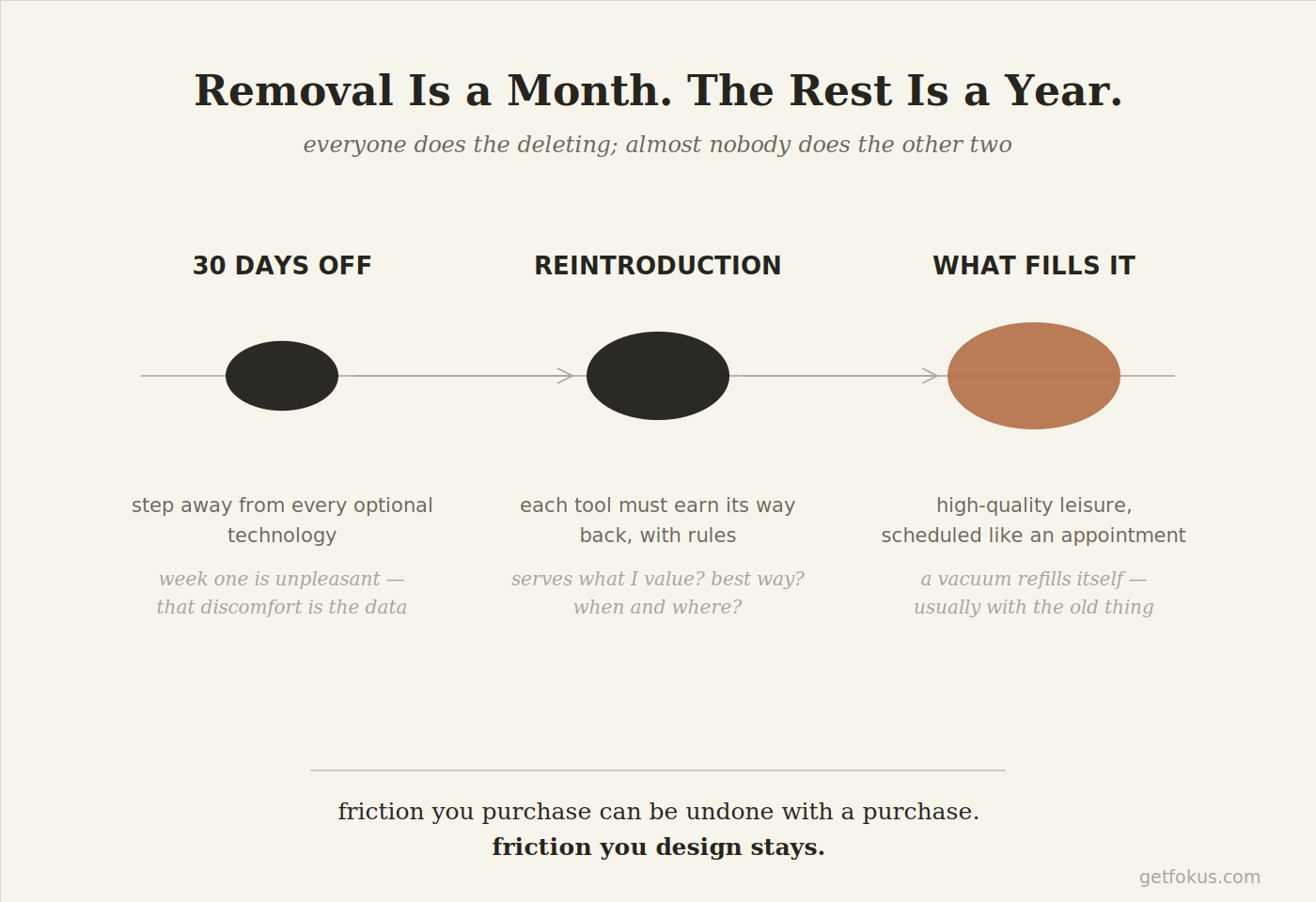
Removal is a month. Reintroduction rules and something to fill the space are what make it a year.
The aesthetic trap (an engineer’s note)
There’s a version of this that’s cosplay, and it’s spreading: the dumbphone bought and returned in three weeks, the wired earbuds as identity, the $200 e-ink device solving a problem a settings menu solves for free. I understand the appeal — buying is easier than deciding — but the honest engineering view is that friction you purchase is friction you can also undo with a purchase, while friction you design stays. Deleting three apps, moving the phone charger to the hallway, and turning off notifications at the OS level costs nothing and outperforms most hardware. Buy the device if the constraint genuinely fits your life; just don’t confuse the aesthetic with the outcome. And a related caution: these products are built by people like me, competing for the same attention they promise to protect. The tell for whether a tool respects you is simple — does it help you finish and leave, or is “time in app” the number on its dashboard?
Digital minimalism FAQ
What is digital minimalism in simple terms? Using a small number of carefully chosen digital tools that strongly serve things you value, and cheerfully skipping everything else. It’s about intentionality, not abstinence.
What is the 30-day digital declutter? Thirty days away from optional technologies, followed by a deliberate reintroduction where each returning tool must serve something you value, be the best way to serve it, and come back with explicit rules. The reintroduction is the important half.
Does digital minimalism work if I work on a computer all day? Yes — but as attention minimalism rather than deletion: fewer surfaces per tool, scheduled checking instead of ambient availability, single-purpose focus modes, and a quarterly audit of overlapping tools.
Does minimalism help with ADHD? Often, because fewer inputs means less to filter and fewer decisions to make — externalized structure tends to help more than willpower does. Blanket removal can backfire if the removed tool was load-bearing (reminders, timers, habit tracking); cut the noise, keep the scaffolding.

Fokus Team
The Fokus Team
The team behind Fokus — building the smart productivity platform.