The Brain Dump Method: What to Do After You Dump
Get the next article and product update in your inbox
Short product notes, fresh blog posts, and focus systems. No noisy sequence.

Ask Google what a brain dump is and you get a clean answer: write down everything in your head — tasks, worries, ideas, reminders — without judgment or structure, then categorize it, prioritize the top one or two, and discard the noise.
The first half is correct and takes ten minutes. The second half is where the method quietly fails: “categorize and prioritize” is not an instruction, it’s a gesture at one. The top comment on the biggest brain-dump thread in r/productivity puts it plainly — the dump is only the first part; afterwards you still have to pull out what’s a must-do, a maybe, a later.
So here is the version nobody publishes. A brain dump is the act of comprehensively and uncritically recording your thoughts — Merriam-Webster’s phrasing, and a good one. That takes ten minutes. What takes the other twenty is routing: every single item goes to exactly one of five destinations — a calendar block, a dated task, a someday list, the bin, or a separate worry page — and you decide that with one shallow question per item, not by ranking eighty things against each other. Get the routing right and the dump becomes a plan. Skip it and you have transcribed your anxiety into a longer list.
How to run the dump: one timer, ten minutes, no structure
The capture itself is simple, and the standard advice is right:
- Pick one surface. A notebook page, a blank doc, one note. Not four.
- Set a timer for 10 minutes. Five is the common recommendation and a reasonable floor — a five-minute brain dump is what you do between meetings when your head is loud. It’s not enough for a first dump, or for a Monday.
- Write without stopping and without sorting. No categories, no nested bullets, no editing. Sorting while you capture halves your output: the part of your brain that judges is the part that blocks recall.
- Keep going past the point where you think you’re done. The last two minutes are where the real items surface. The first two minutes produce the things you were already thinking about; those weren’t the problem.
- Stop when the timer stops. Not when the page feels finished — it never does.
An ADHD brain dump works the same way with two adjustments: shorten the timer (3-5 minutes, because the resistance is at the start, not the middle) and dump more often, since the working-memory load rebuilds faster. The routing step below matters more for ADHD, not less — an unrouted dump is just a bigger pile of undifferentiated demands.
The volume nobody warns you about: 60 to 120 items
Every published example of a brain dump shows about fifteen items. Buy milk, email Dana, book the flight. That’s the demo, not the reality.
A working professional’s first honest dump — one where you actually kept writing past the comfortable point — lands somewhere between 60 and 120 items. Mine, on a Monday after a launch week, was 84. That number is the whole reason the standard advice collapses at step four.
Because “sort them by priority and urgency” is fine for fifteen items and impossible for eighty-four. Ranking means comparing items against each other, and the number of comparisons grows far faster than the list does. Twenty minutes in you’re not prioritizing, you’re just tired, and a tired brain defaults to whatever is loudest. This is the decision fatigue no brain-dump article mentions, and it’s why people do one dump, feel great, and never do it again.
The fix is a sequencing change: route before you rank.
The five routing rules: where every item actually goes
Routing asks one shallow question per item — where does this live? — and it has exactly five answers. It’s mechanical, it’s fast (I do 84 items in about eighteen minutes), and it costs almost no willpower because you’re never holding two items in your head at once.
Before you start, one pre-pass: anything that takes under two minutes, do it now. That’s usually five or six items and they’re gone.
Then, item by item:
1. Calendar block — it needs 25+ minutes of uninterrupted attention, or it has a hard external deadline. Board deck. Performance reviews. The architecture doc. These get a day and a time, not a checkbox. If you don’t give them a slot they will lose every negotiation against your inbox. This is the only bucket where the work of time blocking is worth the overhead.
2. Dated task — under 25 minutes, needs a specific day, doesn’t need a specific hour. “Send the revised SOW” is a Tuesday, not a 2:15pm. The rule that makes this bucket work: an item with no date is not a task. If you can’t name the day, it isn’t one — it goes to bucket 3.
3. Someday — real, valued, not now. This list is only useful if you actually reopen it, which is why it belongs inside your weekly planning review rather than in a note you’ll never see again. A someday list you don’t review is a graveyard with better branding.
4. Delete — the biggest bucket, and the one no article will tell you about. Twenty-seven of my 84 items went straight in the bin. Not deferred: deleted. The test is blunt — if this never happens, who complains? If the answer is nobody, or only a version of you from four months ago, it’s noise you’ve been paying rent on.
5. Worry page — it has no next action, or the action isn’t yours. This is the big one, and it gets its own section below.
Here’s how the 84 actually split: 6 calendar blocks, 23 dated tasks, 19 someday, 27 deleted, 9 worries.
Now — and only now — do you prioritize. You have six calendar blocks to order. Six is a list a human can rank honestly, and it’s the right size for the Eisenhower matrix or any other prioritization frame. Feeding it 84 items is what makes those frames feel like busywork. If the six still feel impossible to order, that’s a different problem, and everything feeling urgent has its own fix.
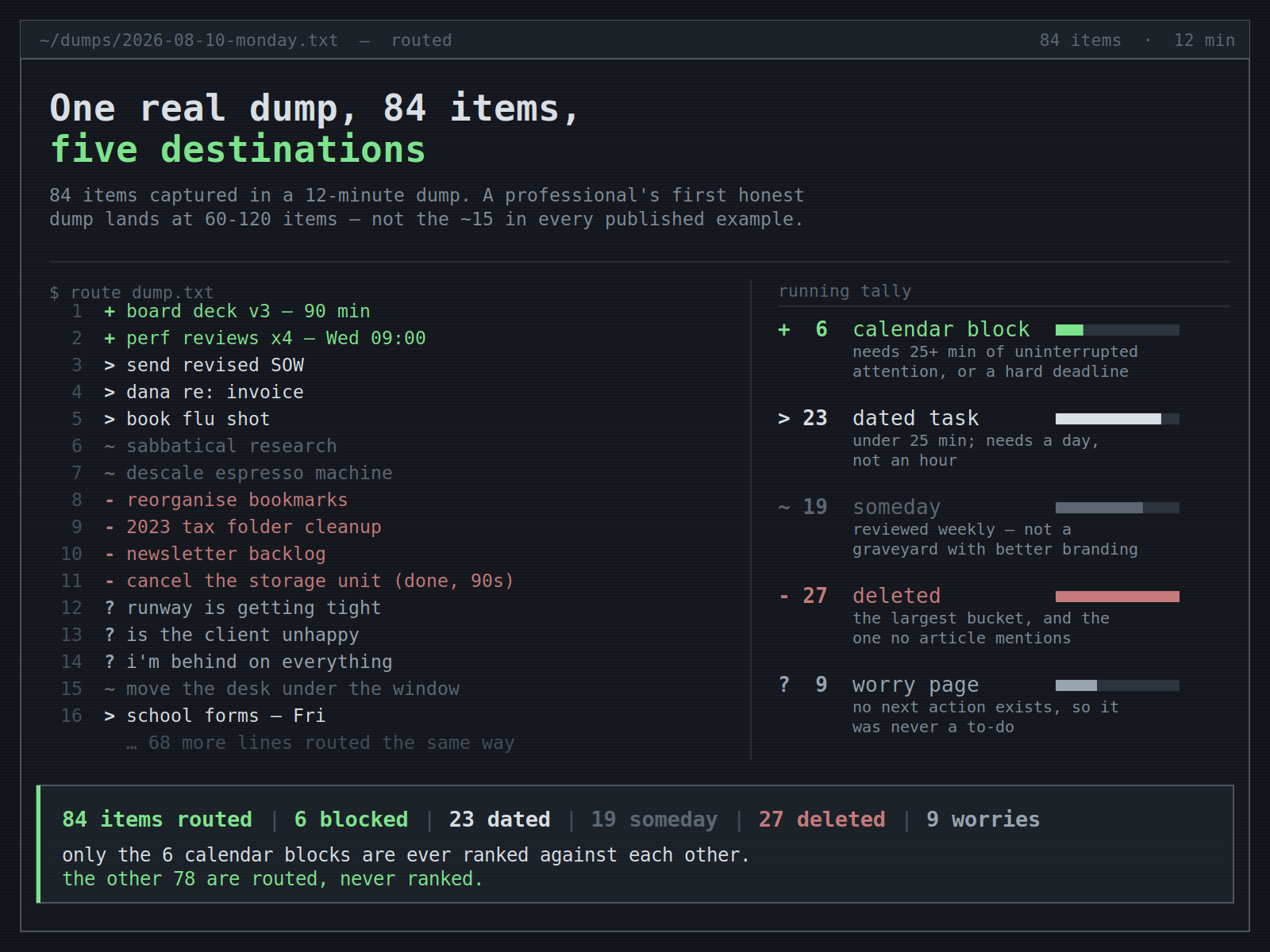
Eighty-four items, twelve minutes. Only six of them ever get ranked against each other.
Worry or task? The split that saves the method
The most common reason a brain dump makes people feel worse is that worries end up on the to-do list, where they can never be completed, so the list never shrinks.
The distinction is testable. It’s a task if it has a verb and an object, a single owner (you), and fits inside one working day. It’s a worry if no next action exists, the action belongs to someone else, or the outcome isn’t yours to control.
- “Runway is getting tight” is a worry. “Draft a three-scenario cash model, Tuesday 9:00, 90 minutes” is the task hiding inside it. Convert it and the worry dissolves.
- “I think the client is unhappy” is a worry. “Ask them one direct question on Thursday’s call” is the task. Convert it.
- “I’m behind on everything” is a worry with no task inside it. It stays a worry. Give it a date to revisit and stop trying to do it.
Put worries on a physically separate page. This isn’t a stylistic preference — it’s the one place the evidence is fairly pointed. A 2002 study found that journaling about thoughts and feelings may carry mental-health benefits, but that focusing exclusively on negative emotions was correlated with more severe symptoms of mental illness. An unstructured page of everything you’re afraid of, re-read daily, is exactly that failure mode. A bounded worry page you convert or date is not.
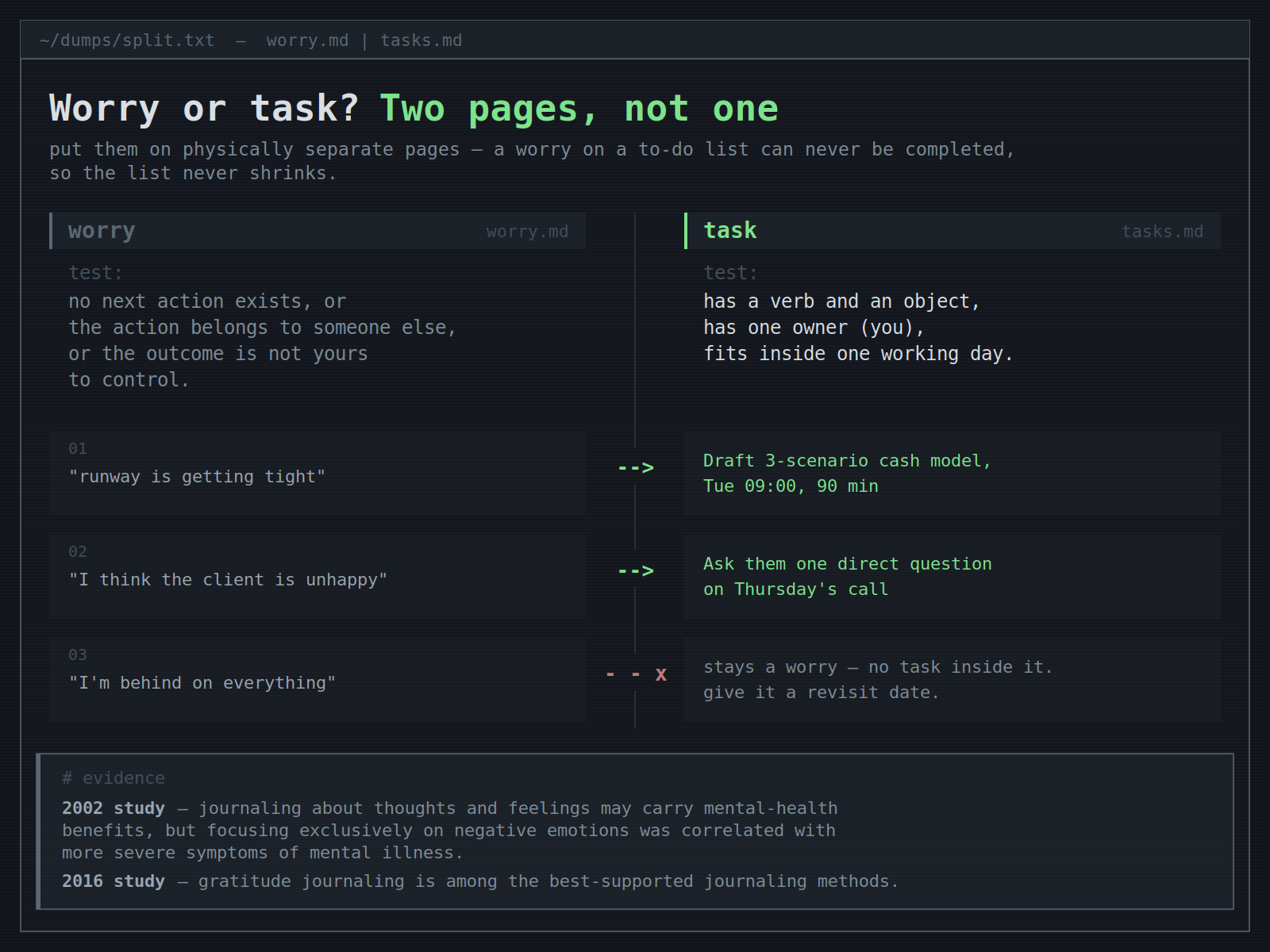
A worry on a to-do list can never be completed, so the list never shrinks. Give it its own page.
The recurring five: when the same items come back every week
Do this weekly for a month and you’ll notice something nobody writes about: the same five items appear in every single dump.
That repetition is the highest-value output of the whole exercise, and it’s data, not failure. A recurring item is always one of three things:
- A project wearing a task’s clothes. “Sort out the hiring process” isn’t a task, it’s twelve of them, so it never gets done and it re-dumps forever. Fix: write the next physical action instead (“draft the screening questions”) and let the rest stay a project.
- Somebody else’s task you’ve adopted. It re-dumps because a part of you knows it isn’t yours. Fix: hand it back, explicitly, in writing.
- Something you value but never schedule. Call your father. Learn the thing. It recurs because it matters and loses every week to what’s urgent. Fix: it goes in bucket 1, with a time.
My rule, and it’s the single change that made dumps stop feeling repetitive: the third-dump rule. If an item shows up in three consecutive dumps untouched, it gets one of exactly three verdicts this week — schedule it, delegate it, or delete it and accept the consequence. No fourth option, no “keep it in mind.”
This is also where the tool matters. I run my week in Fokus, and the reason is narrow: items that roll over keep their rollover count, so the recurring five identify themselves instead of relying on me to notice a pattern across four different notebooks. A dump that lands in the same place your plan lives makes routing one step rather than a copy-paste migration between apps.
Handwriting vs typing (and when it actually matters)
Nobody in the top results takes a position here, so: it depends on what the dump is for, and the honest caveat is that no study I can find compares the two media for brain dumping specifically.
Handwrite when the dump is emotional. Writing by hand is slower, which forces compression and keeps you from producing a wall of text you’ll never re-read. If your head is loud and you mostly need to stop the noise, paper wins.
Type when the dump is operational. Eighty-four items have to be moved, merged, dated and deleted. That’s editing, and editing on paper means recopying the whole list — which is why so many people’s dumps die on the page. If the output is meant to become a plan, type it.
What I do: paper for the first ten minutes when I’m overwhelmed, then type the survivors during routing. The recopying isn’t waste — it’s a second filter, and about a fifth of the list doesn’t survive being typed out.
What the research supports — and what it doesn’t
Brain dumping is sold with a lot of confidence and modest evidence. Psych Central, which ranks second for this query and is the most careful source on the page, says it plainly: the evidence supporting the benefits of brain dumping is limited. That’s the accurate framing, and here’s what actually exists.
- A 2021 study found that brain dump activities helped lower students’ intrinsic cognitive load — the mechanism most people intuit, measured.
- A separate 2021 study found that writing things down can improve recall and memory, which is why the dump makes you remember things you’d forgotten you were tracking.
- A 2022 meta-analysis concluded journaling “could be moderately effective for certain mental health conditions, but we need more research to be able to say for sure.”
- A 2016 study found gratitude journaling is among the best-supported journaling methods — better supported, notably, than dumping.
- And the 2002 finding above: negative-only focus correlated with worse symptoms.
Read together: the cognitive-unloading claim is reasonable, the mental-health claim is plausible but unsettled, and writing everything down without structure has less behind it than the internet implies. Use it because your working memory is finite, not because it’s clinically proven.
One contraindication worth naming: if the dump becomes a nightly re-inventory of the same fears, that’s rumination with a productivity label on it. Convert or date the worries, or stop.
This is GTD’s Capture and Clarify, renamed
Worth saying out loud: the brain dump is not a new method. It’s the Capture step of Getting Things Done, and the routing rules above are Clarify — David Allen’s “what is it, is it actionable, what’s the next action” — with different vocabulary. The full GTD system adds the two steps that make capture durable: a trusted set of lists, and a weekly review. If you brain dump regularly and it keeps evaporating, you don’t need a better dump, you need those two.
How often to dump, and where it should land
- Daily, 5 minutes, at shutdown — not at start of day. The end-of-day version stops overnight open loops.
- Weekly, 10-15 minutes, as the front end of your weekly review. This is the one that produces the recurring five.
- Quarterly, 30+ minutes, uncapped — where the 84-item dumps come from.
On tools, credit where it’s due: Sunsama — a direct competitor, and currently the source Google’s AI overview quotes for the “what to do next” section — builds a genuinely good guided daily planning and shutdown ritual, which is the part most tools skip entirely. Their article stops at “organize and sort by priority” and cites no research, but the ritual itself is worth copying.
What matters most is where the dump lands. If capture happens in a notebook and the plan lives in a calendar, you’ll re-dump the same items forever — nothing you wrote ever became a commitment. Whatever you use — Fokus in my case, a paper notebook, plain GTD lists — the test is the same: after routing, can you close the page and trust that the six things that mattered will show up at a specific time on a specific day?
If yes, you didn’t do a brain dump. You made a plan.

Lina Hayek
Productivity & Workflow Writer
Lina writes about time management, deep work, and building sustainable routines. She has helped thousands of professionals rethink their relationship with productivity.