Work-Life Balance Is a Calendar Problem. Treat It There.
Get the next article and product update in your inbox
Short product notes, fresh blog posts, and focus systems. No noisy sequence.

Almost everything written about work-life balance treats it as a feeling to pursue — read the tips, feel inspired, change nothing, feel vaguely guilty. The tips aren’t wrong (set boundaries! take breaks!), they’re just weightless, because they never touch the machine that actually allocates your life: the calendar. Here’s this guide’s premise, and it’s a little unromantic: work-life balance is not a mindset. It’s an allocation — of hours, attention, and recovery — and allocations live on calendars, where they can be seen, defended, and measured. What follows: why balance collapsed for knowledge workers specifically, the boundary architecture that restores it, the three metrics that tell you the truth, and honest words about the cases the calendar can’t fix.
Why balance broke: work stopped having edges
For most of industrial history, work had physical edges — you left the factory, and the work stayed there. Knowledge work dissolved the edges: the laptop comes home, the phone carries the inbox, and remote work finished the job by moving the office into the kitchen. The result isn’t necessarily more hours — it’s boundary-less hours: work seeps into evenings as a background app, always faintly running. The research on this is consistent and a bit grim: it’s not the Sunday email itself that costs you, it’s the anticipation of it — the never-fully-off state that blocks the mental recovery sleep researchers call psychological detachment. Ambient work destroys recovery at retail prices while producing almost nothing. Which reframes the goal: the aim isn’t fewer work hours (yours may be fine), it’s restoring edges — and edges are exactly what a calendar can build.
Boundary architecture: five structures
1. A hard stop with a shutdown ritual. An end-of-day time that exists on the calendar, with a five-minute closing routine: capture open loops, glance at tomorrow’s plan, close the laptop physically. The ritual matters more than the hour — open loops are what follow you to dinner, and writing them down is what releases them. Tomorrow’s plan already existing is half of what makes stopping feel safe; that’s the evening shutdown doing double duty.
2. Personal blocks that are real appointments. The gym, the family dinner, the Tuesday class — on the calendar, defended like client meetings. Unwritten personal time loses every negotiation with written work time; that asymmetry alone explains half of everyone’s balance problem. Time blocking isn’t just a work technique — its most underrated use is fencing the other side.
3. Notification borders. Work apps silenced outside work hours — actually configured, not intended. Every after-hours ping is a free sample of the workday, and the anticipation effect means the possibility of pings costs almost as much as the pings.
4. Realistic days, or the edges are fiction. Here’s the mechanism the tips never mention: overloaded days are how work invades evenings. A day planned at 110% capacity doesn’t fail politely at 5 PM — it spills. Which makes honest weekly planning with buffer a balance practice, not just a productivity one: a day that fits inside its hours is the only kind that ends on time. This is frankly the deepest reason we built Fokus’s smart scheduling the way we did — it schedules tasks into the hours that exist, around the personal blocks you’ve fenced, and re-plans overflow into tomorrow instead of into tonight. The plan respecting your edges is what makes the edges hold.
5. A weekly balance glance. Thirty seconds inside your weekly review: did the personal blocks survive, or did work eat them? Three weeks of eaten blocks is not a scheduling accident — it’s data about workload or boundaries, and it deserves a decision, not another inspirational article.
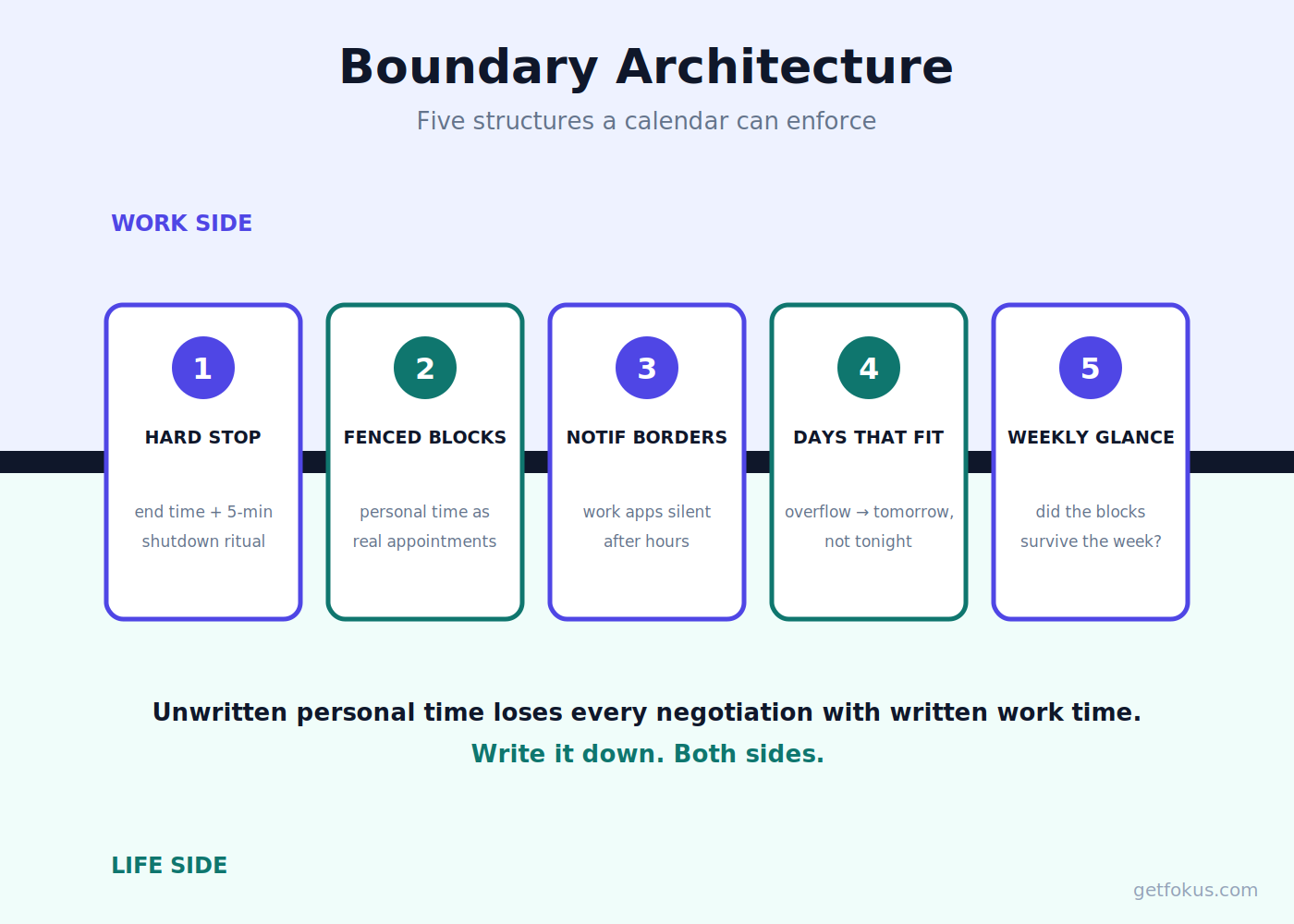
Edges are built, not felt: five structures a calendar can enforce.
Three metrics that don’t lie
Balance-as-feeling is unfalsifiable; balance-as-allocation is measurable. Track these for two weeks:
- Hard-stop hit rate. Days you actually stopped at the planned time ÷ workdays. Below ~60%, your days are overpacked — fix the planning, not your discipline.
- Personal blocks kept. Fenced personal appointments that survived ÷ scheduled. This is the single most honest balance number, because it measures what work displaced, not how you felt about it.
- Off-hours check-ins. Times you opened work apps outside work hours. Count it honestly for a week — most people are genuinely startled — then watch it fall once notifications have borders.
Note what’s not on the list: total hours worked. Fifty bounded hours with real recovery routinely beats forty boundary-less ones. The 8-8-8 rule (eight hours work, sleep, life) is a fine cartoon of the idea, but the edges, not the arithmetic, are what matter.
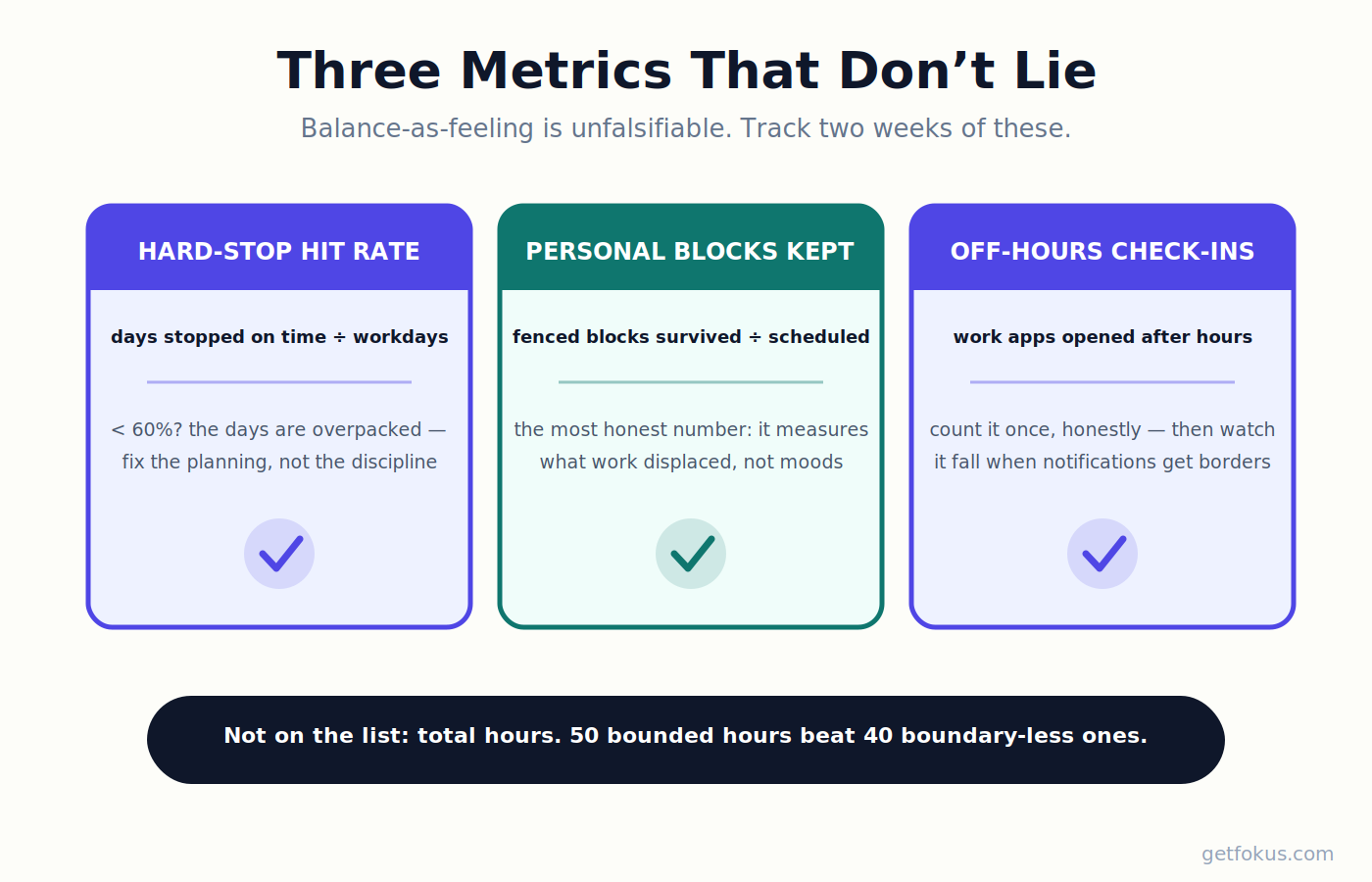
If it isn’t measured on the calendar, it’s a mood. These three numbers are the truth.
What the calendar can’t fix
Honesty section. Sometimes the calendar audit returns a verdict no technique can soften: the job simply demands more hours than any healthy allocation contains. Chronic 110% workload is a negotiation with your manager — backed by the audit data, which turns “I’m overwhelmed” into “here’s what I’m dropping to fit the hours; confirm the priorities” — or eventually a decision about the job itself. Caregivers and single parents live a version where “life” is a second shift, and for them balance advice about yoga classes reads as satire; the structures above still help (edges protect the remaining discretionary time), but the honest fix is usually help and reduced load, not better scheduling. And if the off-state never comes — if work anxiety persists through protected evenings, if rest doesn’t restore — that pattern is worth taking seriously beyond productivity content. This is a sensitive corner of the topic: if it feels personally heavy, a conversation with someone qualified is worth more than any system, and I say that as someone who writes systems for a living.
Work-life balance FAQ
What is a good work-life balance? Not a ratio — a state where work has edges: it ends at a knowable time, personal commitments survive contact with it, and your attention is genuinely off outside its hours. Measured, not felt.
What is the 8-8-8 rule? Eight hours each for work, sleep, and personal life. Useful as a cartoon of “life deserves an allocation too”; useless as arithmetic — boundaries and recovery quality matter more than equal thirds.
What are the signs of poor work-life balance? Work with no reliable end time, personal plans that routinely lose to it, checking messages compulsively off-hours, and rest that doesn’t restore. The metrics above turn each of these into a number.
Does remote work make balance better or worse? Both, on the same mechanism: it removes the commute (edge gained) and the building (edge lost). Remote workers need the boundary architecture more, not less — the hard stop, the fenced blocks, and a closed door where the office used to be.

Nadia Amari
Focus & Well-being Writer
Nadia writes about mindful productivity, work-life balance, and the science of focus. She believes the best tools should help you do less, better.