Getting Things Done (GTD): What to Keep in 2026
Get the next article and product update in your inbox
Short product notes, fresh blog posts, and focus systems. No noisy sequence.

Getting Things Done is the grandparent of every productivity system you’ve ever tried — David Allen’s 2001 book has sold millions of copies, spawned an industry, and shaped the vocabulary (“next action,” “inbox zero” is a grandchild) that even its critics argue in. And people keep asking the same modern question about it: is GTD still a thing? Fair question — the book predates smartphones, and full-dress GTD has a reputation as a system you maintain instead of a life you live. The honest answer: GTD’s core insights have aged magnificently; its apparatus hasn’t. This guide covers the method in brief, then does the audit the summaries won’t: what to keep at full strength in 2026, what to keep in reduced form, what to drop — and the one thing Allen underweighted that modern practice has to add back.
GTD in five steps (the brief version)
The system’s engine is a five-stage workflow. Capture everything that has your attention — every task, idea, and commitment — into trusted inboxes, because (Allen’s most famous line) your mind is for having ideas, not holding them. Clarify each item: is it actionable? If not, trash it, file it, or incubate it. If yes, decide the next physical action — and anything under two minutes, do immediately. Organize the results into lists: next actions (sorted by context), projects (anything needing more than one action), waiting-for, someday/maybe, and a calendar for true date-bound items. Reflect — the weekly review, where you empty inboxes, update every list, and look ahead. Engage: pick what to do using context, time, energy, and priority. Underneath the workflow sit two big claims: open loops held in your head generate background stress that writing them into a trusted system relieves (the psychology here — closer to the Zeigarnik effect literature than to gadgetry — has held up well), and fuzzy to-dos are unactionable until converted into concrete next actions.
The 2026 audit: keep, shrink, drop
Keep at full strength — capture and next-action thinking. These two are the permanent contribution. Ubiquitous capture into one trusted inbox is even easier now than in 2001, and the next-action discipline remains the single best cure for list-rot: a task that starts with a verb is startable; “mom’s birthday” is not. If you adopt nothing else from GTD, adopt these and you’ve got most of the value.
Keep at full strength — the weekly review. Allen called it the critical success factor, and twenty-five years of GTD abandonment stories agree: every dead GTD system died review-first. It survives outside GTD too — it’s the same organ as the weekly planning routine, just with more list-grooming. Non-negotiable in any system wearing any name.
Shrink — contexts. Sorting next actions by @phone, @computer, @errands made sense when tools were places. In 2026 every context is the same glass rectangle, so the classic contexts are mostly dead weight. What survives is sorting by energy and depth — a deep-work list versus a shallow-admin list is a context split that still pays, because those belong in different calendar blocks anyway.
Shrink — someday/maybe. Keep the list, cap the ceremony. A quarterly skim beats weekly re-reading of your fantasy woodworking projects.
Drop — the apparatus. The 43 folders, the tickler file, the elaborate filing taxonomies: paper-era solutions to problems search boxes solved. And drop the full-orthodoxy standard itself: the classic GTD failure mode is spending more time curating the system than doing the work it organizes — productivity’s most respectable form of procrastination. If your system needs a weekend to set up, you’ve built a hobby.
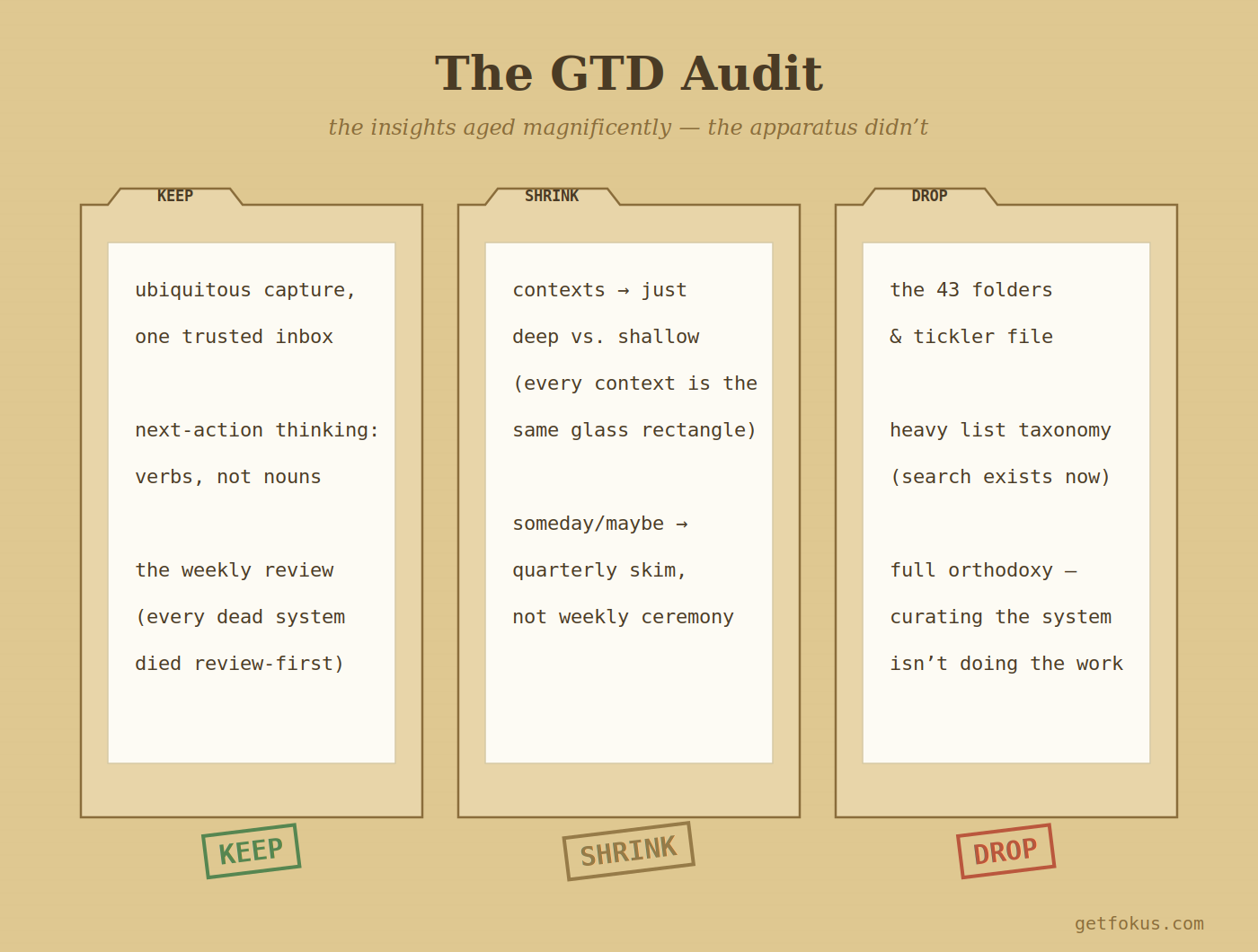
The insights aged magnificently. The apparatus didn’t. Audit accordingly.
What Allen underweighted: the calendar
Here’s the audit’s one addition, and it’s structural. GTD famously treats the calendar as “hard landscape” only — appointments and date-bound items, nothing else; day-planning your tasks was considered fragile. Reasonable advice in 2001, when a day’s interruptions couldn’t be re-planned without an eraser. But it leaves GTD with a quiet gap: enormous rigor about defining work, near-silence about when work happens — and a context-sorted next-action list still loses every afternoon to whoever fills the calendar first. Modern practice inverts the advice: priorities earn real time blocks, buffered honestly, re-planned when the day breaks — the fragility Allen feared is exactly what scheduling software now absorbs. This is the layer Fokus adds to a GTD-shaped workflow: capture and clarify feed a task list with priorities and durations, and smart scheduling turns the “engage” step from an in-the-moment choice into a plan that already exists, rebuilt automatically when meetings move. Allen’s lists tell you what the work is; a calendar is what makes it true — the same list-to-calendar bridge every system eventually needs.
GTD-lite: the version that survives contact with 2026
For the impatient, the whole audit as a running system. One capture inbox, emptied daily; every item clarified to a next action, two-minute items done on the spot. Two action lists only — deep and shallow — plus projects with one named next action each, waiting-for, and a quarterly someday/maybe. Priorities ranked honestly and given calendar blocks for the week. One weekly review, 30 minutes, protected. That’s the entire system — call it GTD-lite, call it common sense with a lineage; it keeps the psychology, drops the paperwork, and adds the calendar spine. Setup time: an afternoon, once.
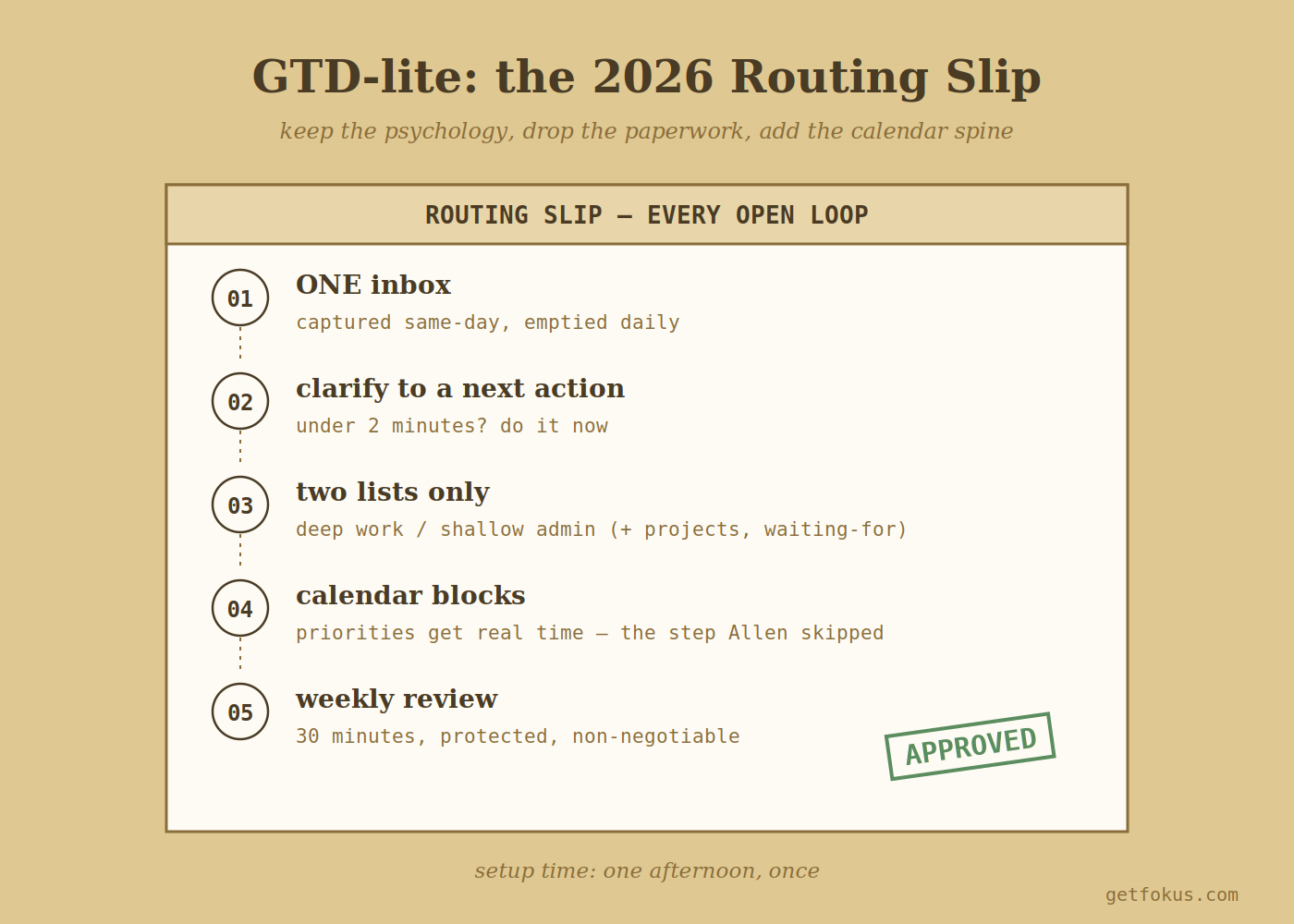
Keep the psychology, drop the paperwork, add the calendar spine.
GTD FAQ
What are the 5 steps of GTD? Capture (collect everything into trusted inboxes), clarify (decide what each item means and its next action), organize (sort into lists and calendar), reflect (the weekly review), engage (choose work by context, time, energy, priority).
Is GTD still relevant in 2026? Its core — ubiquitous capture, next-action thinking, the weekly review — is as relevant as ever. Its apparatus (contexts, tickler files, heavy list taxonomy) belongs to the paper era; keep the psychology, modernize the mechanics.
What is the 2-minute rule in GTD? During clarification, anything doable in under two minutes gets done immediately rather than tracked — tracking it would cost more than doing it. It’s a triage rule, not a life philosophy.
Why does GTD fail for so many people? Two reasons with one root: the full apparatus demands maintenance most lives can’t sustain, and skipped weekly reviews let the lists rot until the system loses trust. Shrink the apparatus, protect the review, and add calendar blocks so defined work actually gets time.

Lina Hayek
Productivity & Workflow Writer
Lina writes about time management, deep work, and building sustainable routines. She has helped thousands of professionals rethink their relationship with productivity.