8 Time Management Techniques That Actually Fit Your Job
Get the next article and product update in your inbox
Short product notes, fresh blog posts, and focus systems. No noisy sequence.

Search for time management techniques and you’ll find lists — 8 techniques, 13 techniques, 30 techniques. What you won’t find is the answer to the only question that matters: which one fixes your problem? A technique that saves a salesperson’s week can wreck an engineer’s. So this guide does something the listicles don’t: it starts from the failure mode you actually have, matches techniques to it, shows how the good ones combine into one system, and tells you how to check whether any of it is working.
Why most time management techniques don’t stick
Techniques fail for a predictable reason: they get adopted by popularity instead of by fit. Pomodoro is famous, so people with a prioritization problem try Pomodoro — and quit, because no 25-minute timer tells you whether you’re doing the right task. The Eisenhower Matrix is elegant, so people whose real issue is interruptions sort tasks into quadrants and still lose their afternoons to Slack.
Every technique below is a fix for one specific failure mode. Diagnosis first, then prescription.
Pick by problem, not by popularity
Be honest about which of these sentences sounds like your week:
- “I work all day but the important thing never happens.” → prioritization problem: Eisenhower Matrix, 80/20, or the ABCDE method.
- “I can’t get started on the hard thing.” → initiation problem: Eat the Frog, Pomodoro, the two-minute rule.
- “I’m busy with fifty small things and can’t focus.” → fragmentation problem: task batching, time blocking.
- “My plan is dead by 11am.” → adaptation problem: time blocking with buffers and re-planning.
- “I don’t even know where my time goes.” → awareness problem: a one-week time audit before you touch any technique.
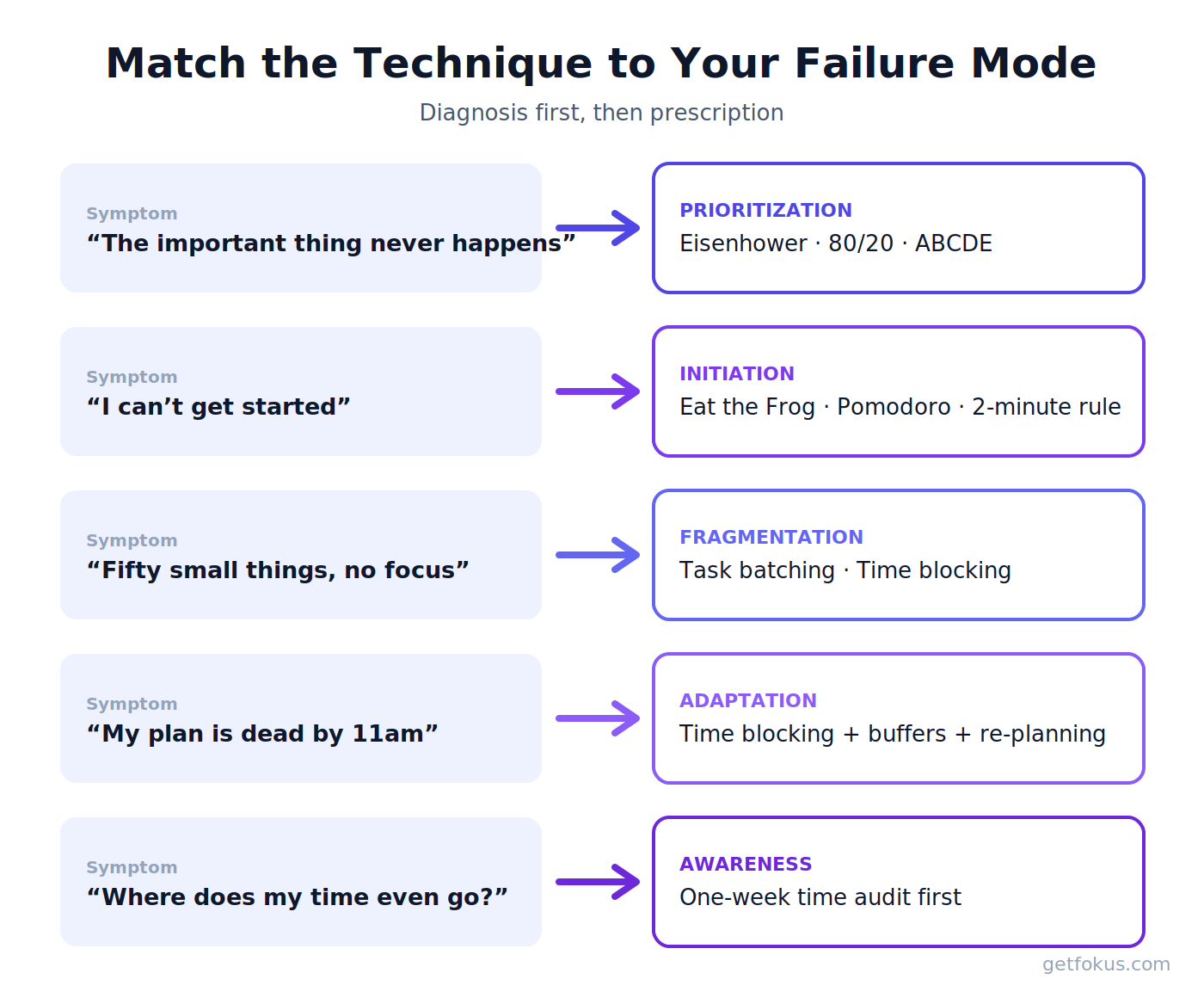
Five failure modes, and the techniques that actually address each one.
The 8 techniques worth knowing
1. Time blocking — reserve calendar slots for specific work; treat them like appointments. The backbone of everything else, and the one technique that turns intentions into a schedule. It fails when over-packed — the fix is a 15–20% buffer and a midday re-plan, which we covered in depth in our complete time blocking guide.
2. The Eisenhower Matrix — sort by urgent × important; do, schedule, delegate, or delete. Best weapon against the “everything is urgent” trap — the mere-urgency effect that makes us chase deadlines over value. Fails when everything lands in quadrant one; that’s a workload conversation, not a sorting problem.
3. The 80/20 rule (Pareto) — a minority of your tasks produce most of your results; find and protect them. A lens, not a schedule: it tells you what deserves deep work, not when to do it. Pair it with time blocking.
4. Pomodoro — 25 minutes on, 5 off. Superb for starting when a task feels aversive, and for training focus stamina. Fails for deep work that needs 90-minute immersion — treat the intervals as training wheels, not a ceiling.
5. Eat the Frog — do the hardest, most important task first, before your willpower is spent. Simple and brutally effective for chronic delayers; pairs naturally with scheduling your frog into your peak-energy block.
6. Task batching — group shallow work (email, invoices, messages) into dedicated blocks instead of letting it perforate your day. Context switching taxes every transition; we’ve written about that reactive-state productivity tax before. Fails only when your role genuinely requires real-time responses — then batch what you can and add reactive blocks.
7. The ABCDE method — label tasks A (must) to E (eliminate), and never touch a B before the As are done. Five minutes of discipline that beats an hour of calendar Tetris; the full walkthrough is in our ABCDE guide. Fails when you lie to yourself about what’s an A.
8. Getting Things Done / Zen to Done — capture everything out of your head into a trusted system, clarify next actions, review weekly. The heavyweight for people drowning in open loops; if full GTD feels like a second job, its minimalist cousin ZTD keeps the essentials.
One system, not eight hobbies
The dirty secret of technique lists: the techniques aren’t competitors. They’re layers of one machine, and each solves a different stage.
- Capture everything into one list (GTD/ZTD).
- Prioritize the list (Eisenhower, 80/20, ABCDE).
- Schedule the priorities (time blocking, with your frog in the first block).
- Protect the blocks (batching for the shallow work, Pomodoro to start the hard work).
- Review weekly — what got done, what carried over, what to change.
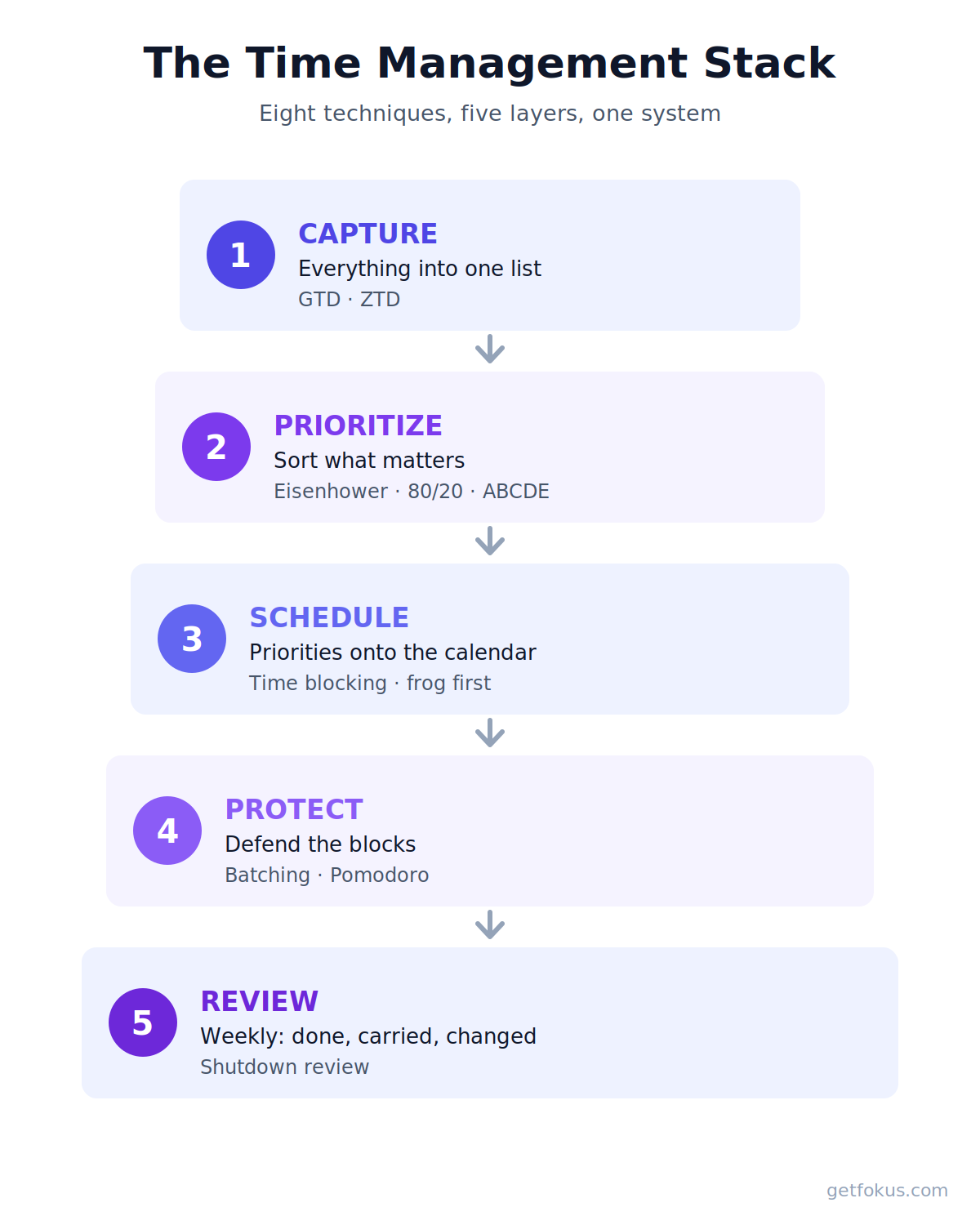
Eight techniques, five layers, one system.
Run the layers in order for two weeks and you’ll notice something: most “time management” advice is just one layer of this stack marketed as the whole machine.
The 3-3-3 rule, the 5 P’s, and other named frameworks
The 3-3-3 rule (Oliver Burkeman): three hours on your most important project, three shorter urgent tasks, three maintenance chores. It’s the stack above pre-assembled at starter size — a genuinely good first week.
The 5 P’s — “Proper Planning Prevents Poor Performance.” A mnemonic, not a method; its one real insight is that planning happens before the day starts, not during it.
The five/seven/ten techniques you’ll see in other guides are almost always subsets of the eight above wearing different names. If a “new” technique doesn’t fix one of the five failure modes, it’s content, not a tool.
How to tell if a technique is working
The listicles never tell you this part. Two weeks per technique, three numbers:
- Completion rate — planned tasks finished ÷ planned. Healthy is 70–85%.
- Carry-over rate — tasks rolled to tomorrow ÷ planned. Falling = the technique fits.
- Deep-work hours per week — the number that correlates with work you’re proud of.
If the numbers don’t move in two honest weeks, the technique doesn’t fit your failure mode — change the diagnosis, not your character.
Where AI fits: techniques are algorithms
Look at the stack again and you’ll notice every layer is a rule you execute by hand: sort by urgency × importance, put the frog first, batch the shallow work, re-plan when a meeting overruns. Rules are exactly what software is good at. That’s the bet we made with Fokus — its smart scheduling runs the prioritize-schedule-protect layers automatically: tasks carry priorities and durations, the calendar builds itself around your meetings, and when the day breaks it re-plans instead of leaving you with calendar fiction. You still make the judgment calls; the machine does the sorting and shuffling. If you’d rather run the stack by hand, everything above works with a paper planner — the method is the same, only the labor changes.
Time management techniques FAQ
What are the five time management techniques? The five most cited: Pomodoro, time blocking, the Eisenhower Matrix, the 80/20 rule, and Eat the Frog. But five, eight, or thirty — the count matters less than matching one to your actual failure mode.
What are the 7 essential time management skills? Skills, not techniques: prioritizing, planning, estimating honestly, saying no, single-tasking, delegating, and reviewing. Techniques are how the skills get practiced.
Do these work for students? Yes — the failure modes are identical, the calendar is just different. Students lean hardest on Pomodoro (initiation) and time blocking around fixed classes.
Which technique is best for the workplace? For meeting-heavy professional calendars: time blocking with buffers, plus batching. Prioritization techniques matter most when your workload exceeds your hours — which, for most professionals, is always.
Can I combine techniques? You should — that’s the whole point of the stack. The common trap is running two techniques in the same layer (Eisenhower and ABCDE) instead of one per layer.

Lina Hayek
Productivity & Workflow Writer
Lina writes about time management, deep work, and building sustainable routines. She has helped thousands of professionals rethink their relationship with productivity.