Analysis Paralysis: Why You Overthink and How to Stop
Get the next article and product update in your inbox
Short product notes, fresh blog posts, and focus systems. No noisy sequence.

Analysis paralysis is overthinking a decision to the point where no decision gets made. You research options, compare, re-compare, open a spreadsheet, ask two more people — and stay exactly where you started, minus the hours and plus a low hum of dread. It feels like diligence. It functions like avoidance. And the standard advice (“just decide!”) is as useful as telling an insomniac to just sleep. This guide takes the condition seriously: what’s actually happening in your head, the four causes worth distinguishing, a decision system that prevents the spiral rather than willing your way out of it — and the honest line between everyday overthinking and something worth professional attention.
What’s actually happening
Overthinking isn’t a defect of careful people; it’s careful thinking pointed at the wrong target. Somewhere the goal quietly shifted from making a good decision to making a decision that cannot be criticized — by your boss, your future self, anyone. And since no such decision exists, the analysis can never finish. It’s not looking for information anymore; it’s looking for certainty, and certainty isn’t in the data.
The research adds a cruel detail: more analysis doesn’t just delay decisions, it degrades the decider. In the famous jam study by Iyengar and Lepper, shoppers offered 24 jams were a tenth as likely to buy as shoppers offered 6 — more options produced less action. Choice overload is a real cognitive tax, and every extra tab you open charges it. Psychologists also distinguish maximizers (who must find the best option) from satisficers (who take the first option meeting their criteria) — and consistently find satisficers end up not just faster but happier with their choices. Keep that word, satisficing; it’s the engine of everything below.
The four causes (know yours)
1. Too many options. Cognitively, comparing options is expensive, and the cost grows fast with the count. Past a handful, your working memory can’t hold the comparison, so you loop. The fix is never “compare harder” — it’s cutting the option set before comparing.
2. Fear of the wrong choice. The decision feels bigger than it is, so the error feels fatal. The tell: you’re fine deciding small things but freeze on anything labeled important. Usually the label is wrong — most “important” decisions are reversible.
3. Perfectionism. You’re not choosing between options; you’re auditioning them for a flawless outcome that doesn’t exist. The tell: “good enough” physically bothers you — even after choosing, you keep re-litigating.
4. Information overload. You believe the answer is one more article away. The tell: research sessions that end with more candidate options than they started with. Information has diminishing returns, and past the knee of the curve it actively harms — it feeds cause #1.
These need different medicine, which is why generic “5 tips” articles bounce off. Diagnose first — and notice the paralysis is also rarely about the decision in front of you. It’s a habit of how you treat all decisions, which is why the fix is a system, not a pep talk.
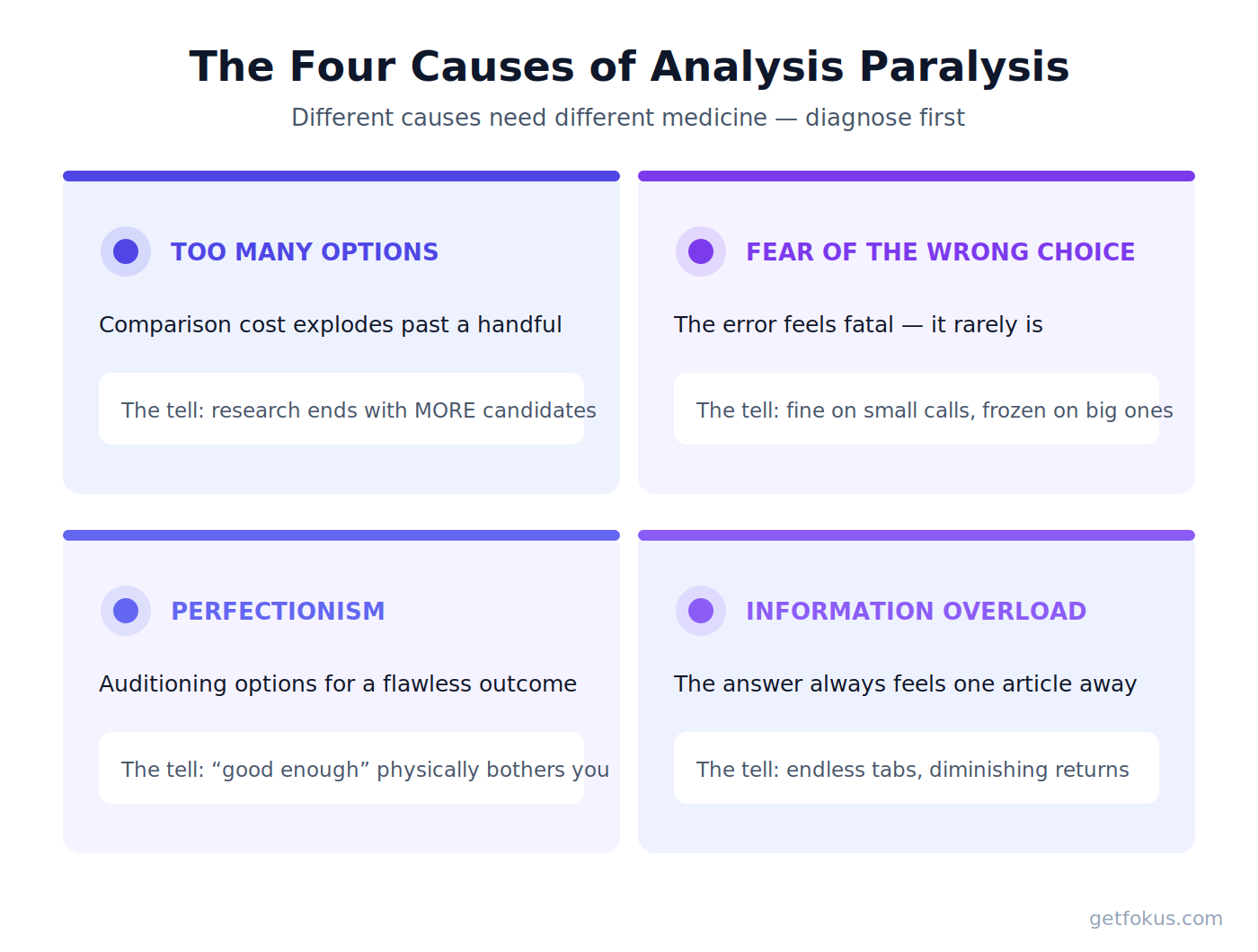
Four different causes, four different tells. Generic advice fails because it treats them as one.
A decision system (not a pep talk)
Sort by reversibility first. Before anything else, ask: can this be undone? Reversible decisions — most of them: tools, drafts, plans, restaurant choices — deserve minutes, because the cost of a wrong choice is a cheap correction later. Irreversible or expensive-to-reverse decisions — hiring, signing, quitting — deserve real analysis. Analysis paralysis is, at its core, applying irreversible-grade scrutiny to reversible choices. One sorting question deletes most of the problem.
Write criteria before looking at options. Three must-haves, written down, before you browse. Then take the first option that clears them — that’s satisficing, and it short-circuits both perfectionism (the target is now “meets criteria,” not “is best”) and option overload (clearing the bar ends the search). Criteria written after browsing don’t count; they’ll quietly bend toward whatever you’re already circling.
Give every decision a deadline — on the calendar. Open-ended decisions expand to fill all available worry. Closed ones get made. “Decide on the vendor” as a floating intention will haunt you for three weeks; as Thursday, 2:00–2:30 it takes thirty minutes, because deliberation runs until a boundary stops it. This is time blocking applied to thinking — and it’s the move that turns all this from psychology into schedule.
Cap the research. Decide the budget up front — “five reviews, two opinions, then I choose” — and stop at the cap even though it feels premature. It will always feel premature. That feeling is not information; it’s cause #4 talking.
Train on small reps. Order in ten seconds. Pick the movie without reviews. Reply to the low-stakes email with your first draft. Each tiny unagonized decision that turns out fine is evidence against the catastrophe story, and confidence is built from exactly this evidence — never from more analysis.
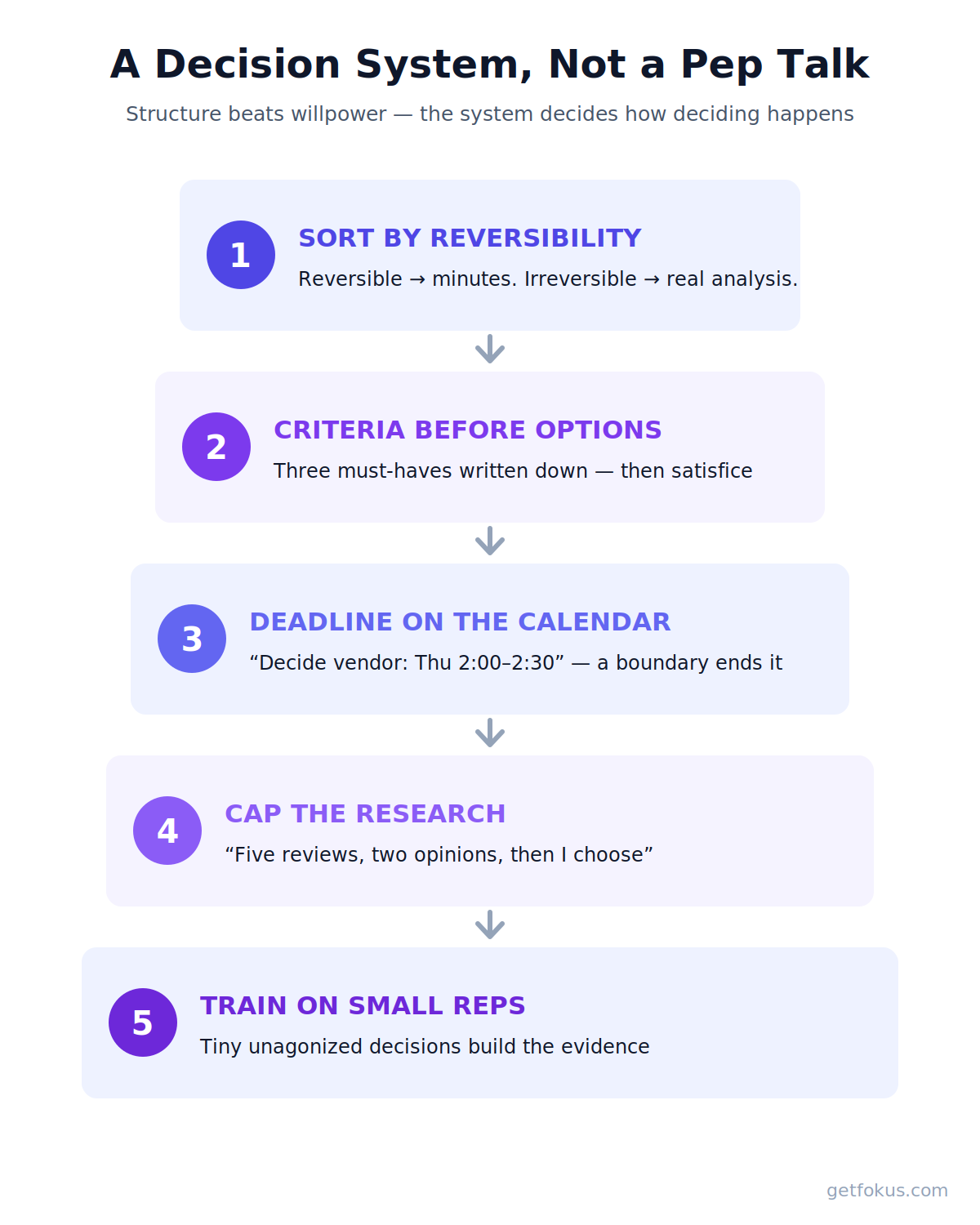
Structure beats willpower: the system decides how deciding happens.
Paralysis in your daily plan
Work has a special version of this: you sit down, look at the task list, and can’t pick — so you “warm up” with email, and the choosing moment quietly becomes the procrastinating hour. Deciding what to work on is itself a decision, subject to everything above, and it’s where knowledge workers pay the paralysis tax daily. The fix is the same medicine at daily scale: choose once, in advance, at a scheduled planning moment — evening or first thing — using a fast forced-ranking like the ABCDE method, then put the top tasks into actual calendar slots so the workday contains zero “what now?” moments. (If everything on the list screams urgent, that’s its own solvable problem.) This is honestly why we built Fokus the way we did: smart scheduling takes tasks with priorities and places them into your calendar itself — and re-plans when the day breaks, which matters, because for an overthinker the 3pm wreckage of a broken plan is a fresh invitation to paralysis. The planner decides so you don’t re-decide. Overthinking that starts after the start — abandoned drafts, endless polishing — is procrastination’s cousin; we’ve covered that system here.
When it’s more than overthinking
Analysis paralysis isn’t a diagnosis — it’s a pattern, and most of us visit it. But chronic indecision can travel with anxiety, depression, and ADHD (where executive-function differences make choosing genuinely harder, and where externalized structure — written criteria, visible deadlines, a planner that decides the schedule — helps more than exhortation). If indecision regularly causes real distress or costs you opportunities, jobs, or relationships, that’s a conversation for a professional, not a productivity blog. This is a sensitive corner of the topic — if any of it feels personally heavy, talking to someone qualified beats reading more articles.
Analysis paralysis FAQ
What is analysis paralysis a symptom of? Usually of maximizing habits, perfectionism, or choice overload — a thinking pattern, not an illness. Persistent, distressing indecision can accompany anxiety, depression, or ADHD and deserves professional attention.
How do you break analysis paralysis right now? Shrink it: check if the decision is reversible (it probably is), write three must-have criteria, set a 15-minute timer, pick the first option that meets the criteria. Done beats optimal — and “optimal” wasn’t findable anyway.
Is analysis paralysis the same as procrastination? They overlap but differ: procrastination avoids starting known work; paralysis can’t close a choice. The cures rhyme — shrink the step, externalize the deadline — but the diagnosis matters.
Does analysis paralysis go away? The tendency tends to stay; the behavior is very trainable. People who adopt reversibility sorting, pre-set criteria, and calendar deadlines report the spiral shortening from days to minutes — not because they think less carefully, but because the structure ends deliberation on time.

Nadia Amari
Focus & Well-being Writer
Nadia writes about mindful productivity, work-life balance, and the science of focus. She believes the best tools should help you do less, better.