Note-Taking Methods That Work Outside the Classroom
Get the next article and product update in your inbox
Short product notes, fresh blog posts, and focus systems. No noisy sequence.

Almost everything written about note-taking methods was written for students — Cornell columns for lectures, outlines for textbook chapters, mind maps for exam revision. Useful, if you’re twenty and facing a midterm. But most people searching this topic are professionals whose notes come from meetings, 1:1s, incidents, and their own half-formed ideas — and for us, the student playbook quietly fails, because it optimizes for retention (passing a test later) while work notes need to optimize for action and retrieval (doing something next, finding it in March). This guide covers the five classic methods honestly, which ones transfer to working life, and the layer the academic guides never mention: what happens to a note after it’s taken — which is where nearly all real-world note value lives or dies.
The five classics, honestly reviewed
Cornell. Page split into a cue column, a notes column, and a summary strip. Its real innovation is processing built into the format — the cues and summary force a review pass. Superb for study; at work it survives best as a habit rather than a layout: one line of “so what” at the bottom of any meeting note is Cornell’s soul without its ruler lines.
Outline. Indented hierarchy — topics, subpoints, details. The default of every digital tool, and rightly: it matches how structured discussions actually flow, it’s fast, and it’s scannable later. Its failure mode is fake structure: nesting things four levels deep while the meeting was actually a flat argument. If you fight the indentation, the content wasn’t hierarchical.
Mind mapping. Central topic, radiating branches. Genuinely good for generating — brainstorms, untangling a messy problem, planning an essay or architecture doc. Genuinely poor for meetings (too slow, too spatial) and for retrieval (you can’t skim a spider). Use it as a thinking tool, not a recording tool.
Charting. Rows and columns for comparisons. Narrow and unbeatable in its lane: vendor evaluations, option matrices, incident timelines. If the content is a comparison, the note should be a table — most people reach for prose here and regret it in the meeting where someone asks “wait, which option had the cheaper tier?”
Sentence method. Rapid line-by-line capture, no structure. This is what everyone actually does under pressure, and the guides treat it as the weakest method. It’s fine — if it gets a two-minute cleanup pass afterward. Raw sentence notes without cleanup are where information goes to be technically written down.
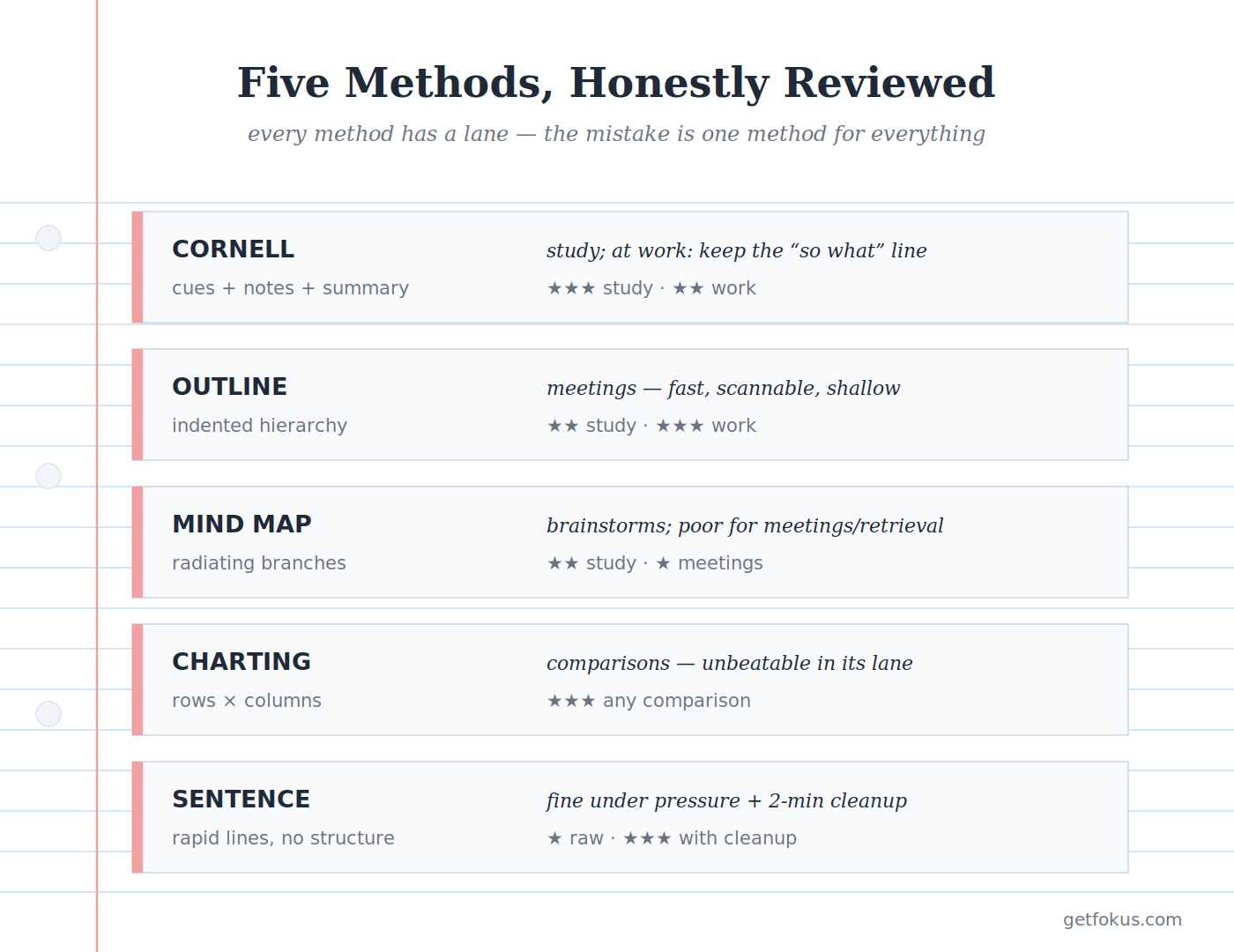
Every method has a lane. The mistake is using one method for everything.
The professional layer: notes are input, not output
Here’s the shift that separates work notes from student notes, and it changes everything downstream: at work, a note is not the deliverable — it’s raw material for exactly three products: things to do, things to decide or remember as decided, and things to reference later. A meeting note that never resolves into one of those three did nothing except make you feel diligent while typing.
Which yields the one work-note habit that outranks every method choice: the two-minute triage at the end of any note-taking session. Read what you wrote and extract: (1) actions — every commitment, yours and theirs, moved into your task system with owners and dates, because a to-do living only inside meeting notes is a missed deadline in incubation; (2) decisions — stated in one line, “we chose X because Y,” which is the line future-you will search for during the inevitable relitigation; (3) reference — filed where it’ll be found, which mostly means titled well: “2026-07 pricing sync — decided tier structure” beats “Meeting notes” by roughly infinity at retrieval time. In Fokus this triage is deliberately short-circuited — notes live beside tasks, so “extract the action” is a step, not an app-switch — but the habit is tool-independent: notes that don’t become actions, decisions, or findable reference are a diary, and diaries are fine, but nobody’s shipping from one.
One more professional-layer honesty: the research favoring handwriting (better conceptual retention, the famous laptop-vs-longhand studies) is real but study-flavored — it measured learning, not work. At work the tradeoff flips for most cases: typed notes are searchable, shareable, and triage-able, which outweighs the retention edge except where thinking-heavy generation is the goal. Hand-sketch to think; type to record.
Matching method to situation (the actual skill)
The classroom question is “which method is best?” The professional question is “which method, when?” A working default kit:
- Meetings and 1:1s → outline, kept shallow, with a symbol convention:
→for actions,!for decisions,?for open questions. The symbols make the two-minute triage a scan instead of a re-read. - Brainstorms and design thinking → mind map or freeform sketch, by hand if you like — then photograph and file, because unfiled whiteboards are the analysis-paralysis of note-taking: rich, unretrievable, useless.
- Comparisons → chart, always.
- Learning something on purpose (course, deep read) → Cornell-style with real review passes; here the student research applies fully, and spaced review during weekly planning is what turns notes into knowledge.
- Everything captured in a hurry → sentence method plus the cleanup pass, no shame attached.
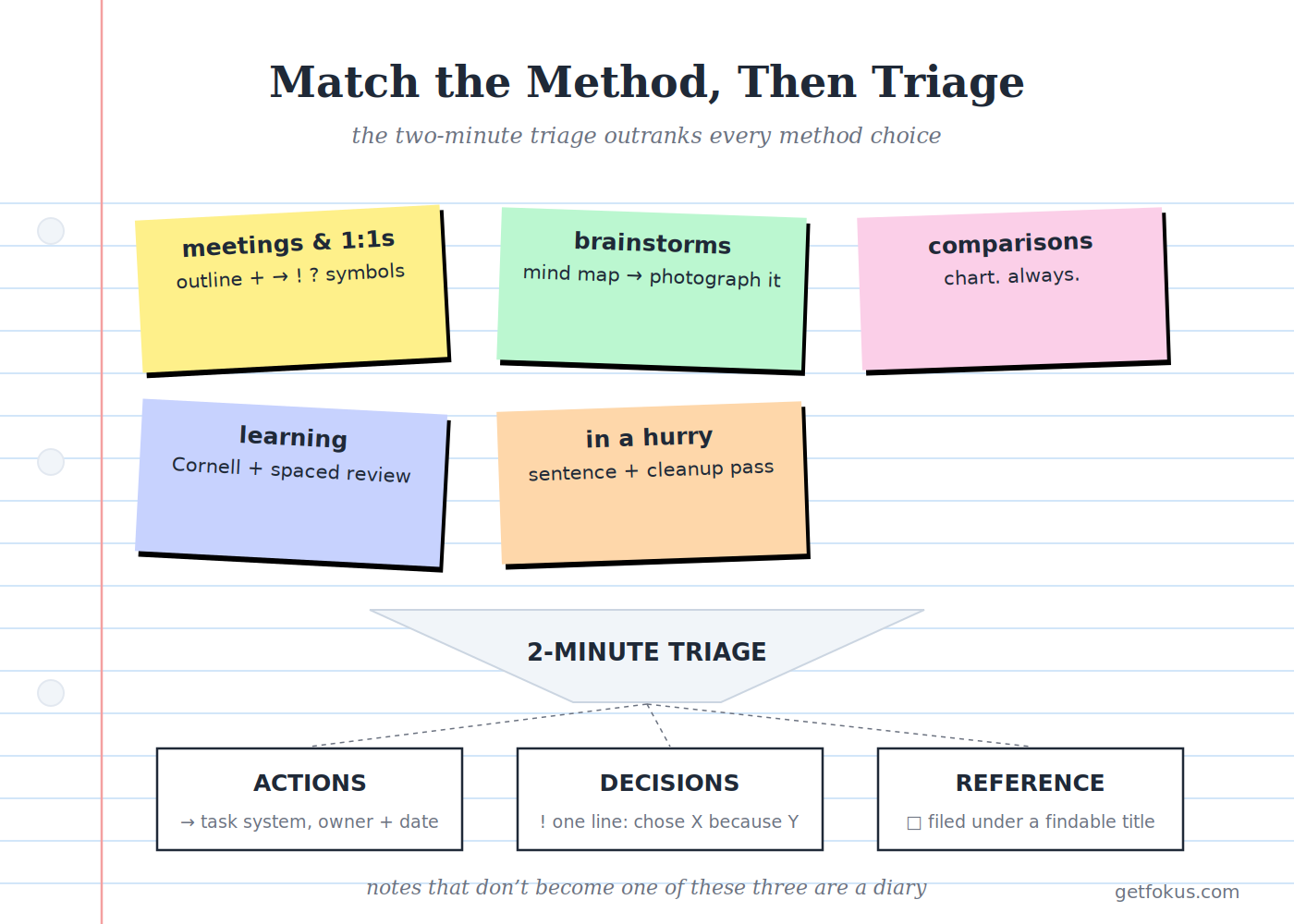
The skill isn’t one method — it’s the match, plus the triage that turns notes into motion.
Note-taking methods FAQ
What are the 5 note-taking methods? Cornell (cue column + notes + summary), outline (indented hierarchy), mapping (visual branches), charting (comparison tables), and sentence (rapid lines). Each has a lane; none is best everywhere.
Which note-taking method is best for work meetings? A shallow outline with action/decision symbols, followed by a two-minute triage into your task system. The triage matters more than the layout.
Is handwriting better than typing notes? For learning and idea generation, handwriting has a real research edge. For work capture, typing usually wins on search, sharing, and turning notes into tasks. Sketch to think, type to record.
What do good ADHD-friendly notes look like? Minimal and symbol-heavy: capture as little as possible in your own words, use consistent markers for actions, and lean on the triage pass rather than in-the-moment structure — externalizing the follow-up beats perfecting the page.

Marko Berger
Engineering & DevTools Writer
Marko covers developer workflows, engineering culture, and the tools that help teams ship faster. Former senior engineer turned full-time tech writer.