Daily Planner Guide for Professionals: Why AI Beats Static Planning
Get the next article and product update in your inbox
Short product notes, fresh blog posts, and focus systems. No noisy sequence.

In the life of a modern professional, the day rarely unfolds according to plan. A carefully written to-do list can be thrown off by one urgent email. A perfectly color-coded calendar can unravel because of a surprise meeting. For years, the default advice has been more discipline, better systems, and tighter planning. But what if the real problem is not you, but the tool itself?
Traditional daily planners, whether paper-based or digital, are static by design. They capture your intentions at one moment in time, but they do not help you navigate the messiness of reality. That is the gap modern AI-powered planning tools are starting to close. This guide explains how daily planners have evolved, why traditional systems fail under pressure, and why the AI daily planner is becoming the strategic tool serious professionals actually need.
What is a daily planner and why does it matter?
A daily planner is a tool that helps you organize tasks, appointments, and goals on a day-to-day basis. At its best, it acts as a command center for your time, turning vague intentions into concrete actions.
For professionals managing multiple projects, deadlines, and communication streams, a planner is not optional. It is part of how you maintain clarity under load.
The main benefits of a daily planner are straightforward:
- Enhanced focus: Writing tasks down frees mental bandwidth so you can concentrate on the work itself instead of remembering everything.
- Better prioritization: A planner forces decisions about what actually matters, so your attention goes to high-impact work.
- Lower stress: A visible plan turns a cloud of obligations into an ordered sequence you can act on.
- Strategic alignment: It connects daily execution to weekly, monthly, and long-term goals.
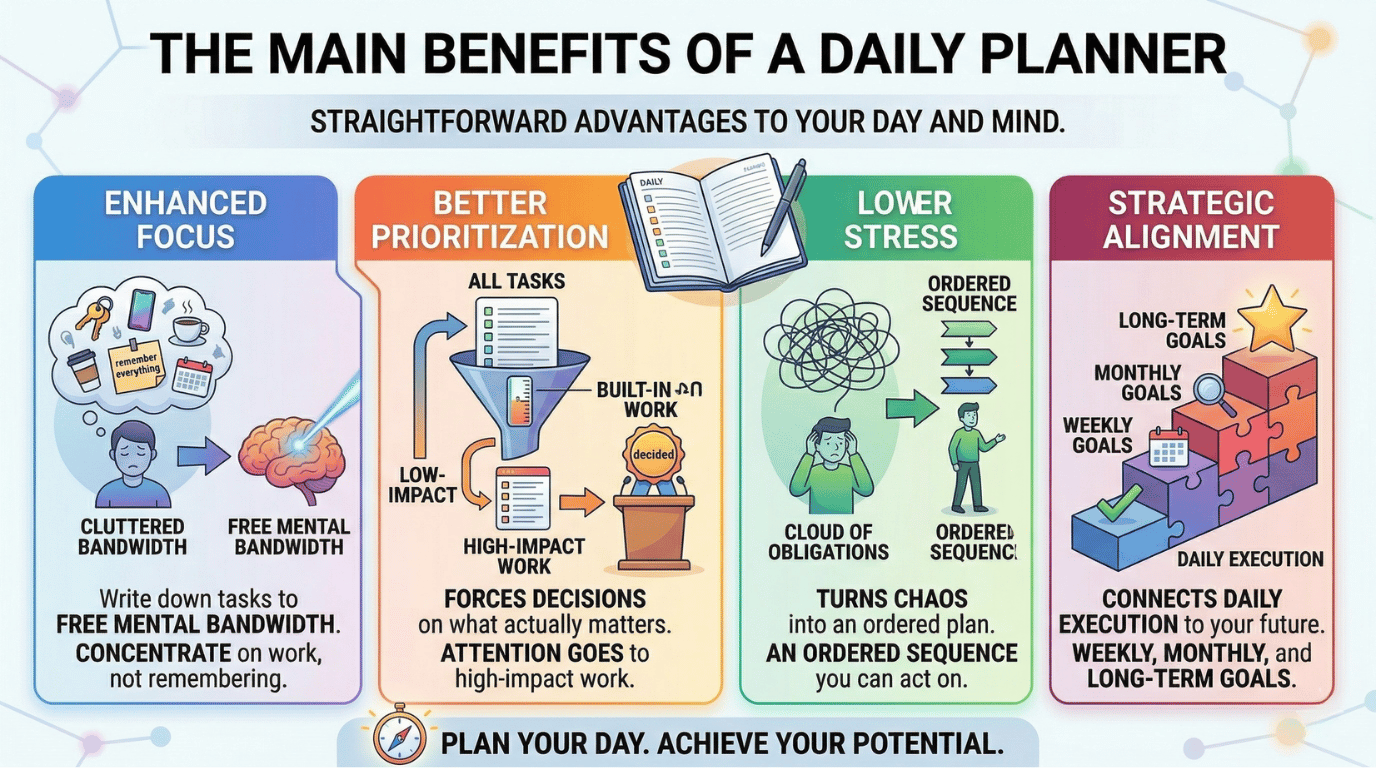
Main benefits of a daily planner: enhanced focus, better prioritization, lower stress, and stronger strategic alignment.
Physical vs. digital vs. AI daily planners
Choosing a planner is personal, but the trade-offs are not mysterious. Most options fall into three categories.
1. Physical planners
- Pros: Writing by hand can improve recall, reduce distractions, and make crossing off tasks feel satisfying.
- Cons: They are rigid. Every disruption forces manual rewriting, they do not integrate with your tools, and they offer no useful analytics.
2. Standard digital planners and calendars
- Pros: They are accessible across devices, easier to edit, shareable, and often include reminders and calendar sync.
- Cons: Most are still static lists or calendars. You still have to manually prioritize, schedule, and reschedule everything. They do not learn from your patterns or help you make smarter trade-offs.
3. AI-powered planners
- Pros: They adapt. They can auto-schedule tasks, re-prioritize your day after disruptions, sync deeply with calendars and work tools, and surface insights about how you actually spend time.
- Cons: There is a learning curve. You have to trust automation more than you would with a manual system, and good results depend on giving the tool the right context up front.
At Fokus, we are direct about the trade-off: an AI planner asks you to give up some manual control. In return, it absorbs the cognitive load of constant re-planning and gives you back time for actual work.
The number one reason traditional daily planners fail
The biggest failure point in a traditional planner is rigidity.
Your day is dynamic. Your planner should be dynamic too.
Imagine a common workday scenario: you start with two hours blocked for deep work on an important report. At 9:05 AM, a critical client request lands in your inbox and needs immediate attention.
With a paper planner or a basic digital calendar, your plan is now broken. You have to manually answer a chain of stressful questions:
- How long will this interruption take?
- What should be de-prioritized to make room for it?
- Does another meeting need to move?
- What happens to the rest of today and the week?
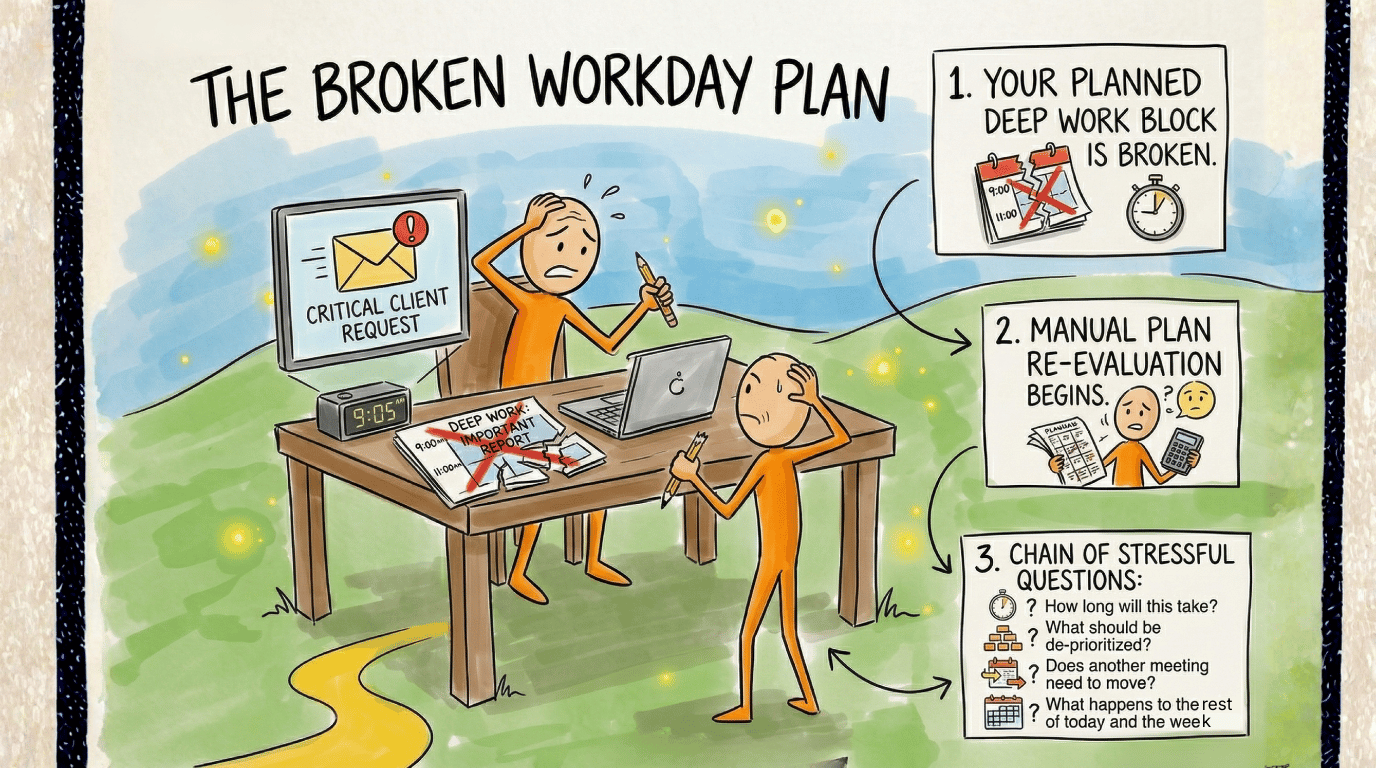
When one urgent input breaks the day, manual re-planning starts immediately unless the system can adapt for you.
This is where traditional systems create friction. You end up managing the plan more than executing it.
The fix is not more discipline. The fix is a more intelligent planning system. An adaptive planner can absorb new information and recalculate the most realistic path forward in seconds.
Meet the AI-powered daily planner
An AI daily planner is not just a prettier to-do list. It behaves more like a chief of staff for your day.
When a disruption appears, the system can reshuffle your schedule, adjust task order, and present a new plan that still respects priorities and deadlines. Instead of asking you to do all the coordination manually, it does the coordination for you.
An AI-powered daily planner typically works through four core capabilities:
- Context awareness: It connects to your calendar, email, and project tools so it understands your commitments, deadlines, and incoming work.
- Goal-based prioritization: It weighs urgency against importance using your goals, not just due dates.
- Intelligent automation: It places work into realistic time blocks based on duration, availability, and constraints.
- Dynamic rescheduling: When the day changes, it recalculates the schedule instead of simply adding more items to a list.
“Before, my daily plan was obsolete by 10 AM. With an AI planner, disruptions are just new inputs. The system adapts, and I stay focused on execution instead of damage control.”
Sarah L., Director of Operations and Fokus power user
How AI helps you plan and execute better
AI planning is useful because it improves methods professionals already trust.
Getting Things Done
AI makes the capture step easier by pulling tasks from email, chat, and other tools into one place. It can also help clarify, organize, and schedule those tasks without requiring a separate planning session for every input.
Eisenhower Matrix
Instead of manually sorting every task by urgency and importance, AI can support intelligent task prioritization. By combining deadlines with project context, it can surface the tasks that belong in your “do first” category automatically.
Time blocking
This is where AI becomes particularly useful. Manually time blocking a full day is tedious and fragile. An AI planner can take your task list, find the best time for each item, create focus blocks, and rebalance the day when meetings or urgent work appear. For more on the method itself, see how to implement time blocking effectively.
What to look for in a modern daily planner app
If you are evaluating planner tools today, focus on features that reduce friction instead of adding more admin work.
- AI scheduling engine: The system should be able to turn tasks into a realistic schedule, not just store a list.
- Strong integrations: It should connect with tools like Google Calendar, Outlook, Slack, Asana, and Jira so planning reflects your real workload.
- Dynamic prioritization: It should help rank work using importance, deadlines, and goals instead of only due dates.
- Productivity analytics: It should show how you spend time, when you do your best work, and where distractions keep breaking the day.
- Low-friction capture: You should be able to turn messages, emails, and quick thoughts into tasks from anywhere.
If you want to see this in practice, explore Fokus’s smart scheduling and how it turns scattered inputs into an actual plan.
Which planner fits your work style?
The best planner depends on how dynamic your work really is.
| Feature | Physical planner | Standard digital app | AI-powered planner |
|---|---|---|---|
| Adaptability | None | Low | High |
| Scheduling | Fully manual | Manual drag and drop | Automated time blocking |
| Prioritization | Fully manual | Manual list ordering | AI-assisted |
| Integrations | None | Basic | Deep |
| Analytics | None | Minimal or none | In-depth insights |
| Best for | Offline planning, journaling | Simple task management | Fast-changing, high-complexity work |
If your days are predictable and your task load is light, a standard digital list may be enough. If you prefer analog tools, a physical planner can still be effective. But if your calendar changes often and your inputs come from multiple systems, an AI planner is the only option designed for that level of complexity. You can see real examples in how professionals use Fokus.
Frequently asked questions about daily planners
Is a paper or digital planner better for productivity?
Neither is universally better. Paper is excellent for focus and reflection, but it breaks down in dynamic and collaborative environments. A basic digital planner is more flexible, but still creates a lot of manual planning overhead. For most professionals, the strongest option is a digital planner with adaptive AI capabilities.
How should I structure my day with a daily planner?
Start with a short daily review. Capture new tasks, identify one to three most important tasks, and protect time for those first. Then schedule the rest of your work around them. An AI planner can automate much of this by identifying task priority and placing work into realistic blocks.
What should a good daily planner include?
A strong planner should include a time-based schedule, a prioritized task list, your top goals for the day, and room for notes or context. A modern intelligent planner connects those pieces instead of leaving them in separate views.
Do dated and undated planners still matter in the digital age?
That distinction mainly matters for paper products. In digital planning, the calendar is continuous. You can start at any time, skip days without waste, and reschedule without losing structure.
How does a planner integrate with tools like Google Calendar or Slack?
Modern planners use API integrations. Calendar sync means events created in one system appear in the other. Messaging integrations can turn a Slack message or email into a task instantly, which closes the gap between communication and execution.
Beyond the to-do list
The old to-do list is not useless. It is just insufficient for the pace and complexity of modern work.
Professionals are no longer only managing tasks. They are managing volatility, context switching, and constant incoming demands. A planner should not be another source of manual coordination. It should absorb complexity and return clarity.
That is why the future of planning is adaptive. An AI-powered daily planner does more than organize tasks. It helps you stay focused, recover from disruption quickly, and move through the day with a plan that still makes sense after reality intervenes.
Ready to see what adaptive planning looks like in practice? Download Fokus and get started for free.

Sarah Chen
AI & Product Writer
Sarah explores the intersection of AI, product design, and personal productivity. She writes about how intelligent tools are reshaping the way we work.