Micromanagement: Usually a Visibility Problem
Get the next article and product update in your inbox
Short product notes, fresh blog posts, and focus systems. No noisy sequence.

Micromanagement is when a manager controls how work gets done at a level of detail the work doesn’t need: approving routine decisions, asking for status several times a day, rewriting deliverables that already met the brief, and keeping every choice routed through themselves. Coursera’s definition is the one I’d keep — “excessive scrutiny of and control over a team and its members”. The word that matters is excessive. Close oversight on a new hire’s first production deploy is management. The same oversight on someone’s fortieth is micromanagement.
That’s what Google’s AI overview tells you, and it’s correct as far as it goes. Signs: no delegation, constant approvals, excessive reporting, nitpicking. Causes: fear, low trust, a need for control. Effects: morale, productivity, turnover. Fix: over-communicate, focus on outcomes, have the conversation.
Here is what it leaves out, and what I’ve come to believe after years on both sides of the 1:1: most micromanagement is a visibility problem wearing a control costume. The manager can’t see where the work stands, so they ask. Asking is the only instrument they have. Each ask feels like distrust to the person being asked, who replies briefly and defensively, which tells the manager even less, which produces more asking. Nobody in that loop is a villain. They’re both working around a missing status line.
Fix the information flow — an agreed check-in cadence, status that’s visible without asking, and decision rights sized to risk — and most of it goes away. Not all of it. The rest of this piece covers how to tell which kind you’re dealing with, and what to do from either chair.
The signs of micromanagement, from both chairs
Most lists describe the manager’s behaviour. It’s easier to spot from the effects, because those are what you actually experience.
If you’re being micromanaged, you’ll recognise:
- “Any update?” messages between check-ins you already have.
- Being asked how you’ll do something after you’ve agreed what you’ll deliver.
- Small decisions — a subject line, a slide colour, which customer to call first — needing sign-off.
- Finished work coming back rewritten in their voice, not corrected for a real error.
- Being copied, or asked to copy them, on threads they have no part in.
- Deadlines set without asking how long the work takes. Coursera lists rigid, unrealistic deadlines among its nine signs, and it’s the one people forget.
If you might be micromanaging, look for:
- You can’t state the status of your team’s top three pieces of work without asking someone.
- Work visibly slows when you’re on holiday, and speeds up when you’re back.
- People ask permission for things you’d have said yes to without reading.
- You’ve rewritten something this month that met the brief.
- Your calendar has more “quick sync” slots than it did a quarter ago.
The quickest single test I know: count how many of your status questions this week were already answered somewhere you could have looked. If the answer is “most”, you don’t have a trust problem. You have a place-to-look problem.
Micromanagement, coaching, and absence: a spectrum, not a switch
People talk about micromanagement as if the opposite were “leave me alone”. It isn’t. Too little involvement has its own name — absentee or hands-off management, sometimes called macromanagement — and its own failures: surprise reviews, late course corrections, people stuck for a week because nobody noticed.
The useful middle is coaching: an agreed rhythm, questions about outcomes and obstacles rather than steps, and help when it’s wanted. Coursera draws the line well. Accountability means trusting people to meet their goals while tracking progress and supporting them; micromanagement signals distrust. Same amount of attention, pointed at a different thing.
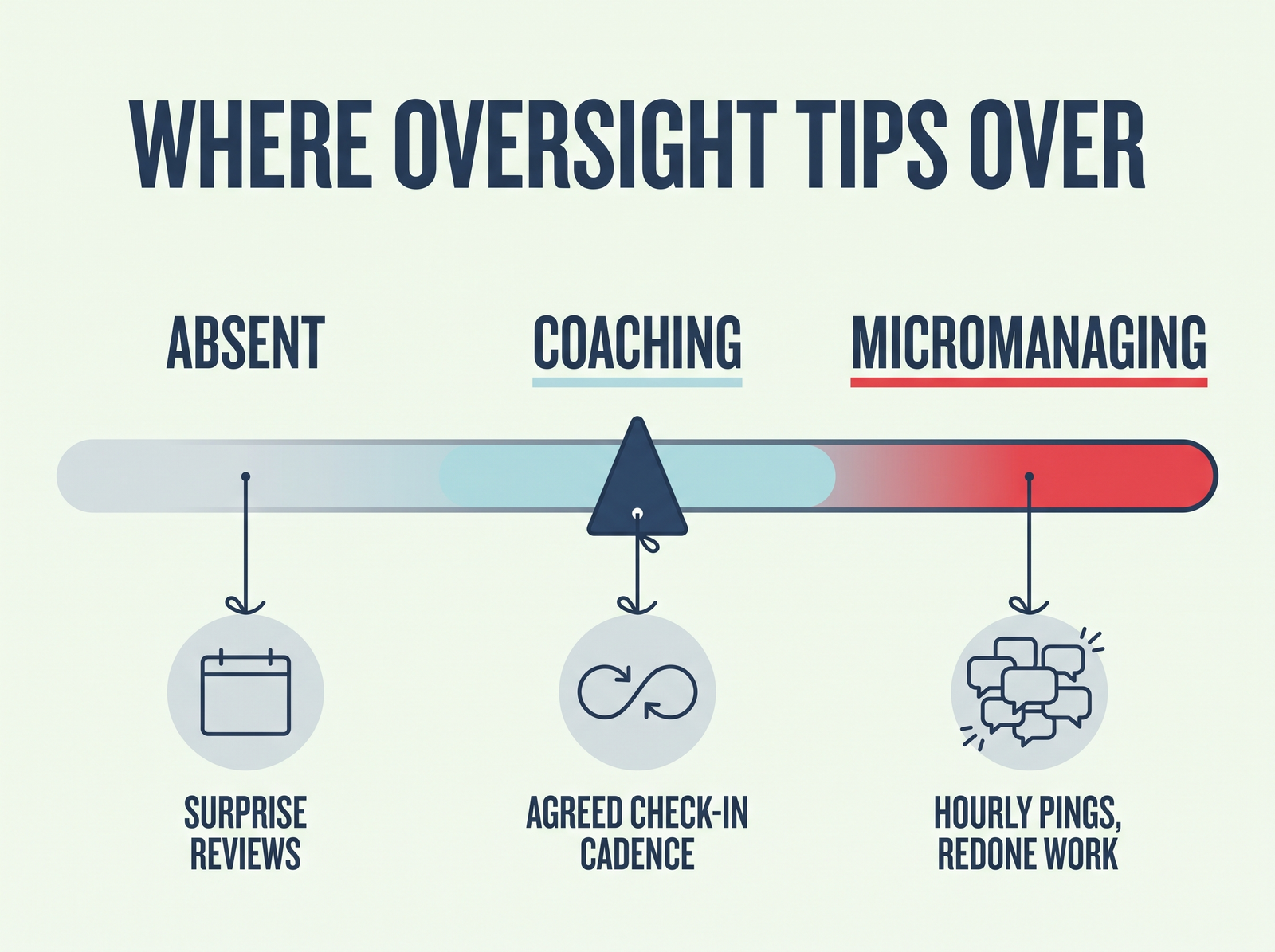
Oversight is a dial. The middle isn’t “less”; it’s attention aimed at outcomes on a schedule both people agreed.
What moves a manager along the dial is usually not a change of character. A new VP asks sharper questions, a quarter goes badly, a project gets visibility, and a coaching manager slides right. Understanding why tells you what to fix.
Why managers micromanage — and why it’s usually about information
The standard causes are real. The AI overview names fear of failure, low trust and a need for control. Coursera, citing Harvard Business Review, adds two I find more useful: senior managers who feel disconnected from the ground-level work and want to feel connected, and managers who struggle to let go of the operational work they were promoted out of.
Look at those again, and add one the lists miss. Three of them are about information:
- Fear of failure is fear of a failure you won’t see coming. If you could see it coming, you’d intervene once, early, instead of hovering always.
- Feeling disconnected is literally not knowing what’s happening.
- Pressure from above — the cause that doesn’t make the lists — is being asked a question by your own boss you can’t answer. The first time a director can’t answer “where are we on the migration?” in a staff meeting, they will start asking their team daily. I’ve done exactly this.
Two more, trust and the pull of the old job, are partly information problems too. Trust is built on a track record, and a track record is only as visible as the status it leaves behind. And the ex-engineer who keeps reviewing pull requests is often doing it because code review is the one place they can still see the work.
So the mechanism, most of the time, is a status vacuum. The manager needs to know three things — is it on track, is anything blocked, will I be surprised — and has no way to find out except asking. Asking interrupts. Interrupting feels like distrust. The report responds minimally, the vacuum stays, the asking increases.
What personality is a micromanager? People search this a lot, and I’d be careful with the answer. There’s no validated “micromanager personality” in anything I read for this piece, and the pattern above suggests why: the same person coaches in one context and micromanages in another. Some people do have a stronger pull toward control, especially under stress. But “my manager is a control freak” is a conclusion you can do nothing with. “My manager can’t see status and is being asked for it” is one you can.
What micromanagement costs — both of you
Victor Lipman, writing in Psychology Today, lists the damage plainly: it undermines autonomy, stifles creativity, dampens motivation, reduces productivity, and drives turnover. His example is a friend who said working for a micromanager made her feel like a five-year-old — a capable employee who, predictably, took her skills elsewhere.
The research behind HBR’s “How to Help (Without Micromanaging)” by Colin Fisher, Teresa Amabile and Julianna Pillemer adds something the lists skip: people have strong negative emotional and physiological reactions to help they didn’t need or want, and it erodes the working relationship. Unwanted help doesn’t land as neutral. It lands as a verdict.
Three costs I’d add from experience, because they’re the ones that compound:
The interruption tax. Every unscheduled “quick question” breaks whatever the report was focused on, and the damage is the recovery, not the thirty seconds of answering. A team fielding status pings all day has no uninterrupted working time left, only gaps between pings.
Learned permission-seeking. After a few months, people stop making calls they’re qualified to make. Not from fear exactly — from economics. If every decision will be revisited, asking first is cheaper than redoing. Now the manager is a bottleneck, and gets asked even more, and concludes the team can’t decide anything on their own. The micromanagement has manufactured its own evidence.
The manager’s own capacity. The hours spent checking come out of the work only a manager can do: hiring, direction, the uncomfortable conversation with their own boss. Micromanagers are usually drowning, and the checking is part of the water.
Why is micromanaging toxic? Because it’s corrosive in both directions and self-reinforcing: less autonomy produces less initiative, which justifies less autonomy. Is micromanaging a form of abuse? On its own, no — most micromanagers are anxious, not cruel, and the fix is structural. But close control that comes with humiliation, singling one person out, public criticism, or threats is a different thing, and the advice in this article isn’t the right tool for it. Keep dated notes and talk to HR or your manager’s manager.
For managers: a self-diagnosis and a fix in three parts
Before you change anything, spend one week counting. Every time you ask for status, write down what you asked and whether the answer existed somewhere you could have looked. Every time you rewrite, note whether the original was wrong or just not how you’d have done it. It’s uncomfortable. It’s also the fastest way I know to see the size of the vacuum.
Then fix the information flow, in this order.
1. Agree a check-in cadence — and size it by risk and track record. Not everyone and everything needs the same frequency. Two variables decide it: how costly a mistake on this task would be, and how much evidence you have that this person handles this kind of work. HBR’s authors make the same point from the other side: match your pattern of involvement to what the work actually needs, whether that’s intensive short-term guidance or occasional obstacle removal.
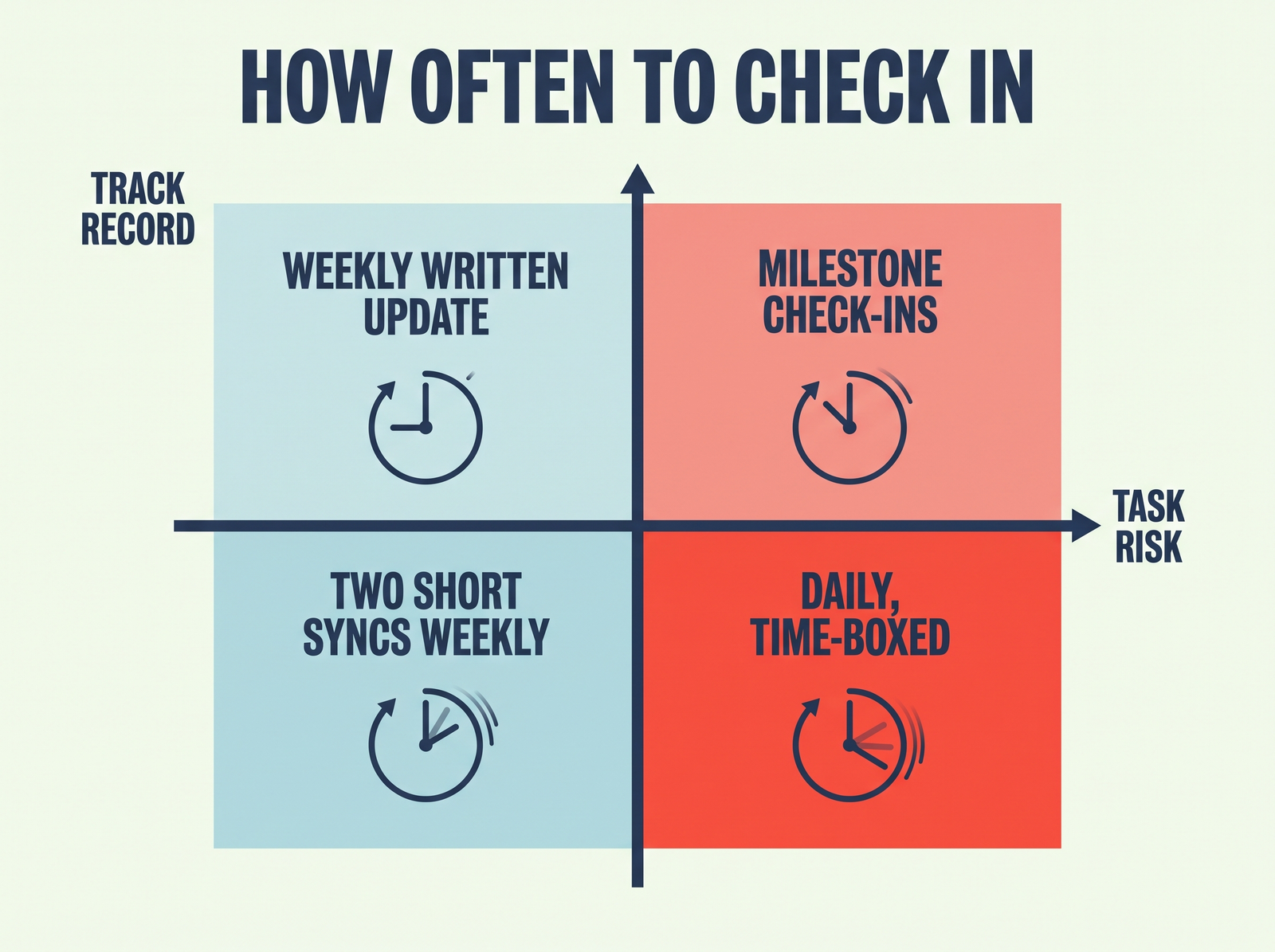
Check-in frequency is a setting, not a personality. Agree it out loud, per piece of work, and change it as the track record grows.
The bottom-right box — high risk, new to this — is where daily contact is correct, and good reports will want it. The problem isn’t daily check-ins. It’s daily check-ins in the top-left box.
2. Make status visible without asking. Agree one format and one place. Mine is three lines — done, next, blocked — posted at an agreed time, in the channel or tool where the work already lives. Then keep your side of the deal: read it before you ask anything. Most of the relief comes from this step, because it replaces dozens of interruptions with one written update. It’s also what basic task hygiene gives you for free: if every piece of work has one owner, a status and a date in a shared system, the answer to “where are we?” is on screen. I keep my own team’s objectives and the tasks beneath them together in one Fokus workspace (free during its public beta, no credit card), so in a 1:1 my question is “what’s in the way?” rather than “where are we?”.
3. Set decision rights by risk, in writing. Permission-seeking stops when people know which calls are theirs. For each person, write one line: what they can decide without asking, and what triggers a check-in — a cost threshold, a customer commitment, anything irreversible. This is the “authority envelope” from our RACI chart guide, and you don’t need a full RACI to use it. One sentence per person does most of the work.
Then give it two weeks and count again. If your status questions dropped and the work didn’t suffer, the vacuum was the problem. If you’re still itching to check, ask yourself honestly what you’re afraid of seeing — and whether it’s about the work, or about your own boss.
For reports: how to handle a micromanager
You can’t change your manager’s personality. You can change what they can see, which is often the same thing in practice.
Over-supply status for two weeks, then negotiate down. It feels backwards, and the AI overview’s “over-communicate” is the right instinct but too vague. Be specific: send the update before they’d ask, at a fixed time, in a fixed format. You’re filling the vacuum so there’s nothing left to ask about. I write mine right after the End-of-Day Review in Fokus, when the day’s work is already in front of me, so it takes five minutes rather than twenty.
Then have the conversation — about the system, not about them. Here’s a script that’s worked for me and for people I’ve coached:
“I want to make sure you never have to chase me for where things stand. Can we try this for two weeks: I’ll send done, next and blocked every Tuesday and Thursday by four, and I’ll flag anything at risk the same day I see it. In return, can we keep the in-between check-ins for things that are actually on fire? If you’re missing something after two weeks, tell me and we’ll adjust.”
Notice what it doesn’t say. It doesn’t say “you’re micromanaging me”. It offers the manager what they actually need — no surprises — in exchange for what you need: uninterrupted time.
Then ask for decision rights, one category at a time. “For customer emails that don’t change price or scope, can I send and tell you after? For anything touching pricing, I’ll check first.” Small, specific, reversible. Each approved category is evidence for the next.
Ask what “good” looks like before you start. If finished work keeps coming back rewritten, the brief was probably incomplete. A five-minute question up front — “what would make you say this is done?” — saves a rewrite and the resentment that comes with it.
How do you shut down a micromanager? How do you annoy one? Both get searched a lot, and the honest answer to both is the same: don’t try. Withholding updates, going quiet or answering in one word all widen the vacuum, and more checking is what fills it. The only reliable way I’ve seen to get less oversight is to make oversight unnecessary — then name the change, so it sticks.
When it isn’t a visibility problem
Sometimes you do all of the above and nothing changes. Status is visible, cadence is agreed, the decision rights are written, and the checking continues. That’s information too.
Signs you’re dealing with something other than a status vacuum:
- The close control is aimed at you and nobody else doing similar work.
- Your manager ignores the written update and asks anyway, every time.
- Criticism is personal or public rather than about the work.
- Agreed decision rights get overturned after the fact without a reason.
At that point the conversation moves up a level — to your manager’s manager or HR, with dates and examples rather than adjectives. And if the load has started following you home, it’s worth checking against the signs of job burnout your calendar shows first. Sometimes the right fix is a different manager, and knowing that clearly is better than another six months of optimising your updates.
The short version
Micromanagement is excessive control over how work gets done. Most of it isn’t a personality defect; it’s a manager who can’t see status, is being asked for it from above, and has only one instrument: asking.
For managers: count your status questions for a week, then set check-in frequency by task risk and track record, make status visible in one agreed place, and write down what each person can decide alone.
For reports: fill the vacuum before it’s felt, offer a fixed update in exchange for fewer interruptions, and earn decision rights one category at a time.
If the information is flowing and the control isn’t loosening, it was never about information. Escalate with dates, not adjectives.

Fokus Team
The Fokus Team
The team behind Fokus — building the smart productivity platform.