The 40% Productivity Tax: Why Your “Reactive State” is Killing Your Deep Work (and How Task Batching Fixes It)

1. Introduction: The Reactive Trap
Modern workflows have devolved into a state of high-alert triage. Most professionals spend their hours in a “reactive state,” perpetually swatting at incoming tasks like a never-ending swarm of digital pests. This reflex-driven workflow creates a sense of profound overwhelm, where your schedule is dictated by the loudest notification rather than your highest priorities.
The question for the modern knowledge worker is no longer how to do more, but how to move from this state of chaos to a proactive environment where you dictate the terms of your engagement. The solution lies in Task Batching—a strategic framework that acts as a “protective wall” for your mental bandwidth, shielding your focus from the relentless erosion of minor interruptions.
2. The “Protective Wall”: Shielding the Vital Few from the Trivial Many
Task Batching is the practice of grouping similar, low-level tasks into confined time slots to prevent them from bleeding into the rest of your day. This approach is a practical application of the 80/20 Principle: the realization that 20% of your activities account for 80% of your results.
In the language of Brian Tracy’s Eat That Frog methodology, your workday is comprised of “Frogs” (the vital few, high-impact tasks) and “Tadpoles” (the trivial many, administrative duties). Without a protective wall, the tadpoles will swarm your morning, leaving you with zero cognitive energy to tackle your most significant frog when it matters most. By batching administrative work, routine emails, and minor errands into a single block, you create a sanctuary for strategic growth.
“The key to success is not to try to do everything. Rather, focus fully on the most vital tasks, break them into manageable pieces, take action, and complete them well.” — Brian Tracy
3. Defeating the “Mere-Urgency Effect” Through Grouping
Human psychology is naturally susceptible to the “Mere-Urgency Effect.” Research indicates that our attention is drawn to time-sensitive tasks over less urgent ones, even when the less urgent tasks offer significantly greater long-term rewards. This bias leads us to spend the day in “crisis mode,” treating Quadrant 3 tasks (Urgent but Not Important) as if they were life-or-death matters.
Task batching acts as a manual override for this biological glitch. According to research on the Eisenhower Matrix, the mere-urgency effect is reversed when workers are prompted to explicitly consider the consequences of their choices. By scheduling low-importance/high-urgency “fires” into a single afternoon batch, you force a cognitive pause. You stop reacting to the clock and start weighing the long-term impact of the task. This transition allows you to protect Quadrant 2 (Important but Not Urgent) work—such as professional development and deep planning—from being cannibalized by the “urgent present.”
4. The 40% Productivity Tax: The High Cost of Context Switching
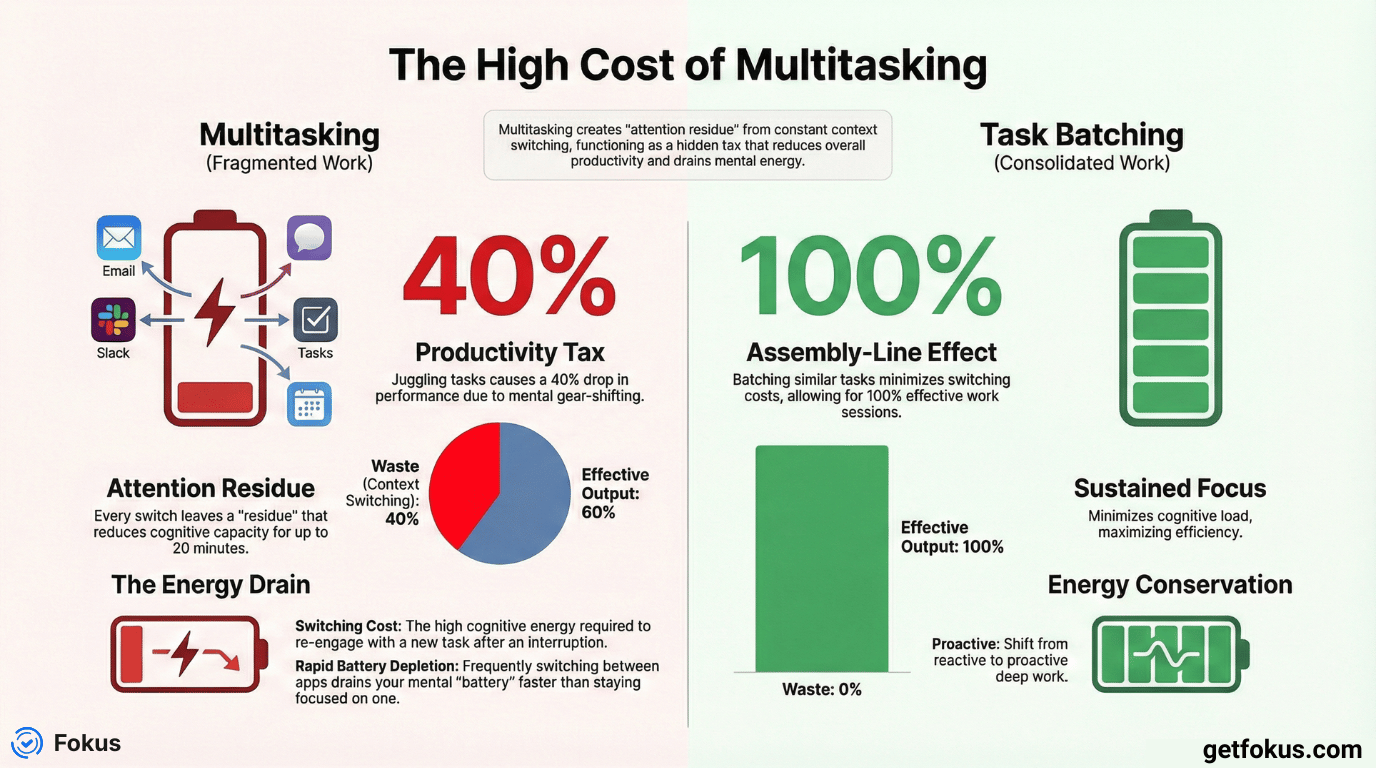
The habit of multitasking or jumping between unrelated tasks carries a staggering cognitive price. Data from the ABCDE Method and multitasking research suggests that when a worker attempts to juggle different types of thinking, their productivity doesn’t just dip—it drops to 40% of their total capacity. This means you are operating at a 60% loss of effectiveness every time you “quickly check” an email while writing a report.
Task Batching eliminates this “switching cost” by allowing the brain to remain in a single cognitive mode for sustained periods. This facilitates “Deep Work,” a state where the brain is freed from “open loops”—those nagging mental reminders of unfinished, unrelated tasks. By adopting the “Do” habit from the Zen To Done (ZTD) system, workers can focus on one task at a time without distractions, providing the only known antidote to the exhaustion associated with constant context switching.
5. Strategic Scheduling: Batching for your Biological Prime Time
Task Batching is not merely about what you group, but when you execute those groups. Every individual has a Biological Prime Time (BPT)—a window where energy and focus reach their peak. A strategic journalist or manager must recognize the distinction between “Early Birds” and “Night Owls.”
If you are an Early Bird, your “Frogs” must be eaten before noon, leaving the low-energy “Tadpole” batches (calls, filing, admin) for the mid-afternoon slump. Conversely, a Night Owl might find their “second wind” in the late afternoon; for them, the “trivial many” batch must happen in the AM to save their PM peak for deep, complex work. Aligning your workload with your internal biological clock maximizes your “return on energy” and prevents the burnout caused by trying to force high-value thinking during a physiological trough.
6. Managing Cognitive Load with Structured Intervals
Cognitive Load Theory posits that our working memory is a finite resource. Task batching manages this load by segmenting work into structured intervals. While the standard Pomodoro Technique suggests 25-minute segments, a 2025 scoping review of structured study intervals suggests a “Suggestion 2” model for complex material: 35-minute work intervals followed by 10-minute breaks.
The data is compelling: these structured intervals lead to approximately 20% lower fatigue and a 0.5-point improvement in distractibility compared to self-paced schedules. By using defined “start and end” points for a batch, you reinforce metacognitive awareness. You are no longer just working; you are managing a cognitive sprint. This prevents the working memory from being overloaded by unrelated information and allows for the deep focus required by high-complexity fields.
7. Conclusion: From Passenger to Pilot
Transitioning to a Task Batching framework requires what Brian Tracy calls the “3Ds of New Habit Formation”: Decision to build the habit, Discipline to keep applying the system, and Determination to persevere until it becomes second nature.
Moving from a reactive to a proactive state is the difference between being a passenger in a chaotic schedule and being the pilot of your own career. As you look at your calendar for the coming week, ask yourself: What “vital few” goals am I currently neglecting because I am obsessed with the “trivial many”?
It is time to stop reacting and start orchestrating. By building these protective walls, you follow the ultimate path laid out by Ryder Carroll: you move from being the “passenger to the pilot of your own life.”