Time Boxing vs. Time Blocking: What’s the Difference?
Do you ever reach 5:00 PM, exhausted, only to realize you didn’t actually finish the one thing that mattered most? You aren’t alone. In our “always-on” world, it is easy to mistake being busy for being productive.
The solution isn’t to work more hours; it is to structure the hours you have with more intent. This is where two powerhouse methodologies come into play: Time Blocking and Time Boxing.
While often used interchangeably, they are fundamentally different tools for different cognitive problems. If you want to drastically improve your output and stop wondering where the day went, you need a solid grasp on how—and when—to use them.
Let’s tackle the confusion and get your schedule working for you.
📚 Time Blocking vs. Time Boxing: The Definitions
Before we compare them, let’s define them clearly.
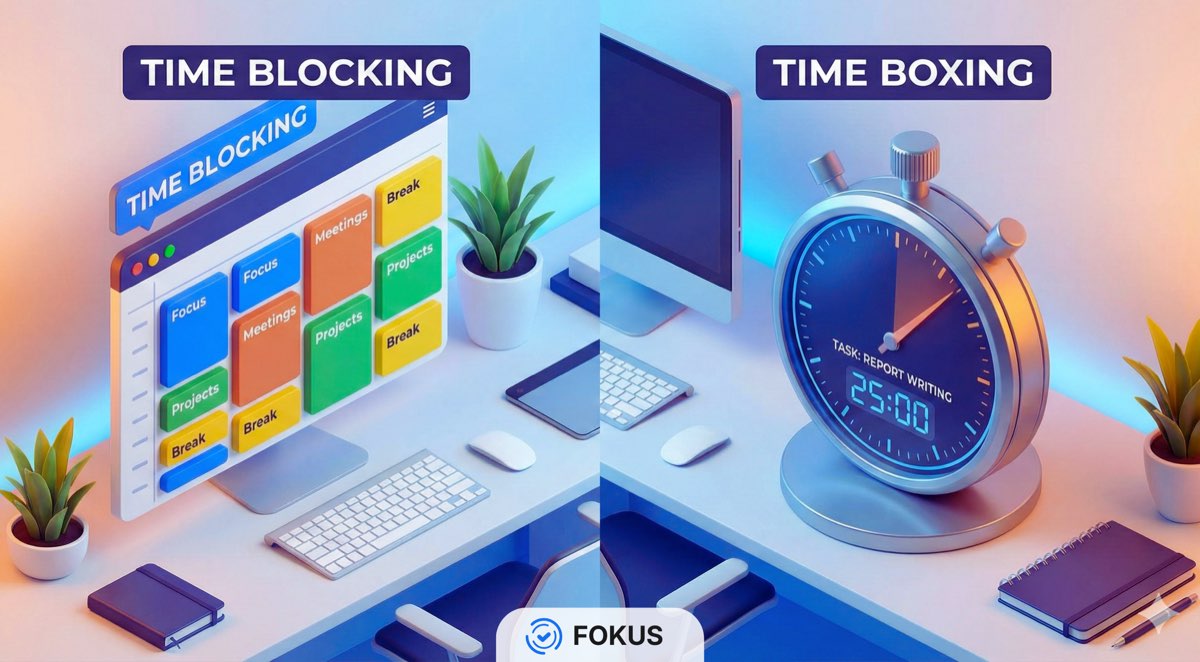
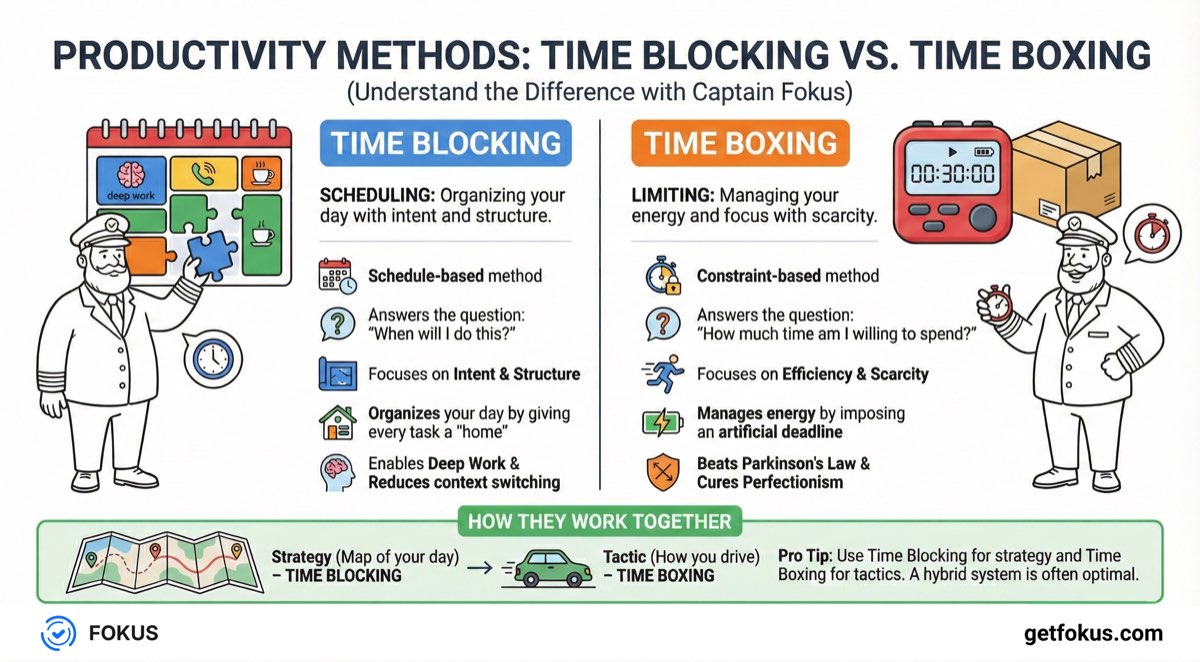
Time Blocking is a schedule-based method. It involves dividing your day into distinct blocks of time, where each block is dedicated to a specific task or group of tasks. It answers the question: When will I do this?
Time Boxing is a constraint-based method. It involves setting a fixed, maximum limit of time for a specific task and stopping when the timer goes off. It answers the question: How much time am I willing to spend on this?
⚖️ Time Boxing vs. Time Blocking: The Key Differences
The confusion between these two usually stems from the fact that they both involve calendars. However, the psychology behind them is distinct.
Time Blocking is about Intent and Structure. It is strictly for organizing your day. By giving every task a “home” on your calendar, you ensure that your priorities aren’t crowded out by urgent but unimportant interruptions. It protects your time from external distractions.
Time Boxing is about Efficiency and Scarcity. It is for managing your energy and focus. By imposing an artificial deadline (the “box”), you force yourself to work faster and drop unnecessary perfectionism. It protects your time from internal distractions (like over-researching or scrolling).
Pro tip: Think of Time Blocking as the strategy (the map of your day) and Time Boxing as the tactic (how you drive through the traffic).
🚀 Why These Methods Work: The Benefits
Implementing these strategies can feel like magic because they leverage specific psychological principles to hack your brain’s default mode of functioning.
-
Beats Parkinson’s Law: The old adage states that “work expands to fill the time available for its completion.” If you give yourself all day to write a report, it will take all day. Time Boxing creates artificial scarcity, forcing you to complete the task efficiently.
-
Enables Deep Work: Time Blocking reduces context switching—the mental tax paid when jumping between emails, Slack, and heavy projects. By grouping similar tasks, you can find your rhythm and enter a “flow state” faster.
-
Eliminates Decision Fatigue: Constantly deciding “what should I do next?” burns cognitive energy. With a blocked schedule, you make those decisions once (during planning), allowing you to execute on auto-pilot during the day.
-
Cures Perfectionism: For tasks that could go on forever (like design tweaks or research), a strict Time Box forces you to accept that “done is better than perfect.”
🛠️ How to Implement These Strategies Effectively
You don’t have to choose just one. The optimal approach is often a hybrid system. Here is a step-by-step guide to building a bulletproof schedule.
Step 1: The Brain Dump & Prioritize List everything you need to accomplish. Identify your “big rocks”—the complex tasks with heavy dependencies or strategic value.
Step 2: Time Block Your “Big Rocks” Take your most important tasks and assign them to your peak energy hours (usually mornings). Give these tasks generous blocks (e.g., 90 minutes) to allow for deep focus.
Step 3: Time Box the “Shallow Work” Identify tasks prone to procrastination or perfectionism (e.g., “Check Email” or “Format Slides”). Assign them a strict, short box (e.g., “Email: 30 minutes”). When the timer rings, you stop. This gamifies the boring stuff and keeps it contained.
Step 4: Build in Buffers Don’t schedule every minute back-to-back. Leave 15–30 minute “buffer blocks” to absorb the inevitable interruptions of life. A rigid tree breaks in the wind; a flexible one survives.
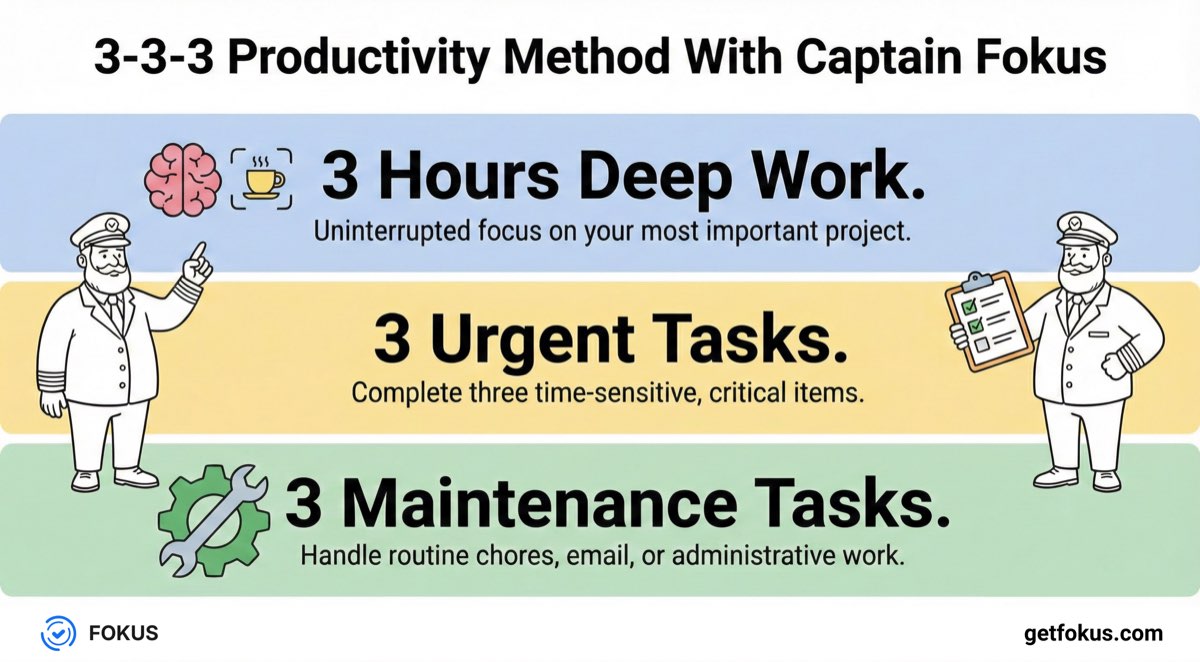
Pro tip: Try the 3-3-3 Method. Aim to spend 3 hours on your most important project, complete 3 shorter urgent tasks, and handle 3 maintenance activities (like laundry or email). It’s a simple way to combine blocking and boxing without overcomplicating it.
💻 How to Use Software to Streamline Your Schedule
While a paper planner works, digital tools can automate the heavy lifting. Here is how technology can help you maintain a solid grasp on your time.
-
Calendar Apps (Google Calendar, Outlook): The foundation of Time Blocking. Use color-coding to distinguish between Deep Work (Blue), Meetings (Red), and Personal Time (Green).
-
Task Managers with Calendars (Todoist, TickTick): These allow you to drag tasks directly onto a calendar view, effectively bridging the gap between your to-do list and your schedule.
-
Dedicated Time Blocking Tools (Reclaim.ai): These are game-changers. Many tools encourage you to estimate time for tasks before you start your day. Reclaim.ai uses AI to automatically find slots for your habits and tasks, reshuffling them if a meeting pops up.
-
Time Tracking (Toggl Track): Use this to audit your Time Boxing. Are you actually finishing in 30 minutes, or do you need to adjust your estimates?
✨ Conclusion
Time is your most non-renewable resource. Whether you choose the structural defense of Time Blocking or the efficient offense of Time Boxing, the goal remains the same: to move from being reactive to being proactive.
Start small. Block out your morning tomorrow. Box your email time. You will be surprised at how much lighter your day feels when you stop worrying about the clock and start commanding it. Worry less and accomplish more—you’ve got this.